
Online darts betting
 Available in US
Darts is a winter sport that turns the Christmas fortnight into the busiest stretch on the betting calendar. The 2026 PDC World Championship ran from 11 December 2025 to 3 January 2026 at Alexandra Palace, with 128 players, a £5,000,000 prize fund and a £1,000,000 winner’s cheque, and bookmakers take more action on darts in those weeks than in the rest of the year combined. What follows is the picture for anyone placing those bets online from Great Britain: where the sport fits in a licensed sportsbook, how the markets are built, what an in-play bet looks like on a leg-by-leg sport, and what a welcome offer costs the punter who claims one.
*Current as of 27 October 2026 · verified against the Gambling Commission’s public register.*
Staying in control while betting on darts
Darts looks like a small-stakes game. A £5 accumulator on evening fixtures, a fifty-pence live bet on the next leg, a Premier League darts free bet through the summer. The numbers stay low; the temptation to chase them when a session goes wrong rarely does. That is why the responsible-gambling tools around licensed darts betting matter out of proportion to the stake size.
Every operator in this guide holds a Gambling Commission remote licence and is a member of GAMSTOP, the national online self-exclusion scheme. Excluding yourself is free; periods run from six months to five years, with a further seven-year lock beyond the minimum if you do not ask for it to come off. The scheme is mandatory for online operators and covers sites and apps; a separate scheme runs in high-street bookmakers, which matters if a darts bettor also walks into a shop on a Saturday afternoon.
Two checks now apply routinely at every licensed site before a customer can deposit or place a first bet. Identity verification is the first: name, address and date of birth are checked before a free bet or a bonus is credited, so the era of anonymous play at a licensed brand is closed. A financial vulnerability check is the second: once a customer’s net deposits cross £150 in a rolling 30 days the operator must run a public-record check (bankruptcy and county-court judgments are examples), not an income or credit-reference check. Affordability assessments in the stricter sense are announced, staged and have no start date; a press line that calls every licensed bookmaker “doing affordability checks” outruns the regulation behind it.
Help is one tap away. GamCare runs the National Gambling Helpline; GambleAware funds treatment and advice; the NHS runs clinics in several regions; Gamblers Anonymous runs meetings in person and online. Fitzwilliam Sports and several other operators link these services directly from the safer-gambling page of their account. The harder job is using the tools in the moment, before a bad night turns into a worse week.
What a darts welcome offer is actually worth
The headline on a sportsbook banner is rarely the headline a punter ends up with. A “free £40” turns into £40 of free bet credit that expires in seven days and does not return the stake with winnings; a “100 % bonus” sits behind a wagering multiple that asks for ten times the bonus amount in qualifying bets before any penny becomes withdrawable. The shape of these offers has tightened under a Commission rule that took effect on 19 January 2026: wagering requirements are capped at ten times the bonus, and mixed-product promotions — an offer that says “place a sports bet to unlock casino free spins” — are banned outright.
Reading a welcome offer on a darts site means fixing four numbers in your head before clicking anything:
- What the offer pays and in what form. Cash, free bet, free spins or bet credit each settle differently. A free bet whose stake is not returned with winnings is worth less than its face value on odds below evens.
- The minimum odds and the market restriction. Coral’s sports welcome, for example, asks for a qualifying bet at minimum odds of 2.0 (1/1), after which £40 of free bets is credited within seven days.
- The expiry. Sky Bet’s free bets expire thirty days after they are credited and can only be used on singles or each-way markets; Coral’s expire seven days after issue. A short clock can wipe out an offer that looked fine on a Monday morning.
- The stake-returned rule. Free bets typically pay winnings only; a real-money bet pays the stake back alongside them. A £10 free bet at odds of 5.0 pays £40, while the same wager in real money would pay £50.
The wagering cap is the one structural change that has bitten hardest on UK welcome offers. A bonus worth £10 used to be tied to a turnover factor as high as fifty times in some places; the cap puts a £100 ceiling of qualifying bets on any such bonus, which is small enough that a punter can read the rulebook and finish the job in a weekend. The bonus is still not free money; the underlying turnover is, and so is the margin baked into every price the bonus is cleared on, which the next section takes apart.
In-play betting and cash-out on a leg-by-leg sport
Darts scores faster than almost any other televised sport. A leg of 501 takes between roughly three and seven minutes from the first dart to the checkout, with breaks of throw and instant momentum shifts every time a player hits a treble. That rhythm is why in-play darts is one of the most heavily traded live markets in a winter sportsbook.
Three product shapes dominate the in-play experience:
- Match winner markets that settle at the next boundary. A bet placed between legs is settled as soon as one player finishes; the odds update continuously on the operator’s display.
- Next-leg markets at a shorter price. The market for “player to win the next leg” lets a punter back a player who has just held throw, but the bookmaker’s price for a player holding serves again is correspondingly shorter than it was pre-match.
- Cash-out. A bookmaker offers to buy the bet back at a live price before the match settles. A punter who backed the eventual winner at longer pre-match odds can lock in profit at the cost of the rest of the return; a punter whose bet is going badly can recover a slice of stake. The buy-back price is set by the operator and carries its own margin on top of the live market.
The mechanic that decides which brands handle live darts well is the refresh rate. Prices update as soon as a dart lands or a leg finishes; the operator’s site may show seconds of delay depending on the feed. A frozen odds panel during a break of throw is more annoying than decisive, but a frozen panel during an actual leg is unusable, and the cheaper end of the licensed market tends to lag the bigger books.
Cash-out is an offer, not a right. Spreadex reminds customers that on its spread-betting side — which is regulated by the FCA, not the Commission, and runs alongside a fixed-odds sportsbook — losses can exceed deposits. The fixed-odds cash-out on a licensed bookmaker is a separate product and does not work that way, but the wider point about product risk is worth carrying into the live market: the price the operator offers is the price the operator offers, and the button is one tap away from a click the punter did not mean to make.
Tips, predictions and the limits of “today’s darts betting tips”
The phrase “darts betting tips today” is searched several thousand times a week in the UK around major tournaments. What sits behind it is rarely one tipster’s view; it is a feed of picks — often offered with a stake-sizing plan and a long losing-streak disclaimer — that promises more winners than a flat-staking punter could find alone.
The honest reading of the search is unflattering to the picks. Professional darts is a small field at the top: roughly twenty players win almost every televised event, and the players outside that group are priced accordingly. A tipster who picks the favourite at short odds is not wrong often, but the odds are short because the market knows the favourite is the favourite; the value after the bookmaker’s margin has done its work is thin. A tipster who picks a longer-priced winner is right less often; when they are right the return is large, and the tipster’s tip sheet shows the wins but not the dozens of losers between them.
A punter using tips is well served by three working rules. Treat a tip as one input among several, not as the bet. Staking plans that ask for a fixed percentage of bank per pick are a way of giving a losing streak permission to keep going, not a way of bending odds. The punter who bets only when the price looks long enough is the punter whose bank stays even across a season. The bookmaker’s margin, which the next section opens up, is the reason a price has to be longer than it looks before it carries value.
How darts odds work, from the board to the payout
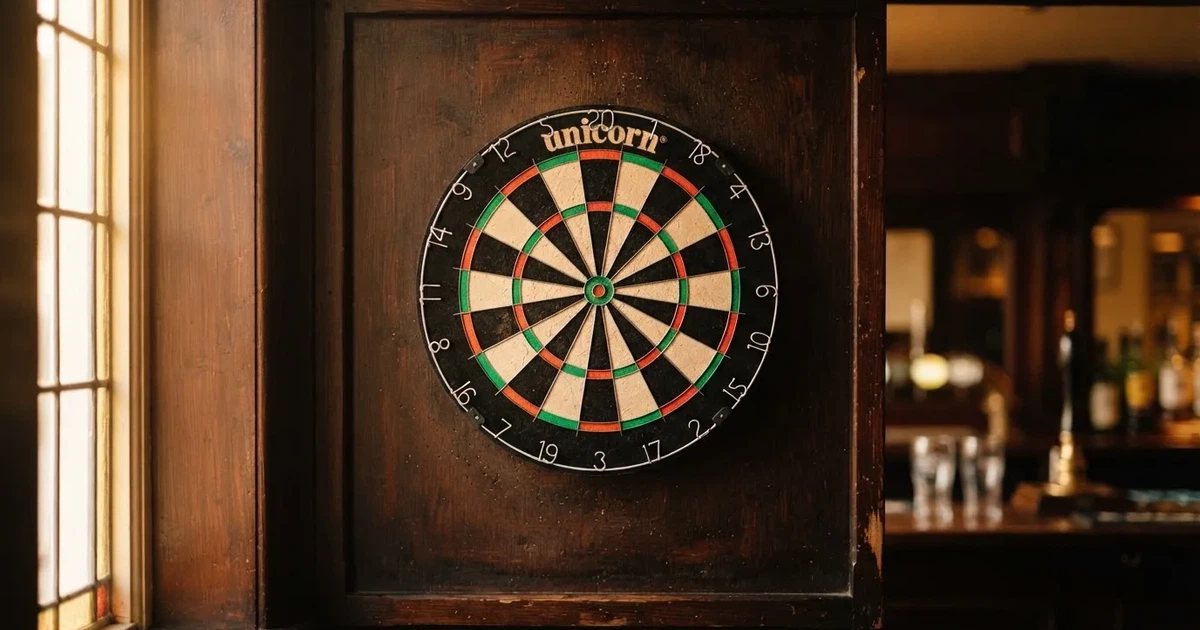
A dartboard has twenty numbered segments, each with single, double and treble areas; the bullseye scores 50 and the outer bull 25. Players start a leg of 501 at 501 and must finish on a double or the bullseye, so the highest possible three-dart finish is 170 and the shortest possible leg takes nine darts. Those numbers matter because the markets track them: the next-leg price depends on the score a player is on, the checkout price depends on the highest-scoring finish available, and the match-winner price depends on a model of how many visits to the board a player needs to close out a set.
The simplest bet on a darts match is the match winner. Two prices, one for each player, add up to more than 1.00 in decimal terms because the bookmaker’s margin is built in. A market priced at 1.90 and 1.90 (fractional 9/10 each side) implies an overround of about 5.3 % (sum of probabilities 1.053), which corresponds to a bookmaker margin of 5.0 %. At the tighter end of the market the prices are 1.83 and 1.83 (15/8 and 15/8, sometimes written 1.875/1.875 after Best Odds Guaranteed) for an overround near 6.5 %, and at the looser end, prices like 2.10 and 1.71 are quite common on underdogs and favourites respectively, and the margin pushes higher. On a market this shallow, every fraction of a point eats into long-run returns.
A short calculation makes the bite visible. In a market priced 1.90 / 1.90 (9/10 each side):
- The bookmaker’s margin sits around the low- to mid-5 % range, depending on which snapshot is in front of the reader.
- A stake of £10 returns £19 at decimal odds 1.90 — that is the £10 stake back plus £9 profit.
- Across 100 such stakes on each side of the market, the punter risks £1,900 and collects back roughly £1,800 if the two outcomes split evenly across many matches, leaving a long-run loss of about £100, or around 5 % of total stakes.
Combination bets multiply the per-leg price into one price across all selections, and the margin compounds the same way. A four-fold acca at odds of 2.00, 2.00, 2.00 and 2.00 is a 16.00 combined price; if each leg carries a 5 % margin then the combined margin works out close to 19 %, because the bookmaker’s edge stacks across every leg. The headline payout looks life-changing; the long-run cost is built in.
A bet builder on the same event is structured differently and is harder to read. The bookmaker quotes prices for player-to-win, total 180s, highest checkout and a leg-specific market, then combines them with a margin layered on top of the parts. The pages for these tools tend not to show how the combined price is built, and the practical answer is to back-calculate the margin from the components: add the implied probabilities of each leg at the bookmaker’s price, then take the inverse. Anything well over 1.00 is the implied probability; 1 minus the inverse is the margin the operator has taken on the combination.
Each-way betting is a separate mechanic, used mostly on outright tournament markets at longer odds. The punter’s stake is split into a win bet and a place bet; the win bet pays at the full odds, the place bet pays at a fraction (typically a quarter or a fifth of the win odds for darts outrights, though it varies by tournament), and the total stake doubles. A £10 each-way bet at 10.0 with quarter odds costs £20 and pays out if the player wins or places. Outright markets are wide enough that a place payout at a quarter of the win odds can match or beat a smaller win bet elsewhere.
The tournaments worth a betting slip
The professional darts calendar is built around three governing bodies. The PDC runs the Premier League, the World Championship and the bulk of televised events; the World Darts Federation runs the BDO lineage of events and international amateur play; smaller tours and exhibitions fill the calendar between them. The PDC World Championship over the Christmas and New Year period is the biggest betting event of the year, with every round structured around a target number of sets — first to three in the early rounds at Alexandra Palace, climbing to first to seven by the final — and a prize fund that justifies the marketing around it.
Most televised darts events resolve quickly enough to settle in a single sitting. A Premier League Darts night has seven matches, each first to a small number of legs; the outright winner market on the tournament can run for three months before it settles. Outrights are where Best Odds Guaranteed, acca insurance, and the standard £/€/$5 free bet all do their work for a punters who like a long-priced player; the carry is built into the long odds and the punter’s only real job is to read the place terms (which tournament, which fraction) before the bet is placed.
The licensed field for darts betting
The brands below all hold a Gambling Commission remote licence and offer darts among their sports. The list is not a ranking and not a recommendation: every licensed operator that takes GB customers is on a similar legal footing, and offers are described only as each operator’s own terms state them.
10bet
10bet’s sportsbook runs football, tennis and horse racing as the headline sports alongside a wider menu, with Cash Out, Bet Builder and Live Streaming as the product pillars. The remote licence sits with Blue Star Planet Limited, and the brand takes its share of darts fixtures through the year.
- Licence: Gambling Commission remote licence 043173-R-322899-023 (Commission account 43173); remote general betting standard (real events); licence holder Blue Star Planet Limited.
Operator highlights for the season
10bet’s sportsbook features Cash Out, Bet Builder and Live Streaming as headline product pillars, with football, tennis and horse racing leading the menu. The brand lists televised darts fixtures through the season.
Sky Bet
Sky Bet’s free bets are a useful illustration of the welcome-offer shape described earlier: they are non-withdrawable, do not return the stake with winnings, expire 30 days after crediting and can only be used on single or each-way markets excluding virtuals. The licence sits with SBG Sports Limited.
- Licence: Gambling Commission remote licence 067370-R-341330-005 (Commission account 67370); remote general betting standard (real events); licence holder SBG Sports Limited.
Sky Bet promotional terms
Free-bet stake is not returned with winnings; expiry is 30 days from crediting; usable only on single and each-way markets; virtuals are excluded.
DragonBet
DragonBet’s app leads with Welsh football and rugby, with racing, American football, in-play betting and bet builder markets alongside. Darts sits inside the wider menu and the brand takes its share of televised events through the season. Licence holder is DragonBet Ltd.
- Licence: Gambling Commission remote licence 064908-R-339041-003 (Commission account 64908); remote general betting standard (real events); licence holder DragonBet Ltd.
DragonBet feature overview
Strong on Welsh sport, with in-play and bet builder available; wider menu covers darts alongside mainstream sports.
888sport
888sport runs pre-match and in-play betting with Cash Out, Bet Builder, racing streams, BetFinder form tools, a live bet feed and daily boosted odds. The licence sits with 888 UK Limited.
- Licence: Gambling Commission remote licence 039028-R-319297-014 (Commission account 39028); remote general betting standard (real events); licence holder 888 UK Limited.
888sport product summary
Pre-match and in-play betting; Cash Out and Bet Builder; racing streams; BetFinder form tools; live bet feed; daily boosted odds; darts sits in a broad menu.
Fafabet
Fafabet offers Best Odds Guaranteed on UK and Irish horse racing win and each-way bets from 9am on race days: if the starting price is bigger than the price the punter took, the bigger one is paid. The licence sits with Taichi Tech Limited; the brand runs a sports menu that puts football and horse racing at the front with darts underneath.
- Licence: Gambling Commission remote licence 057385-R-333191-006 (Commission account 57385); remote general betting standard (real events); licence holder Taichi Tech Limited.
Fafabet BOG details
Best Odds Guaranteed on UK and Irish racing from 9am; if the SP beats the price the punter took, the SP wins; darts appears as a televised sport when fixtures are live.
Star Sports
Star Sports runs a personal service through a free phone line on 08000 521 321 and an inbox at [email protected] for account opening and bet placement, which is unusual among licensed online operators and useful to a punter who wants a real voice on the other end of the line. Licence holder is Star Racing Limited, with listings as the only data source on darts fixtures carried in this guide.
- Licence: Gambling Commission remote licence 009177-R-104555-019 (Commission account 9177); remote general betting standard (real events); licence holder Star Racing Limited.
Star Sports contact channels
Trade desk on 08000 521 321 for account opening, bet placement and queries; support inbox at [email protected]; darts coverage reported through operator listings.
Coral
Coral’s sports welcome offer is the cleanest worked example in this guide: a deposit and a sports bet of £20 or more at minimum odds of 2.0 (1/1) credits £40 of free bets within seven days, for new GB customers who opt in. The free bets expire seven days after they are credited. The licence sits with LC International Limited.
- Licence: Gambling Commission remote licence 054743-R-330863-014 (Commission account 54743); remote general betting standard (real events), remote betting intermediary; licence holder LC International Limited.
Coral welcome offer specifics
Welcome offer credits £40 of free bets after a qualifying £20 bet at minimum odds of 2.0 (1/1); free bets expire seven days after issue and are restricted to new GB customers who opt in.
Betfair
Betfair’s sportsbook — distinct from its exchange — carries in-play betting, Bet Builder, free live streaming of events such as UK and Irish horse racing and football within the app, and a 90-minute payout market for football. Licence holder is PPB Counterparty Services Limited, and the brand sits alongside Paddy Power under the same parent group’s consumer brands.
- Licence: Gambling Commission remote licence 039439-R-319330-013 (Commission account 39439); remote general betting standard (real events); licence holder PPB Counterparty Services Limited.
- What the terms say on the key subjects: in-play betting; Bet Builder; free in-app live streaming for events such as UK and Irish racing and football; 90-minute payout market on selected football matches; darts appears as part of the mainstream menu.
DAZN Bet
DAZN Bet’s deposit menu runs from £5 by debit card, Apple Pay, Paysafecard, Trustly and Skrill to £20 by PayPal, with no processing fees attached. The brand is comparatively new on the GB sportsbook side and the licence sits with DZBT Limited.
- Licence: Gambling Commission remote licence 048756-R-327274-019 (Commission account 48756); remote general betting standard (real events); licence holder DZBT Limited.
- What the terms say on the key subjects: deposit methods include debit card, Apple Pay, Paysafecard, Trustly and Skrill from £5, and PayPal from £20, with no processing fees; darts covered as a televised sport when fixtures are listed.
Kalooki Sportsbook
Kalooki Sportsbook is operated by Kalooki Sportsbook Limited under Commission account 57730 and is a GAMSTOP member. The brand sits at the quieter end of the licensed market and serves customers from its own terms.
- Licence: Gambling Commission remote licence 057730-R-333396-005 (Commission account 57730); remote general betting standard (real events); licence holder Kalooki Sportsbook Limited.
- What the terms say on the key subjects: licensed under account 57730; GAMSTOP membership confirmed on the operator’s own home page; identity verification required before a first deposit or first bet.
| Brand | Gambling Commission licence | Licence holder | What the terms say on the key subject |
|---|---|---|---|
| 10bet | 043173-R-322899-023 (account 43173) | Blue Star Planet Limited | Cash Out, Bet Builder, Live Streaming; football, tennis and horse racing lead the menu |
| Sky Bet | 067370-R-341330-005 (account 67370) | SBG Sports Limited | Free bets expire after 30 days; non-withdrawable; stake not returned with winnings; singles and each-way only |
| DragonBet | 064908-R-339041-003 (account 64908) | DragonBet Ltd | Welsh football and rugby lead; in-play and bet builder available |
| 888sport | 039028-R-319297-014 (account 39028) | 888 UK Limited | Pre-match and in-play; Cash Out; Bet Builder; daily boosted odds; racing streams |
| Fafabet | 057385-R-333191-006 (account 57385) | Taichi Tech Limited | Best Odds Guaranteed on UK and Irish racing from 9am; SP wins if it beats the price taken |
| Star Sports | 009177-R-104555-019 (account 9177) | Star Racing Limited | Trader desk on 08000 521 321; support inbox; darts coverage via operator listings |
| Coral | 054743-R-330863-014 (account 54743) | LC International Limited | £40 of free bets after a £20 qualifying bet at minimum odds of 2.0 (1/1); free bets expire after 7 days |
| Betfair | 039439-R-319330-013 (account 39439) | PPB Counterparty Services Limited | In-play and Bet Builder; in-app live streaming; 90-minute payout market |
| DAZN Bet | 048756-R-327274-019 (account 48756) | DZBT Limited | Deposits from £5 by debit card, Apple Pay, Paysafecard, Trustly and Skrill; PayPal from £20 |
| Kalooki Sportsbook | 057730-R-333396-005 (account 57730) | Kalooki Sportsbook Limited | Identity verification before first deposit or bet; GAMSTOP membership |
A licensed brand is not automatically the cheapest, fastest or broadest. LCCP and the £150 vulnerability check apply to every operator in the table; everything else — odds depth, market coverage, free-bet shape, deposit and withdrawal menu — is each brand’s own commercial decision and varies widely within the same legal frame.
What the darts betting market looks like in 2026
Darts sits in an odd commercial position in a British sportsbook. It is not a top-three sport by handle (football, horse racing and tennis lead), but the volume is concentrated in a few short windows — the World Championship, Premier League nights, the World Matchplay and the Grand Slam — which is when bookmakers put their best prices up. Outside those windows the menu thins out, with fewer markets per match and longer suspension times around televised games, and a punter looking for value on a Tuesday-night floor event will often find the operator’s deeper menus are focused elsewhere.
Three trends have changed the picture in the last two seasons. The first is the structural shift at the top of the PDC, which has spread the field of players capable of winning a televised event. A price that would have been 1.50 to back the outright winner of a tournament five years ago is closer to 3.00 today, because the favourite-to-field ratio is less one-sided; for an outright-market punter this is good news, since each-way terms become more meaningful when favourites are not lapping the field. The second is the rise of bet builder and same-event multi markets on darts, where the operator is composing several selections into one price on a single event; the products are popular because they look engineered to the punter’s read of the leg, but the combined margin is rarely published and tends to be wider than the margin on any one of the parts. The third is the in-play cash-out button, which was rare on darts three seasons ago and is now standard on every licensed sportsbook listed here — to the punter’s cost when the operator’s buy-back price is set wider than the live market would justify.
The wider context is the British regulatory frame. The Commission has spent the last three years tightening player-protection rules — identity checks, vulnerability checks, the bonus-and-wagering cap, the GAMSTOP mandate — without yet biting the operators hard on competitiveness. The licensed operators have responded by raising the price of offers in some cases and tightening the small print in others; the licensed field is harder to read than it was a few seasons ago, but it is also the only field in which the Commission register has any real meaning for a punt complaint that goes wrong.
Licences, law and what a GB licence actually changes
In Great Britain, providing gambling facilities to a customer here requires a Gambling Commission licence, irrespective of where the operator is based. That is the effect of the Gambling (Licensing and Advertising) Act 2014 and sections 33 and 36 of the Gambling Act 2005 as amended; a Curaçao, Maltese or Gibraltar licence is not a substitute for serving GB customers. The Commission’s public register, searchable by business name, trading name, domain or account number, is the whole test of who holds a licence.
Two limits on what a licence means are worth naming. First, the licence gives a route to complaints and dispute resolution that an unlicensed site does not: if a licensed brand withholds funds, the Commission investigates and approved ADR bodies (IBAS) handle disputes the operator’s own service desk cannot settle. Second, the licence costs the punter in ways the bonus banner does not show: identity verification before the first bet means no anonymous play; the £150 rolling-30-day vulnerability check means a self-employed punter can be asked to confirm income; and a deposit limit has to be set on the account before the first deposit, even if the punter sets it to the maximum.
Offshore brands operate under their own house rules and offer no Commission, no ADR route, no GAMSTOP coverage, no 10x bonus cap and no £150 vulnerability check. The “is it legal to use?” framing is wrong as well as right: no offence aimed at a customer who bets on an unlicensed site has been established, but the loss of protection is real and not theoretical, and a customer whose account is closed without a payout has no British remedy. The Commission’s enforcement is disruption (cease-and-desist, payment-provider referrals, domain and search work) rather than blocking at the consumer’s connection, and ISP-level DNS blocking has been signalled but is not in operation. Neither licensed nor unlicensed is “the safe choice” by default; the licensed choice has checks, limits and a complaints route that the unlicensed one does not.
Payments are a cleaner case. Credit cards were banned for gambling in Great Britain on 14 April 2020 and the ban extends to credit-card-funded e-wallet deposits. Debit cards and bank-based payments are not affected. No state list of approved or prohibited payment methods has been published beyond that. Cryptocurrency deposits at licensed operators are not addressed by statute and remain a question of each operator’s own terms.
On winnings, the player pays no tax on betting winnings in Great Britain. General Betting Duty is the operator’s tax, currently 15 % on gross profits, with a remote betting rate of 25 % scheduled from 1 April 2027 alongside the existing 15 % rate for in-person and UK-horse-racing bets. Whether operators pass duty on through tighter odds has not been settled in the public record; a punter betting on a licensed site should not write duty down as a cost, and an unlicensed site does not change the picture.
Age is set at 18 across the board. Identification is verified at sign-up, before the first deposit and before any bonus credit, so the question of whether to claim a welcome offer includes the question of whether the punter has documents to hand. A short process; an unavoidable one.
Frequently asked questions
The process of placing a darts bet
Pick a licensed bookmaker, deposit by debit card or another non-credit method, find the darts fixture under the sport menu, choose a market (match winner, handicap, total 180s, correct score, outright tournament), enter the stake and confirm the bet on the bet slip. The bet settles after the event — instantly on in-play bets once the relevant leg or set finishes, after the match for pre-match bets, and at the end of the tournament for outright winner markets.
Defining online darts betting markets
It is wagering on the outcomes of professional darts events. Match-winner bets settle on who wins the match; handicap markets settle on who wins once a leg or set handicap is applied; totals markets settle on whether the combined 180s, highest checkout or another stat is over or under a line; outright markets settle on the tournament winner. The sport is played in 501, where players start at 501 and must finish on a double or the bullseye, with a maximum three-dart finish of 170.
Understanding darts handicap betting mechanics
Handicap markets apply a legs-or-sets handicap to balance a match between a favourite and an underdog. A favourite giving a 1.5-leg handicap on the match line means the favourite must win by two legs or more for the handicap bet to land; the underdog at +1.5 wins the handicap market as long as they win the match or lose by exactly one leg. The favourite’s price shortens as the handicap gets larger because the bar the favourite has to clear rises.
Verifying a bookmaker’s Gambling Commission licence
Search the Commission’s public register by business name, trading name, domain or account number. The register is the whole test of a licence; the entry will show the licence categories (for example remote general betting standard, real events) and the licence holder. None of the ten brands in the table above is the only licensed operator, and listings on the register run into the hundreds.
Calculating returns from stake and odds
In decimal odds, multiply the stake by the odds to get the return — that is the stake back plus profit. A £10 bet at decimal odds 1.90 returns £19; a £10 bet at 5.50 returns £55. In fractional odds, the fraction is the profit per unit staked, so 9/10 returns the stake plus nine-tenths of it as profit, the same outcome as 1.90 in decimals. A combination bet’s odds are the product of the leg odds, so a treble at 2.00, 3.00 and 4.00 settles at 24.00.
How do odds boosts work?
Bookmakers offer boosted odds on selected markets to provide better potential returns than the standard price. Boosts can be applied to singles or combined bets like bet builders. Always check if the boost carries specific maximum stake limits or if it replaces standard market availability for that selection.
Can you cash out on darts?
Yes, most licensed operators offer cash-out on darts markets. It allows you to settle your bet before the match finishes for a value set by the bookmaker. The cash-out offer is not a right; the operator may suspend the feature during volatile moments of a leg or match.
Is there a tax on darts betting winnings?
No, in Great Britain, there is no tax on betting winnings for private punters. General Betting Duty is paid by the operator on their gross profits. If you are a professional gambler whose main income is derived from betting, check your tax status with HMRC or a professional advisor.
What is a ‘leg’ in professional darts?
In 501, a leg is a game where players race to reduce their score from 501 to zero. The first player to finish a leg by hitting a double or bullseye wins the leg. Matches are typically played as the first to a specific number of legs or sets.
How are darts statistics like 180s used in betting?
Total 180s markets track the number of maximum scores (180s) hit during a match. You can bet on the total number of 180s to be over or under a given line, or on specific players to hit the most 180s. These are often included in bet builders.
It is the share of every unit staked that the bookmaker keeps across a market in the long run. For a two-way market with decimal odds o1 and o2, convert each to its implied probability (1 ÷ odds), add them, and subtract from 1 to get the overround: (1/o1 + 1/o2) − 1. A market priced 1.90 and 1.90 carries an overround of 5.3 % (1.053 sum of implied probabilities), which corresponds to a 5.0 % margin. The lower the margin, the better the punter’s long-run position.
Tennis, darts & cue sports – Best betting
Content created by the «Best betting» team
