
Badminton betting tips 2026: how a tip is built, and what it costs the punter who follows one
 Available in US
Data current as of 27 October 2026, checked against the Gambling Commission’s public register and each operator’s own published terms.

Badminton is the kind of sport punters approach sideways. There are no sheepskin-wrapped tipsters on the telly, no evening newspaper column, and almost no in-play chatter on the radio. The BWF calendar keeps running all the same: All England, Thomas & Uber Cups, the Sudirman Cup, the World Championships, and the Olympic cycle that starts every four summers. Whoever wants a bet on the sport gets to build it almost alone. This guide is for those who already suspect that — readers who want to understand what a tip actually is, how a value bet is constructed, how the margin of a market hides inside every price, and which British bookmakers are worth opening an account with when the next BWF event lands on the schedule. Nothing on this page is a prediction of any particular match, and no system that wins is offered. What follows is the working that turns a hunch into something with a price tag.
Responsible gambling and the cost of clearing a bonus
A licensed bookmaker in Great Britain is required to put a set of safer-gambling tools in front of every customer, and a serious read of any betting guide starts by understanding what those tools actually do — because they are the only safety net that operates at the moment a punter decides to place the next bet rather than the next one after that.

GAMSTOP is the national multi-operator self-exclusion scheme, and it is a mandatory licence condition for every online operator on the British market. A punter who registers with GAMSTOP is locked out of every GB-licensed site and app for the period they choose — six months, one year, five years, or five years with auto-renewal. After the minimum period the exclusion stays in place for a further seven years unless the punter asks GAMSTOP to remove it. The scheme covers online sites and apps; high-street bookmakers run a separate in-shop service. The point of the design is exactly this: a self-exclusion is something a punter puts in place at a clear head, so it has to outlive the moment when they want it removed.
Deposit limits are the next layer, and they are partly the customer’s choice and partly the operator’s duty. A licensed remote operator must offer a gross deposit limit on a fixed time frame — daily, weekly, or monthly. The first changes have applied since 31 October 2025, and a second phase was postponed to 30 September 2026; whether that phase is live at the moment of reading is not pinned down. There is no state-set deposit or loss ceiling for betting. What the operator sets, the customer can lower at any time; raising a limit, where it is allowed, usually takes twenty-four hours to take effect, which gives a punter a day to talk themselves out of it.
The financial vulnerability check, in force since 30 August 2024, applies to licensed remote betting when a customer’s deposits minus withdrawals exceed £150 in a rolling 30 days — a threshold that has applied since 28 February 2025. The check is a public-record check (bankruptcy or county court judgments are the kind of thing it surfaces), not an income check and not a credit reference check. A financial risk assessment, sometimes called “affordability checks” in the press, sits on top of that and has been announced in a staged plan with no start date. Help, where the tools are not enough, runs through GamCare’s National Gambling Helpline, GambleAware, NHS gambling clinics, and Gamblers Anonymous.
A credit card is not an option. Since 14 April 2020 it has been illegal for any GB-licensed operator to accept a credit card for gambling, including a credit-card-funded payment through an e-wallet. Debit cards and bank-based payments are not covered by the ban. Identity verification has to be complete before the first deposit or the first free bet, so anonymous play at a licensed site is no longer possible. None of this is a counsel of despair — the verification, the deposit limit, the GAMSTOP layer are the cost of betting at a bookmaker that has agreed to answer to the Gambling Commission rather than to nobody. The opposite, an offshore bookmaker without a GB licence, costs the punter every one of those protections and offers no British route to recover the money if the operator refuses to pay out. A comparison that ignores that is not a comparison at all.
What a bonus and a free bet actually pay back
Marketing words are the first thing a punter meets and the last thing a sharp-eyed guide should leave alone. A bonus is not free money; a free bet is not a free bet. The arithmetic that turns the headline into the real number is short enough to do in one sitting, and it is the only protection against a punter treating a promotional offer as if it were a tip.
A cash bonus is matched credit that gets added to the account and that has to be turned into withdrawable cash before it leaves. The standard required turnover is the bonus amount times a wagering factor that the operator publishes; a £10 bonus at 50x means £500 of qualifying bets, and at 10x the GB-wide cap that applies since 19 January 2026, no more than £100 of those bets counts. The qualifying bets have to be at or above the minimum price the operator states; an acca full of short-priced favourites does not usually clear the requirement. The free bet that an offer stirs in is a separate beast: the stake is not paid back with a win, only the profit, so a £10 free bet at 2.00 returns £10 of profit, not £20. A cap on free-bet winnings is common, and a deadline of seven days from credit is standard. An “acca insurance” offer refunds a stake as a free bet if one leg of a multiple lets the punter down, with a maximum refund, a minimum number of legs, and a minimum price per leg; BoyleSports, to take one example, sets a £5 minimum stake, a 1/2 minimum price per leg, and a £20 maximum refund that expires in seven days, with bets that have to be placed and settled on the same day. A price boost or an enhanced-odds offer is a one-shot price on a named selection that pays at the boosted number if the event falls the right way; the stake is paid back as on any other bet, but the boost itself is not repeatable, and the punter should treat it as a marketing expense the operator has decided to absorb.
The way to read any of these offers is the same. Take the headline number, take the wagering factor or the stake-not-returned condition, take the minimum price and the deadline, and ask what the offer is worth in average expected return rather than in headline pounds. A bonus that needs £500 of bets at an average margin of 5% costs £25 of expected value to clear, which is more than the £10 bonus pays in, so the headline is a loss once trade is converted. A free bet at 2.00 with the stake not returned is worth the free-bet amount times one-half of the price’s edge — what the offer is worth on average, never what it wins. Mixed-product promotions, an offer that requires gambling on two or more product types such as betting and casino, are banned under the GB promotion rules that took effect on 19 January 2026. None of this makes an offer worthless; it makes an offer legible. A punter who can read the terms before claiming is a punter who can compare two of them side by side.
Live betting, cash out, and what the in-play market actually shows
A badminton rally finishes in seconds, the momentum shifts twice a game, and the in-play market is where a punter who has watched a few matches can sometimes see the price lag the picture. That is the case for live betting on badminton: it is a fast sport with short scoring runs and clear momentum swings, and the market that prices it is sometimes a touch behind. It is also a market where the punter has to remember what the bookmaker’s margin does to a price, because the margin is the same in-play as it is pre-match, and a fast-moving price is still a price with the same overround built in.
Cash out is the bookmaker’s offer to settle a bet mid-event at a number the operator sets. The number is built out of the current in-play price, the original stake, and the bookmaker’s own margin on the cash-out quote, which is wider than the margin on the original bet. A punter who cashes out a winning position takes a fraction of the eventual return; a punter who cashes out a losing position gives back a fraction of the stake. The decision is rarely obvious, and the right way to think about it is as a separate bet at a new price rather than as a guarantee against loss. Some bookmakers, among them Swifty Sports, list Cash Out on horse racing and football markets; Fitzdares offers it on horse racing and a handful of other sports. The presence of cash out is not a verdict on its value, but it does change what a punter can do with an open position.
Bet builders and same-game multiples let the punter combine several selections from the same match into one price. On a sport like badminton, where the markets are thin to start with, a bet builder that totals games won, total points, and a handicap line can produce a price that reflects the punter’s view of the match better than any single market. The price is still a price with a margin, and the more legs the higher the margin usually is. The depth of any given bookmaker’s badminton offering is the variable that decides whether a bet builder is a useful tool or a single button with very little behind it. Badminton is a smaller sport for most British bookmakers, and a reader who bets it regularly ends up knowing which operators bother to price the men’s singles at a BWF Super 500 event and which ones leave the page blank.
A live stream, where one is offered, lets the punter actually watch what they are betting on. bet365 runs in-play betting alongside live streaming of events worldwide, with trackers for following bets across sports. A live stream and an in-play market together is a closer thing to the sport than an in-play market alone, because the punter can see the injury timeout or the change of ends before the price catches up. It is not a guarantee of edge, but it is a guarantee of information.
Predictions, tips, and what a value bet actually is
A tip is somebody’s view of who wins. A prediction is the same view dressed up as a forecast. A value bet is the only one of these three that has a price attached, and it is the only one that has an arithmetic that makes sense. A value bet is a price offered by a bookmaker that sits above the punter’s own estimate of the true probability — once the margin of the market has been taken out of it. If the punter thinks a player wins the match 65% of the time, and the decimal price on that player implies 60% (one divided by the price), the price is a value bet at the margin the punter is willing to accept. The same price at a market margin of 10% is a thinner edge; the same price at a market margin of 2% is a meaningful one.
Building that view is the work. Form is the easiest piece: how the player has done in recent matches, on the surface they are about to play on, against opponents of the ranking they are about to meet. Head-to-head records carry weight in a sport like badminton, where the draw keeps bringing the same names back together, and where a single style match-up can swing a result the rankings do not predict. Statistics are next: the rally length, the unforced error rate, the percentage of service points won, the performance under pressure at 20–20. Line-ups matter in the team events, where a country’s depth can carry a weaker top singles player. None of these is a tip on its own. Each one is a piece of information the punter weighs against the others and against the price the market is offering.
The reason no tip is ever certain is mechanical. A bookmaker’s price is a number with a margin built into it — the margin is the cut the operator keeps out of every pound bet on the market. The punter’s view is a probability, also an estimate. The two are never going to coincide exactly, and a tip that says “this player wins” without quoting a price is a tip that has refused to do the arithmetic. Even a sharp punter with a sound view of the match will lose more often than a coin-flip punter would, because the probability is never 100%, and the price is never paying out a long way above the true probability. A losing streak is part of the trade; a winning streak is part of the trade; the edge, if there is one, sits in the average over hundreds of bets rather than in any one of them.
Staking and bankroll discipline are how the punter turns an edge into something that survives a losing streak. The standard rule is to stake a fixed percentage of the bank on every bet — one or two per cent is the usual band — and to let the bank grow or shrink with the results rather than chasing losses with a bigger stake on the next match. The bank is the working capital: the punter sets it aside, separate from the household money, and stops when it is gone. A staking plan that escalates after a loss is a plan to lose the bank faster, not a plan to recover it. The numbers behind the rule are not complicated — a 5% edge on a flat 2% stake produces a steady growth of the bank over hundreds of bets, and the same edge on a stake that doubles after a loss produces the bank gone in a much shorter time.
The conclusion is the only one a serious guide can offer: a tip is an opinion, a value bet is an opinion plus a price, and the price is the only part that is ever actually compared to anything. A punter who treats a tip as a fact has stopped doing the work.
Bet types, odds, and how the market is priced
A badminton match offers a thinner set of markets than a football match, and the punter who knows which markets exist and how they are settled is the punter who can shop a price rather than take the first one on the screen. The standard pre-match market is the match winner — one selection per player or pair, settled on the result of the match. The handicap market gives one side a game or a points head start, and the price on each side of the handicap reflects the bookmaker’s view of how close the match is. The total games market lets the punter bet over or under a stated number of games in the match, which on a best-of-three contest is essentially a bet on whether the match goes to a third game. The set score market lets the punter bet on the exact score, and the price on each combination reflects the joint probability of two or three individual games falling the right way.
A combination bet — an accumulator, or “acca” in the British usage — multiplies the prices of the legs into one price and pays only if every leg wins. BoyleSports Acca Insurance, to take one named example, refunds the stake as a free bet when a single leg lets the punter down, with a £5 minimum stake, 1/2 minimum odds per leg, and a maximum £20 refund that expires in seven days, on bets that have to be placed and settled on the same day. An each-way bet is two bets of equal stakes — the win part and the place part — so a £10 each-way bet costs £20 in total. Each-way bets are more common on horse racing than on badminton, where the place terms are not always available, but a punter who finds them on a long-odds match winner can use them to back a player to either win or reach the final.
Odds come in two formats in British usage: fractional and decimal. Fractional odds of 5/1 mean a £1 stake returns £6 in total — £5 of profit on top of the £1 stake; evens (1/1) returns £2 in total; 11/4 returns £3.75 in total. Decimal odds of 6.00 mean a £1 stake returns £6 in total, and the conversion from fractional is the fractional numerator divided by the fractional denominator, plus one. A bookmaker who prices in fractions will give the decimal form beside the fractional one. Punters who compare prices between operators usually do the comparison in decimals, because the conversion is built into the number.
The margin of a market is what the bookmaker keeps of every pound bet on it. It is hidden inside the prices: a match winner with two players priced at 1.90 and 1.90 in decimal odds has an overround of 5.26% (calculated as the sum of the reciprocals of the odds minus one: 1/1.90 + 1/1.90 = 1.0526, so 1.0526 − 1 = 0.0526) and a margin of 5.0% (calculated as 1 − 1/1.0526). The narrower the margin, the better the deal for the punter, and the wider the margin, the harder it is for any value bet to clear the operator’s cut. The illustrative two-way market at 1.90 and 1.90 carries a margin of 5.0% — that figure is the kind of margin a serious bookmaker runs on a well-priced match winner. A market at 1.80 and 1.80 has a margin of roughly 10.0%, and a market at 1.70 and 1.70 has a margin of roughly 15.0%. The punter who reads the prices can read the margin without being told it.
The return on a winning bet is the stake multiplied by the decimal odds. A £10 stake at 3.75 returns £37.50 in total, of which £27.50 is profit. A £10 stake at 1.50 returns £15 in total, of which £5 is profit. The return on a combination bet is the stake multiplied by the product of the leg prices, so an acca of three legs at 2.00, 3.00 and 4.00 multiplies into a price of 24.00, and a £5 stake returns £120 in total. The same arithmetic at the operator’s margin makes the combination bet a worse deal than the singles: each leg carries its own overround, and the product carries them all. A punter who builds an acca for the thrill of the long price is paying the bookmaker for the thrill.
Sports, tournaments, and the calendar a badminton punter watches
The badminton calendar is the BWF calendar, and the British punter who bets the sport watches the same six or seven events a year. The BWF World Tour is the weekly tour-level series; the All England Open Championships, first held in 1900, is the oldest and most prestigious of the open events and one of the few that the British audience hears about in passing. The Thomas Cup (men’s team) and the Uber Cup (women’s team) are held every two years, and the Sudirman Cup (mixed team), begun in 1989, is also held every two years, alternating with the team events. The BWF World Championships, first held in 1977, are the individual world title. Badminton has been an official Summer Olympic sport since 1992, with mixed doubles added four years later, and the Olympic event runs every four summers as a focal point of the calendar.
Five disciplines make up the sport: men’s singles, women’s singles, men’s doubles, women’s doubles and mixed doubles. The British bookmaker’s market depth varies by discipline: men’s singles and women’s singles usually carry the deepest pre-match and in-play markets at the bigger events; doubles markets are thinner and sometimes only the outright winner is priced; mixed doubles is the thinnest of the five in many operators’ programmes. The BWF World Tour Super 500, Super 750 and Super 1000 events usually get full market depth at the GB-licensed bookmakers who bother to price them; lower-tier events get match winner only or get priced by a smaller number of operators.
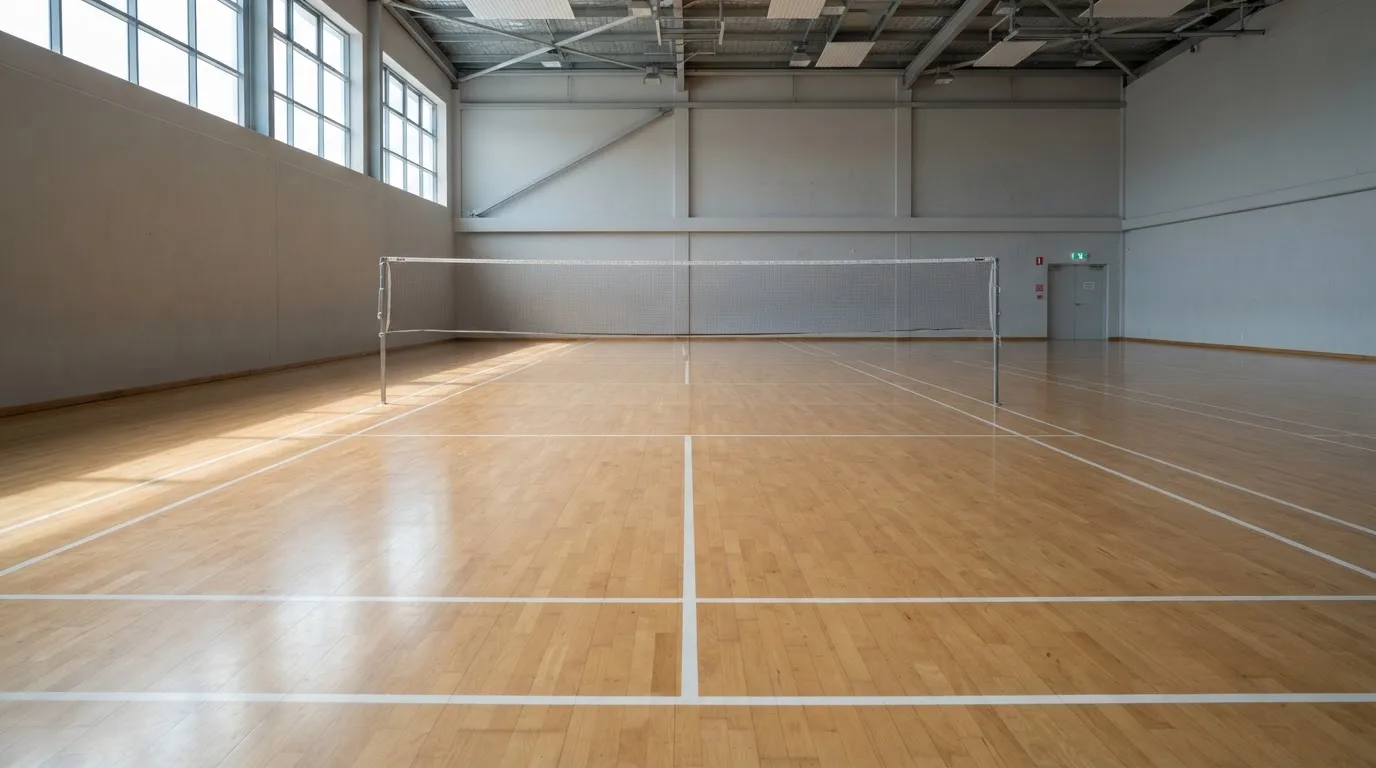
Each badminton game is played to 21 points with rally point scoring, and a match is the best of three games. At 20–20 play continues until one side leads by two; at 29–29 the next point wins the game. A badminton court is 13.4 m long, 6.1 m wide for doubles and 5.18 m wide for singles; the net is 1.55 m high at the edges and 1.524 m at the centre. None of these dimensions changes the price of a match, but they explain why a badminton rally ends when it does, and why a momentum shift in the middle of a game can be worth more than a single point. The Badminton World Federation (BWF) governs the international game; it was founded in 1934 as the International Badminton Federation.
Top 10 UK bookmakers for badminton betting
The comparison below covers ten GB-licensed operators, the brand each runs under, the Gambling Commission account number against the licence on the public register, and what the operator’s own published terms say about the subjects a badminton punter watches most closely: in-play, cash out, acca insurance, price boosts, and safer-gambling tools. Each row is a snapshot of the published terms on the day of reading, and the table is the whole comparison — what it shows is what each brand says it does.
| Brand | Licence holder and account | What the operator’s terms state |
|---|---|---|
| Ladbrokes | LC International Limited, account 54743 | Odds boosts on horse and greyhound bets, Best Odds Guaranteed on UK and Irish horse races, in-play betting, Acca Boosts |
| Copybet | Copybet UK Limited, account 53774 | Best Odds Guaranteed all day every day on all UK and Irish racing, first past the post on horse racing even if the winner is later disqualified |
| BoyleSports | Boylesports Enterprise, account 39469 | Acca Insurance on opt-in, £5 minimum stake, 1/2 minimum odds per leg, £20 maximum refund as a free bet, 7-day expiry, bets placed and settled same day |
| BetTom | Bet Tom Limited, account 64959 | Sports welcome offer of 50% back as a free bet up to £50, with a matching 50% back as free slot funds for casino, full terms apply |
| Tote | TDCO Limited, account 54779 | Pool betting on horse racing, Best Odds Guaranteed on UK and Irish racing from 8 AM on the day of the race, single and multiple bets only |
| Swifty Sports | Swifty Global (UK) Ltd, account 58957 | Best Odds Guaranteed, Cash Out on horse racing and football, daily price boosts, live streaming and in-play, Bet Builder listed as coming soon |
| Fitzdares | Fitzdares Limited, account 400 | Cash out, accumulators, Lucky 15s, specials and antepost markets on horse racing, football, tennis, rugby, cricket, golf and American football, with in-play live odds |
| Betmaster | BM Solutions GB Ltd, account 65699 | Sportsbook terms published, with safer-gambling tools to GB standards, registered in Malta, operates under GB licence |
| Bet600 | Tyche Tech Limited, account 44731 | Best Odds Guaranteed on horse racing, with the starting price paid if bigger than the early or show price |
| bet365 | Hillside (UK Sports) ENC, account 55148 | In-play betting and live streaming of events worldwide, Bet Track, Match Live and a Live Golf Tracker |
The headline difference across the ten is the depth of each operator’s badminton market. A bookmaker like bet365, which runs a global live-streaming and in-play programme, is the place to look for a men’s singles market at a BWF Super 500 event; a bookmaker whose programme concentrates on horse racing is the place to look for an acca insurance that covers a wider sport mix. None of the ten is “the only” licensed operator — the Gambling Commission’s register runs to several hundred holders, and a GB licence is the entry ticket to the comparison, not the finishing line. The punter who bets badminton in earnest usually opens two or three of these accounts and shops the price on each match; the punter who bets occasionally picks one with a deep in-play programme and a clear safer-gambling layout and stays there. The right answer depends on what the punter actually bets.
What badminton betting is, and where it sits in the British market
A punter looking at badminton for the first time sees a small sport with a thin set of markets and a calendar that does not run any longer than the BWF one. That is the surface of it, and it is also the work. The market depth varies by operator and by event, the in-play depth is thinner than football, and the price the punter sees is a price with the operator’s margin built in. None of that makes badminton a bad sport to bet — it makes badminton a sport where the punter has to do more of the work themselves, on form, on head-to-head, on the statistics the BWF publishes, and on the price the market is offering on the day.
What the punter gets back for that work is a market where the prices are sometimes out of line with reality, because the volume is lower and the bookmaker’s automated trader has less to lean on. A punter who knows the sport and reads the calendar can find edges that a casual bettor on a higher-volume sport never sees. The size of that edge is small in absolute terms — a percentage or two on the long-run price — and it disappears in the absence of bankroll discipline. The punter who treats it as a source of income rather than as a hobby loses the bank, and the punter who treats it as a hobby with a price tag attached keeps the bank.
A few specific features are worth knowing about. The All England Open is the highest-profile open event on the calendar and usually carries the deepest market; the Thomas & Uber Cups and the Sudirman Cup are the team events and offer outright winner markets as well as the per-match markets; the BWF World Championships and the Olympic event are the focal points. The five disciplines offer the most market depth in men’s singles and women’s singles; doubles markets are usually match winner only. The British bookmakers that price the men’s singles of a BWF Super 1000 event are the bookmakers to compare first; the British bookmakers that price the men’s doubles are a smaller set.
Legality, regulation, and what a GB licence actually means
A bookmaker that takes bets from customers in Great Britain needs a Gambling Commission licence — that has been the position since the Gambling (Licensing and Advertising) Act 2014 amended sections 33 and 36 of the Gambling Act 2005, and it applies wherever the operator is based. A Curaçao, Maltese or Gibraltar licence is not a substitute for a GB licence; the licence has to be a GB one at the point of consumption. The Gambling Commission is a non-departmental public body sponsored by the Department for Culture, Media and Sport, and its public register is the whole test of who holds a licence. The register can be searched by business name, trading name, domain or account number; every featured brand in this comparison is on the register as of the snapshot date, and the licence number beside each name is the number the register returns.
There are five betting licence types relevant to this market: remote general betting standard (real events), remote general betting standard (virtual events), remote general betting limited, remote pool betting, and remote betting intermediary (the licence for betting exchanges). All ten brands in the comparison hold a remote general betting standard (real events) licence; some hold additional categories. Financial spread betting is regulated by the Financial Conduct Authority rather than the Commission, which is why Spreadex operates under both regimes — the FCA for spread betting and the Gambling Commission for fixed-odds betting. The minimum age for any gambling product is 18, and the operator has to verify the customer’s name, address and date of birth before the first deposit or the first free bet, which has been the position since 7 May 2019.
What may be bet on is not statutorily listed: an operator holds a licence for a category and offers markets under its own rules and the Licence Conditions and Codes of Practice. In-play betting is offered by GB bookmakers under their licence conditions; the controls are the operator’s customer-protection duties. Esports are treated like any other event; virtual events are a separate licence category; bets on politics, TV shows and novelty markets are offered by GB bookmakers and no statutory prohibition has been published. There is no state-set cap on stakes in sports betting — operators set their own maximum stakes and may restrict customers.
Advertising is not licensed by the Gambling Commission; it runs through the CAP Code (non-broadcast) and BCAP Code (broadcast), enforced by the ASA, alongside the LCCP marketing conditions. CAP Code section 16 says marketing must be socially responsible, must not be of strong appeal to under-18s, and no one who is or seems to be under 25 may appear gambling or play a significant role in an advertisement, with an exception for marketing placed where a bet can be made directly — the rule is about who may appear, not about who may bet. Promotion rules in force since 19 January 2026 cap bonus wagering requirements at 10x and ban mixed-product promotions. The “whistle-to-whistle” rule is an industry code rather than statute, and betting advertisements have not been shown on TV from five minutes before a live sporting event to five minutes after it before the 9pm watershed since 1 August 2019 (horse and greyhound racing excluded). The Premier League’s withdrawal of gambling sponsorship from the front of matchday shirts from 2026/27 is voluntary, not law.
The player pays no tax on betting winnings in Great Britain. General Betting Duty is the operator’s tax on gross profits and currently sits at 15%; from 1 April 2027 a new remote betting rate of 25% applies within it, while remote bets on UK horse racing, bets on self-service betting terminals in licensed premises, pool betting and in-person betting stay at 15%. Until 1 April 2027 the remote rate stays at 15%; whether operators pass duty on through odds is not pinned down. The Commission’s statutory levy is a separate charge and not a tax. None of this is tax advice, and a professional gambler is the right kind of reader to ask HMRC or an adviser.
The honest framing of licensed versus unlicensed is that the licensed bookmaker is the bookmaker that has agreed to the GB regime: the verification before the first bet, the £150 financial vulnerability check, the GAMSTOP coverage, the 10x bonus cap, the deposit limit, the safer-gambling tools, and the route through an approved dispute-resolution body if funds are withheld. The unlicensed bookmaker is the bookmaker that has agreed to none of that, that runs on its own house rules, and that has no British route for the punter if the operator decides not to pay out. Neither is “the safe choice” by default; the licensed bookmaker is the regulated choice, and the unlicensed bookmaker is the choice that is regulated by nobody. Enforcement against unlicensed operators is disruption, not blocking: cease-and-desist notices, search-engine referrals, work with registrars, hosts and payment providers, and court-order DNS blocking powers that the Commission has been given or is about to receive. None of that changes the fact that the punter’s own money is on a bookmaker the British regulator does not oversee.
Frequently asked questions
How does a punter actually place a bet on badminton?
A GB-licensed bookmaker lists badminton under its sports menu, usually grouped under “Racket sports” or “Badminton”. The punter opens an event, picks a market — match winner, handicap, total games, set score — and adds a selection to the bet slip. The slip shows the price, the stake, and the potential return. A bet is placed when the punter confirms the stake, and it is settled by the operator’s terms once the event finishes. Identity has to be verified before the first deposit.
What is a value bet, and why is no tip ever certain?
A value bet is a price offered by the bookmaker that sits above the punter’s own estimate of the true probability, once the margin of the market has been taken out. The punter’s view is a probability, the bookmaker’s view is a probability with a margin, and the value sits in the difference. No tip is certain because the punter’s view is itself an estimate, and the bookmaker’s margin means the price is never paying out a long way above the true probability. A losing streak is part of the trade.
What is the bookmaker’s margin, and how is it visible in the odds?
The margin is the cut the bookmaker keeps of every pound bet on the market. It is hidden inside the prices: a match winner priced at 1.90 and 1.90 in decimal has a payout share of 52.6% and a margin of 47.4%, which is wider than a real market — the illustrative figure usually runs around 5%. The narrower the margin, the better the deal for the punter. A punter who can read the prices can read the margin without being told it.
How is the return on a bet worked out from the stake and the odds?
The return is the stake multiplied by the decimal odds. A £10 stake at decimal odds of 3.75 returns £37.50 in total, of which £27.50 is profit. The decimal odds equal the fractional numerator divided by the fractional denominator, plus one — so fractional 5/1 is decimal 6.00, and a £10 stake returns £60 in total. The return on a combination bet is the stake multiplied by the product of the leg prices.
How is it checked that a bookmaker holds a Gambling Commission licence?
The Commission’s public register at the regulator’s own website can be searched by business name, trading name, domain or account number. The punter enters the brand name, looks up the licence, and reads off the account number, the categories, and the licence holder. The comparison table above lists the account number beside each featured brand; a punter who wants to bet with any of them can confirm the licence on the register before opening an account.
Which tools for controlling play does a licensed bookmaker have to offer?
A GB-licensed operator offers deposit limits (daily, weekly, monthly), time-out periods, product restrictions, and self-exclusion, alongside GAMSTOP registration. Unibet’s safer gambling tools, to take one example, include deposit limits, a Player Profile test, product restrictions and self-exclusion, with live chat support and links to BeGambleAware, GamCare, GAMSTOP, Gambling Therapy and the BGC. The financial vulnerability check at £150 of net deposits in a rolling 30 days is a Commission-level requirement rather than an operator choice.
Tennis, darts & cue sports – Best betting
Content created by the «Best betting» team
