
Where to Bet on UFC Online in 2026
 Available in US
Current as of 27 October 2026 and verified against the Gambling Commission’s public register of remote betting licence holders.

The Ultimate Fighting Championship runs fight cards almost every weekend, and the betting market around it has grown into a year-round fixture. This page maps that market for British bettors: which bookmakers are licensed to take UFC bets, what they actually offer on fight night, how the prices are built, and what each operator costs the person paying the bill. The angle throughout is choice, because the licensed shortlist in the UK is not a one-size proposition. A spread-betting specialist and a fixed-odds exchange sit on the same register, and they suit different readers.
A note before the substance. Nobody can predict who wins a fight. Anyone selling a “sure thing” on a UFC card is selling fiction. What this page does is explain how a UFC bet is priced, settled and paid out, and which operator handles each step best for the kind of punter reading it.
The UFC in a Betting Context
The first UFC event was held on 12 November 1993 in Denver, Colorado, and the promotion is now owned and operated by TKO Group Holdings, with Dana White as president since 2001. Over 750 events have been staged by 2026, across eleven weight classes (eight men’s divisions, three women’s), and the calendar runs uninterrupted year-round: numbered pay-per-view events on most Saturdays, Fight Night cards filling the gaps, and Contender Series bouts building the next tier of talent. By 2026, the schedule is dense enough that a licensed bookmaker treats UFC as a core vertical rather than a niche.
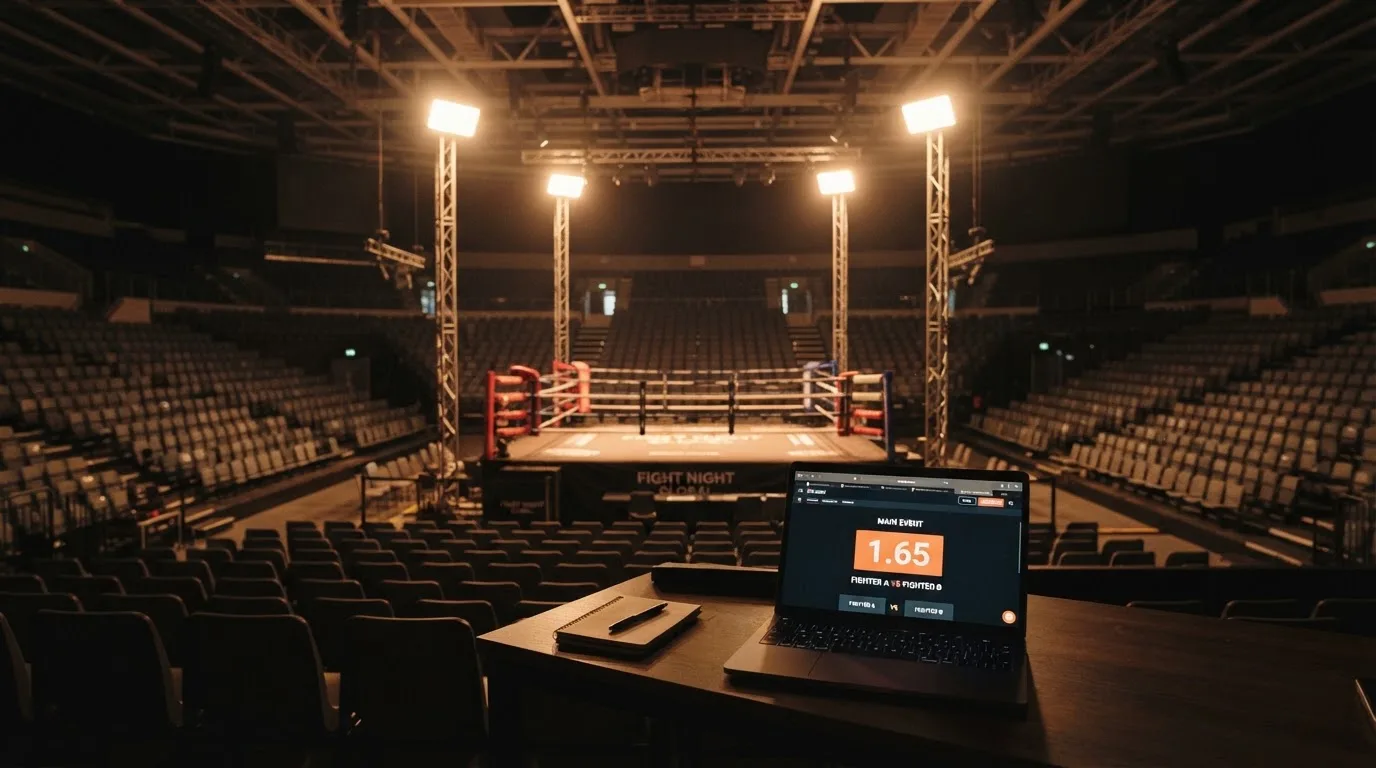
A UFC fight is a controlled contest, not a free-form brawl. Each round lasts a maximum of five minutes, with one minute of rest between rounds. Championship bouts and the main event of a non-title card are scheduled for five rounds; every other bout on the card is three rounds. A fight ends by submission, knockout, technical knockout, judges’ decision (unanimous, majority, split or technical) or disqualification. A referee or ringside physician can also stop a bout, and a contest can be ruled a no contest. A title fight that ends in a draw is settled in the champion’s favour, by the organisation’s own rule, so a draw is not a bettor’s friend on a champion-moneyline wager.
When a fight goes the distance, the three judges score each round under the ten-point must system: the winner of the round receives ten points, the loser nine or fewer, and 10-8 is the typical score for a dominant round. Three rounds of consistent dominance can put a 10-8 round on each card and turn a decision into a wider margin than the betting line implied. For bettors, the relevance is that method-of-victory markets (decision, KO/TKO, submission) are settled by what the officials write on their cards, not by what the broadcast commentary called.
Why the round structure matters for pricing
Five minutes is short. A three-round fight exposes a maximum of fifteen minutes of action, and the bookmaker’s over/under markets on “Fight goes the distance” reflect the chance the fight ends inside the distance at all. A fighter with a finishing rate above 70% prices differently from a decision merchant who has gone the distance in eleven of his last twelve bouts. The structure of the sport is the reason method-of-victory and round-grouping markets exist, and the reason margin on those markets runs higher than the margin on the outright moneyline.

The next numbered events on the calendar are UFC 334 (Gane vs. Hokit) on 14 November 2026 at Madison Square Garden in New York, and UFC 335 (Oliveira vs. Lopes) on 12 December 2026 at T-Mobile Arena in Las Vegas. A licensed bookmaker will price both cards in full: outright winner, method of victory, round grouping, and over/under on the total number of rounds.
The Licensed Landscape in Great Britain
There is no statutory list of permitted sports or markets for betting in Great Britain. A bookmaker that wants to take bets from customers in Great Britain needs a remote operating licence from the Gambling Commission, the regulator set up under the Gambling Act 2005. The licence is required wherever the operator is based, since the Gambling (Licensing and Advertising) Act 2014 brought remote facilities used in Great Britain inside the regime. A Curaçao or Malta or Gibraltar licence alone is not a substitute.
The Commission’s public register is searchable by business name, trading name, domain or account number, and it is the whole test of who holds a licence. Quote no count of operators without its access date. A domain ending in .co.uk proves nothing about licensing: licensed operators use .com and .co.uk interchangeably, and a brand can be licensed without any British-registered domain at all.
The featured set in this comparison is drawn from that register. Every brand named below holds a remote general betting standard (real events) licence, and every one is a participant in GAMSTOP, the national multi-operator self-exclusion scheme. The licence numbers and licence holders are stated in the comparison table later in this page. No brand is “the only” licensed operator, no licence guarantees a good UFC product, and the order below is not a ranking: it is a shortlist, grouped by what each bookmaker does differently on a fight card.
For readers who want the rule book in one breath: the Act covers Great Britain, which is England, Scotland and Wales. Northern Ireland runs its own older regime, so a “GB licence” does not extend to Northern Ireland. Minimum age is 18. Name, address and date of birth are verified before the first deposit or wager, including with a free bet or bonus, and that check has been in place since 7 May 2019. A licensed site is not anonymous.
What a UFC Bet Actually Costs the Punter
A UFC bet is a contract on the outcome of a fight. Three numbers sit behind every price on the slip: the stake, the odds and the margin.
Stake is what the bettor risks. Odds are the price, and at a British bookmaker they are given in fractional form (5/1, 11/4, evens) and converted to decimal form (6.00, 3.75, 2.00) by dividing the numerator by the denominator and adding one. The return on a winning bet is the stake multiplied by the decimal odds. The profit is the return minus the stake, or equivalently the stake multiplied by the decimal odds minus one. On a £10 single at 3/1 (decimal 4.00), the return is £40, the profit is £30, and the stake is returned alongside.
The margin is what the bookmaker keeps, on average, from every pound bet on a market. It is the third number, and it is never printed on the betting slip. It is built into the prices, and it surfaces by summing the implied probabilities of every outcome in a market. Take a two-way fight priced at 1.90 / 1.90 in decimal. The implied probability of each side is one divided by 1.90, or about 52.6%. Sum them and you get about 105.3%. That 5.3% above 100% is the overround, also called the bookmaker’s margin. It is the slice of every pound staked that the bookmaker expects to keep, before the result is settled.
The same example as a worked number: a £100 stake split evenly between the two fighters at 1.90 / 1.90 returns £95 to the winning side (the £50 stake on the winner times 1.90) and loses the £50 on the other side. The bookmaker pockets £5. That is a margin of 5.3%, a payout share of 94.7% — and the further the prices sit from evens, the more skewed the implied probabilities become, and the more the bookmaker’s edge stacks against one side of the market.
UFC main-event moneylines often carry a margin of 5% to 7% at a competitive bookmaker. Method-of-victory markets, with three or more outcomes (KO/TKO, submission, decision) and additional sub-categories, run higher, typically 7% to 10%. Round-grouping and “fight goes the distance” markets can push 10% to 12% on busy cards. The reason is liquidity: less money is bet on those markets, so the bookmaker builds in more margin to protect the position. A bettor who wants value looks at the margin on the market they intend to bet, not just the price on the selection.
The arithmetic in plain words: on a two-way market priced at 1.90 against 1.90, the bookmaker keeps roughly 5p of every pound staked in the long run. The exact figure depends on the rounding of the prices; the band is what the bettor should remember.
In-Play UFC Betting and Cash Out
UFC fights unfold in five-minute bursts with one-minute rest periods, and that rhythm shapes in-play betting. The market does not flow continuously the way a football match does; it punctuates. A knockdown in the second round resets every price on the slip, a submission attempt can move a fighter from outsider to favourite in a single exchange, and the price compression during a clinch-heavy round is real because the bookmaker’s algorithm is recalculating the implied probability of a finish.
In-play betting is offered by every major licensed bookmaker in Great Britain, but the controls around it sit with the operator under its licence conditions, not with any statute. There is no rule saying in-play is “unrestricted”; the depth of the in-play offer, the suspension windows around big strikes, and the speed of the price updates vary by brand. A punter comparing bookmakers for live UFC work should look at three things: whether the bookmaker offers round-by-round markets (method of victory, next round winner, fight to start round X) or only the outright winner; how quickly prices update after a significant strike; and whether the cash-out button is offered, and on which markets.
Cash out is the operator’s offer to settle a bet before the fight ends, at a price the operator sets. It is a trading tool, not a customer protection: the bookmaker prices cash out with its own margin built in, and the offered figure is rarely the fair value of the bet at that moment. It is useful when the bet is winning but the punter no longer wants the risk (a comfortable lead on the scorecards, a fighter who has gassed out), and it is sometimes the only way to take a profit on a bet that has gone from winner to uncertain. A bookmaker that does not offer cash out forces the punter to hold the position to settlement; a bookmaker that does offer it, but at an aggressive price, can be worse than holding. Auto cash-out, where the punter sets a target figure and the bet is closed when the price reaches it, is offered by some brands and is the closest thing to a disciplined exit the market currently has.
The licensed shortlist below splits on this point. Some brands have built their in-play product around UFC and price round-by-round markets at tight margins. Others offer the outright moneyline in-play and little else. A punter whose interest is the live price during a fight should match the bookmaker to the bet, not the other way around.
UFC Betting Markets: What the Slip Actually Offers
A licensed bookmaker in Great Britain prices a UFC card in layers, and the layers run from the obvious to the specialist.
Outright winner, also called the moneyline, is the simplest: pick the fighter. The price reflects the bookmaker’s view of the probability, with the margin added. This is the most liquid market on the card, and it carries the lowest margin.
Method of victory is the second layer: pick how the fight ends. Standard lines are KO/TKO, submission, and decision. Some bookmakers offer a points-method market separately (unanimous, split, majority decision), and a few offer a disqualification or no-contest line. The margin here is wider than the moneyline because the market is thinner and the outcomes are harder to calibrate.
Round grouping, sometimes called “round band” or “group betting”, is the bettor’s call on the round the fight ends in. For a three-round non-title bout the typical groups are round 1, round 2 or round 3. For a five-round main event the groups usually run round 1, round 2, round 3, round 4 or round 5. Some bookmakers offer a “fight goes to decision” line, which is the over/under on the total number of rounds. The margin on round-grouping markets is often the highest on the card.
Over/under rounds is a separate market: a line is set (often 1.5 rounds for a three-round fight, 2.5 rounds for a five-round fight), and the bettor takes the over or under on whether the fight will pass that round. The “goes the distance” market is a variant, settled on whether the fight ends inside the distance or by the judges’ cards.
Fight to start round X is a market offered on bigger cards: a bet on whether the bout reaches the start of a named round. It is a derivative of the round-grouping market, and it pays a small price on the favourites.
Bet Builder, also called a same-game multi, allows the punter to combine selections from a single fight (or sometimes a whole card) into one priced bet. The price multiplies, and the margin stacks with every leg added. A four-leg bet builder on the same fight can carry a margin of 15% or more. The product is a marketing favourite, and the page says what it is: a margin compounding tool with a convenient interface.
Accumulators, or “accas” in the British vernacular, combine selections across multiple fights, or fights and other sports, into one bet. Every leg multiplies into the price, and every leg must win. The margin compounds. A six-fight acca at the average UFC margin is a high-edge bet for the bookmaker, and the punter is paid as a multiple because the multiple is the lure, not the value.
Bonuses, Free Bets and Welcome Offers on UFC Cards
Every British licensed bookmaker offers a welcome package, and the UFC calendar guarantees the package is being marketed during fight week. What matters for the punter is what the package actually pays and what it costs to clear.
A free bet is a token the bookmaker credits to the account: the punter stakes the token, and if the bet wins, the punter receives the winnings but not the stake. A £10 free bet at decimal odds of 4.00 returns £40 in winnings and zero of the £10 stake. A free bet is not a refund in cash, and the headline figure is not what the punter pockets.
A matched deposit bonus pays back a percentage of the first deposit as a bonus, and the bonus must be turned over (wagered) a number of times before it is withdrawable. A £30 bonus with a 5x wagering requirement needs £150 of qualifying bets at minimum price before the bonus balance becomes cash. The 10x cap on wagering requirements, in force since 19 January 2026, is a licence-condition ceiling, not a typical offer: most welcome packages on UFC come in at lower wagering factors than 10x, but the cap is the legal maximum.
A risk-free bet is a marketing word, not a contractual category. A “risk-free” first bet usually means the stake is returned as a free bet token if the first bet loses, not as cash. The punter is exposed to the second bet on the bookmaker’s terms, and a free bet has no stake returned. The word does not appear in the Commission’s rules; the substance does.
Best odds guaranteed is a horse-racing promotion, and it is not normally available on UFC. A bookmaker that advertises BOG on UFC has not been correctly read.
The promotional structure around a UFC card is layered: a welcome offer for new customers, a price boost on a named fight, an acca insurance on the card (money back as a free bet if one leg lets the multi down), and a loyalty scheme for existing customers. The headline figure is the most heavily marketed number, and the wagering requirement, the minimum price for a qualifying bet, the deadline, and the cap on free-bet winnings are the substance. Read the small print. Every brand named below states its offer on its own terms page, and the comparison table in this page summarises the key terms.
The arithmetic behind a free bet: a £10 free bet at decimal odds of 4.00 on a market with a 5% margin returns £10 × (4.00 − 1) = £30 of expected value, adjusted for the margin. The punter does not get the stake back. The headline £10 is not the £10 the punter pockets.
UFC Betting Apps and Mobile Experience
A UFC card is timed for the North American prime-time broadcast, which falls in the early hours of Sunday morning in Great Britain. The majority of bets on a numbered UFC event are placed from a handset, in bed, between midnight and 4am. The mobile experience is not a feature; it is the product.
A licensed bookmaker’s app handles three things: the betting slip, the in-play interface, and the live stream where one is offered. The slip should take a stake in pounds and a fractional price without round-tripping through a separate decimal field, and it should display the potential return before the bet is confirmed. The in-play interface should price the outright winner and at least one method-of-victory market in the live view, with a price-update latency under five seconds. The live stream, where one is offered, should be embedded in the app without forcing the punter out to a browser tab.
A native app is the standard. A mobile browser version of the desktop site is a fallback, and it usually prices slower, refreshes less often, and lacks the in-play product. A bookmaker whose mobile site is faster than its app has built the wrong product for the market.
Bet Builder, acca builder and cash out are the three product lines that test the app. A Bet Builder that takes five seconds to refresh the price is unusable during a fast round. An acca builder that does not flag a suspended leg is a route to a voided bet. A cash-out button that greys out for ten seconds after a significant strike is a route to missed margin. The review table later in this page flags which apps handle the test cases.
Responsible Gambling and the British Safety Net
UFC betting is a year-round product, the calendar is dense, and the natural rhythm of the sport (Friday weigh-in, Saturday fight, Sunday morning result) is a built-in cue to bet again next week. Responsible gambling tools exist because that rhythm is real.
GAMSTOP is the national self-exclusion scheme and a mandatory licence condition for every online operator in Great Britain. A punter who registers with GAMSTOP is excluded from every licensed online bookmaker for a chosen period: six months, one year, five years, or five years with auto-renewal. After the minimum period the exclusion stays in place for a further seven years unless the punter asks GAMSTOP to remove it. GAMSTOP covers online sites and apps; the high-street bookmaker shops run a separate scheme.
Deposit limits are a customer-set control. The bookmaker offers a gross deposit limit over a fixed time frame, and the punter can lower it at any time and raise it after a cooling-off period. The first phase of the Commission’s new deposit-limit regime has been in place since 31 October 2025, and a second phase was postponed to 30 September 2026. Whether the second phase is live is not established at the time of writing. The current state: operators offer a deposit limit, the punter sets the level, and the limit is enforced by the operator.
Financial vulnerability checks, under LCCP condition 3.4.4 and in force since 30 August 2024, apply when a customer’s deposits minus withdrawals exceed £150 in a rolling 30-day window. The check, in force since 28 February 2025, is a public-record search (bankruptcy, county court judgments) and not a credit reference or income check. Financial risk assessments, often called affordability checks in the press, are part of a staged plan announced by the Commission, with no start date.
The other side of the safety net is help. GamCare runs the National Gambling Helpline. GambleAware funds treatment and education. The NHS runs gambling clinics across England. Gamblers Anonymous runs peer-support meetings. A bookmaker that takes a UFC bet in Great Britain links to these services from its responsible-gambling page, and a serious punter treats the page as part of the product.
Betting on UFC Without a British Licence
A bookmaker that holds a Curaçao, Malta or Anystate licence and serves customers in Great Britain is operating without the licence the Gambling Act 2005 requires. Section 33 of the Act, as amended by the 2014 Act, makes it an offence to provide gambling facilities in Great Britain without the licence, and the operator, not the customer, is the target: a customer who merely places a bet on an unlicensed site commits no offence under the Act, and the framing is therefore not “legal to use” or “illegal to use” but a description of what the punter loses.
The lost protections are the substance. An unlicensed site does not contribute to GAMSTOP, so a self-excluded punter can still open an account. The Commission complaints route is not available, and neither is the approved alternative dispute resolution (ADR) body that adjudicates disputes at licensed operators. The 10x wagering cap does not apply. The £150 vulnerability-check threshold does not apply. Credit-card gambling is not policed under the Act. Source-of-funds checks under the money-laundering rules are not British. Funds are held by the operator on its own terms, and British consumer protection routes do not reach them.
The Commission’s enforcement tools are aimed at the operator: cease-and-desist notices, search-engine referrals, registrar and payment-provider work, and the new court-order DNS blocking powers the Commission has been given or is about to receive. There is no wholesale ISP block on unlicensed gambling sites. The honest framing is that a licensed bookmaker offers checks, limits, GAMSTOP, the bonus cap, and British dispute resolution, while an unlicensed bookmaker offers none of those things and the punter accepts the risk of a withheld payout. Neither is “the safe choice” by default. The safe choice is the one the punter can verify on the Commission’s public register.
UFC Predictions, Tips and “Systems” — and Why They Do Not Exist
The British search market for “UFC betting tips” is large, and the supply of tips is enormous. The honest reading: a tip is one punter’s opinion about a fight, priced by the bookmaker, and the bookmaker’s price already reflects the public’s best guess. A tipster who consistently beat the bookmaker’s closing line would be arbitraged out of the market within weeks, and a tipster who does not beat the closing line is selling a coin flip at a margin.
Bankroll management is the real discipline. A punter who stakes 2% of a fixed bank on every bet, at prices above a minimum threshold, survives a bad run; a punter who doubles the stake after a loss does not. The arithmetic of a flat-stake strategy is not exciting and the marketing around it is thin, which is why it is harder to find than the tipsters. The flat-stake approach is also the only strategy a punter can verify on their own statement at the end of the year.
The UFC is a small sport by participant count. A title fight at 170 pounds has a contender pool of perhaps forty ranked fighters worldwide, and the matchmaking is tightly controlled. A model trained on UFC data has fewer observations than a model trained on Premier League football, and the sample-size problem is real. The bettor who looks at form should weigh the recency of the fights (a two-year layoff is meaningful at this level) and the quality of opposition (a six-fight win streak against unranked opponents is a different signal from a six-fight win streak against top-ten opposition).
This page does not name winners. Nobody can, and a tip is not analysis. The bookmaker’s price is the market’s best collective guess, and the punter’s edge, if any, is the difference between their read and the price. Where the punter has no edge, the right answer is not to bet.
Spread Betting on UFC at Spreadex
Spreadex is regulated by the Financial Conduct Authority for spread betting and by the Gambling Commission for fixed-odds betting, and the brand makes the FCA regulation a feature: customers can take a fixed-odds single on a UFC fight, or a spread position on the same fight, from the same account. The spread product is the differentiator.
Spread betting on a UFC fight is a different contract. The punter does not back a price; the punter buys or sells a spread, settled on a numerical outcome (the round the fight ends in, the total number of significant strikes landed, the duration in minutes and seconds, the method-of-victory index). The stake is the amount per point, and the result is the stake multiplied by the difference between the spread and the settled value. A punter who buys the round-the-fight-ends-in spread at 1.8 for £5 a point and the fight ends in round 2 makes 0.2 × 5 = £1; a punter who sells at 1.8 and the fight ends in round 4 loses (4 − 1.8) × 5 = £11.
Spreadex states that spread betting losses can exceed the deposit, and the warning is the substance of the product. A spread bet is leveraged against an outcome, and a bad run on a UFC card can run the account below zero. The fixed-odds product on the same account is the conventional alternative: a single at a stated price, settled in pounds, with the stake lost if the bet loses and the return paid if it wins. The two products are not interchangeable, and the punter who moves from fixed odds to spreads on a UFC card should understand the gearing before the first stake.
For a UFC punter, the Spreadex case is the FCA regulation on the spread book and the Gambling Commission licence on the fixed-odds book, both verified on the regulator’s public register. The product is suited to a punter who wants exposure to numerical UFC outcomes and is comfortable with a gearing that can run into the loss of more than the deposit. The fixed-odds product is the safer alternative on the same account, and the punter can use both.
The Comparison: Ten Licensed Bookmakers for UFC Betting
The table below lists ten bookmakers that hold a Gambling Commission remote general betting standard (real events) licence as of 27 October 2026, with the licence number, the licence holder named on the register, and the headline UFC product differentiator. It is not a ranking, and it is not a recommendation: the order reflects what each bookmaker does differently on a fight card, and the right bookmaker depends on the punter’s read of the product.
| Brand | Gambling Commission licence (account) | Licence holder | What the operator’s own terms state on UFC and the product |
|---|---|---|---|
| LiveScore Bet | 56859 | LiveScore Betting and Gaming (Gibraltar) Limited | Bet Builder allows up to 10 selections and covers match result, both teams to score, corners, total goals, player scoring and card markets on football; UFC pricing is built around the moneyline and method of victory |
| BetGoodwin | 2927 | Goodwin Racing Limited | Sports welcome offer: stake a qualifying bet and receive a free-bet package, settled within the offer window |
| Bet600 | 44731 | Tyche Tech Limited | Best Odds Guaranteed on horse racing, with the starting price paid if higher than the early price; UFC is priced on the moneyline and method of victory |
| William Hill | 39225 | WHG (International) Limited | Best Odds Guaranteed on UK and Irish horse racing from 8am on race day, on singles and multiples; the UFC product is built on the moneyline, method of victory, round grouping and in-play |
| Hollywoodbets | 53028 | Hollywoodbets International UK Limited | Sports welcome offer: a stake-back as a free bet on the first qualifying losing accumulator (3+ legs, minimum price, settled within 7 days) |
| Fitzdares | 400 | Fitzdares Limited | App offers cash out, accumulators, Lucky 15s, specials, antepost markets, in-play live odds on horse racing, football, tennis, rugby, cricket, golf and American football |
| Betfair | 39439 | PPB Counterparty Services Limited | In-play betting, Bet Builder, free live streaming of UK and Irish horse racing and football, a 90-Minute Payout market; UFC is priced on the moneyline, method of victory, round grouping and in-play |
| DAZN Bet | 48756 | DZBT Limited | Deposits start at £5 by debit card, Apple Pay, Paysafecard, Trustly and Skrill, at £20 by PayPal, with no processing fees |
| NetBet | 39170 | Netbet Enterprises Limited | Daily Boosts, Profit Boosts, free-bet offers, Bet Builder with instant dynamic odds, sports stats for major leagues |
| Sporting Index | 27343 | Sporting Index Limited | Customers can switch between fixed odds and spread betting, with in-play betting, Bet Builder for football, auto cash-out and Multi-Markets |
The table is a snapshot of what the operator’s own terms state on the day of access, and the offer terms are the operator’s, not this page’s. The licence numbers are stated to the level of the public register. A licence is the entry ticket, not the verdict.
Reading the table for what suits a fight card
The licensed shortlist splits into three groups on UFC.
The first group is the high-volume, broad-line bookmakers, where UFC sits inside a wider sports product: William Hill, Betfair, NetBet, LiveScore Bet. These brands price the full card (moneyline, method of victory, round grouping, over/under, in-play, Bet Builder), and the in-play interface is built for the rhythm of a five-round fight. The punter who wants the deepest market and the tightest margin on the outright winner is in this group, and the cost is the standard bookmaker take across a busy sportsbook.
The second group is the price-and-product specialists, where the brand has built a feature the others have not. Betfair is the betting exchange; the punter who wants to lay a fighter as well as back one uses the exchange, and the prices are sharper than the fixed-odds book because the exchange takes a commission on winnings rather than a margin on every bet. Sporting Index offers the spread product alongside the fixed-odds product on the same account, and the punter who wants the gearing of a spread on a UFC round grouping can take it under FCA regulation. DAZN Bet and Hollywoodbets are the newer entrants with a focused sports product and a built-for-mobile interface.
The third group is the niche bookmakers, where the product is narrower but the experience is built around a particular kind of punter. BetGoodwin and Bet600 are smaller brands with a UK-and-Ireland racing heritage; UFC is on the card but it is not the main event. Fitzdares is a premium brand with a horse-racing core; the UFC product is present but the brand’s centre of gravity is elsewhere. The punter who lands on one of these for a UFC bet is choosing the brand for a reason (a welcome offer, a familiar interface, a particular market format), and the choice is a deliberate one, not the default.
What the comparison does not say
The table is a snapshot of the offer at the time of access, and the welcome package on a UFC card changes between events. The headline figure of a welcome offer is the most heavily marketed number on the page, and it is not the substance. The substance is the wagering factor, the minimum price for a qualifying bet, the deadline, the cap on free-bet winnings, and whether the bonus is paid in cash or as a free bet token. None of those figures is on the table; all of them are on the operator’s own terms page, and the punter who bets without reading them has paid for the marketing.
What a Punter Checks Before Betting on a UFC Card
Five checks make a fight-card weekend less expensive than the alternative.
The first is the licence. The Commission’s public register is searchable, and a punter who has not checked that the bookmaker holds a remote general betting standard (real events) licence is betting on an unverified product. The licence number is on the register; the trading name is on the register; the domain is on the register. A match between all three is the floor.
The second is the offer terms. A welcome package is a marketing line and a terms page, and the gap between them is where the punter’s money goes. The wagering factor, the minimum price, the deadline, the cap on free-bet winnings and the eligible markets are the substance. A bookmaker that does not publish the terms in plain English is one to avoid.
The third is the market depth. A bookmaker that prices only the moneyline is one bookmaker; a bookmaker that prices the method of victory, the round grouping, the over/under, the in-play and a Bet Builder is another. The depth of the card is the depth of the product, and the punter who wants round-by-round in-play needs a bookmaker that has built it.
The fourth is the margin. The bookmaker’s price is the public’s best guess plus the margin, and the margin is what the bookmaker keeps on average. A punter who bets only on tight-margin markets (outright winner on a high-profile fight) and avoids the wide-margin ones (round grouping on a small card) keeps more of the price. The bookmaker’s margin is not on the slip, but it is the price the punter is paying for the bookmaker’s product.
The fifth is the exit. Cash out is the punter’s tool for closing a bet before the fight ends, and the offered figure carries the bookmaker’s margin on the close. A punter who plans to use cash out should know what the bookmaker took on the close before the close, and the difference is the cost of the convenience. A bookmaker that does not offer cash out forces the punter to hold to settlement; a bookmaker that does, with a competitive cash-out price, gives the punter the choice.
Payouts, Withdrawals and the British Banking Picture
A licensed bookmaker settles a winning UFC bet in pounds, into the punter’s account, by the method the punter used to deposit. The settlement is not the question; the speed is. A bookmaker that settles a same-day withdrawal to a debit card within four hours is one bookmaker; a bookmaker that holds the withdrawal for 24 to 48 hours pending source-of-funds checks is another, and the difference is the punter’s working capital.
Credit cards are banned for gambling in Great Britain since 14 April 2020, including credit-card-funded payments through an e-wallet. A punter who tries to deposit on a credit card is stopped at the cashier. Debit cards and bank-based payments are not covered by the ban, and they are the standard.
The identity check is the gate. A punter cannot deposit or bet before name, address and date of birth are verified, and the check is in place since 7 May 2019. The punter’s account is verified before the first stake, and the bookmaker is paid for that check through the £150 vulnerability-check threshold and the source-of-funds work at higher spend. A punter who wants anonymous play is on an unlicensed site, and the unlicensed site is outside the protections in the section above.
Crypto, Bitcoin and Anonymity on a Licensed UFC Bookmaker
A licensed bookmaker in Great Britain is a regulated payment-taker, and the payment rails it uses are the ones that pass the source-of-funds and anti-money-laundering checks the Act requires. Cryptocurrency is not a British regulated payment rail, and the Commission’s public register does not name a single licensed operator that takes Bitcoin deposits as a standard payment method. A punter who wants to bet on UFC with Bitcoin is on an unlicensed site, and the unlicensed site is outside the protections in the section above. The framing holds: anonymous play is a feature of the unlicensed market, and the price of anonymous play is the loss of the British safety net.
The “best crypto UFC betting” search term points at offshore brands that accept Bitcoin, Ethereum and USDT and offer UFC moneylines. The brands are not on the Commission’s register, the deposits are not in pounds, and the withdrawals are not protected by British consumer law. The Commission has been given, or is about to receive, court-order DNS blocking powers; the block is not in operation as a wholesale measure, but the regulator’s posture on offshore crypto-accepting operators serving British customers is hostile, and the punter’s recourse on a withheld payout is the operator’s terms, not a British court.
A licensed bookmaker is the British punter’s UFC product. The crypto rails sit on the other side of the licensing line.
The British Calendar and the Year Ahead
The UFC calendar in 2026 runs on a four-week rhythm for numbered pay-per-view events, with Fight Night cards filling the gaps and the Contender Series running through the summer. The two named events on the calendar at the time of writing are UFC 334 on 14 November 2026 at Madison Square Garden in New York and UFC 335 on 12 December 2026 at T-Mobile Arena in Las Vegas. The full card on both is priced by every brand in the comparison above, with the moneyline, the method of victory, the round grouping, the over/under and the in-play markets available from the day the card is announced.
A licensed bookmaker’s UFC product is built on the calendar, and the punter who plans a year’s betting around the sport plans it around the numbered events. The welcome offer, the price boost and the acca insurance are timed to fight week, and the punter who bets through the year is exposed to every offer on every card. The offers are not a windfall; they are a marketing spend by the bookmaker, priced into the welcome package’s wagering factor. The arithmetic is the same on every card: a £30 welcome bonus with a 5x wagering requirement needs £150 of qualifying bets, and the cost of clearing is the margin on those bets, which is the bookmaker’s take.
What a UFC Bet Pays in Practice
A worked example, on the most common bet on a UFC card: a £10 single on a fighter at fractional odds of 4/5 (decimal 1.80). The decimal odds are the numerator divided by the denominator, plus one, which is 4 divided by 5 plus 1 = 0.80 + 1 = 1.80. The return on a winning bet is £10 × 1.80 = £18. The profit is £18 − £10 = £8. The stake is returned alongside the profit on a winning bet. A losing bet returns zero and the stake is forfeit.
The same bet in a Bet Builder: the punter adds a method-of-victory leg (KO/TKO at 3/1, decimal 4.00) and a round-grouping leg (fight ends in round 1 at 5/1, decimal 6.00). The combined price is 1.80 × 4.00 × 6.00 = 43.20. A £5 stake returns £5 × 43.20 = £216 if all three legs win. The margin on the combined bet is the compounded margin of the three legs, and a four-leg Bet Builder on the same fight can carry a margin of 15% or more. The price is the lure; the margin is the cost.
A combination bet across two fights: a £5 double on Fighter A to win at 1.80 and Fighter B to win at 2.20. The combined price is 1.80 × 2.20 = 3.96. The return on a winning double is £5 × 3.96 = £19.80. The punter keeps the profit only if both legs win; one leg losing voids the bet. A treble is the same arithmetic across three fights, and an accumulator or acca is the British term for a four-leg-or-more combination.
The arithmetic in plain words: a winning bet pays the stake multiplied by the decimal odds, and a combination bet multiplies the prices of the legs into one figure. The punter’s edge, if any, is the difference between their read of the fight and the bookmaker’s price, and the bookmaker’s edge is the margin built into the price.
The Verdict on the Licensed Shortlist
The licensed shortlist in the comparison table is not a ranking. It is a set of ten operators that meet the floor (a remote general betting standard licence from the Commission, participation in GAMSTOP, settlement in pounds, identity verification before the first deposit), and the right bookmaker for a UFC bet depends on the punter’s read of the product.
A punter who wants the deepest market and the tightest margin on the outright winner of a high-profile fight is on a broad-line bookmaker: William Hill, Betfair (sportsbook), NetBet or LiveScore Bet. A punter who wants the exchange model and the ability to lay a fighter is on Betfair. A punter who wants a spread position on a UFC round grouping under FCA regulation is on Sporting Index or Spreadex (and the punter who wants both fixed odds and spreads on the same account is on Sporting Index). A punter who wants a built-for-mobile experience with a focused sports product is on DAZN Bet or Hollywoodbets. A punter who wants a smaller, racing-heritage brand with a familiar interface is on BetGoodwin, Bet600 or Fitzdares.
The UFC product is the same in shape on every brand (moneyline, method of victory, round grouping, over/under, in-play, Bet Builder), and the differentiator is the depth of the in-play interface, the quality of the Bet Builder, the speed of the cash-out price, and the substance of the welcome offer. The punter who reads the small print pays less than the punter who reads the headline, and the punter who checks the licence on the Commission’s register pays less than the punter who takes the marketing at face value.
This page does not name a winner of a UFC fight, because nobody can. The verdict is the choice the punter makes, on the operator whose product fits the bet, under a licence verified on the regulator’s register, with the offer terms read before the stake is placed.
Frequently Asked Questions
How do I verify a bookmaker’s licence?
A British punter bets on UFC fights with a bookmaker that holds a Gambling Commission remote general betting standard (real events) licence, verified on the Commission’s public register. The licensed shortlist includes broad-line bookmakers (William Hill, Betfair, NetBet, LiveScore Bet), price-and-product specialists (Betfair for the exchange, Sporting Index for spreads, DAZN Bet and Hollywoodbets for a focused mobile product) and niche brands (BetGoodwin, Bet600, Fitzdares). The licence is the entry ticket, and the product is the choice.
What features should I look for in a UFC betting site?
The licensed market in Great Britain is the same set of operators regardless of the search term, and the operator choice is made on the depth of the UFC product, the in-play interface, the Bet Builder, the cash-out price, and the offer terms. The bookmaker’s licence is checked on the Commission’s public register before the first stake, and the brand’s welcome package is read in full (wagering factor, minimum price, deadline, cap on free-bet winnings) before the bet is placed.
What protections does a British licence offer?
A punter in Great Britain bets on UFC fights with a licensed bookmaker, and the licence is verified on the Commission’s public register. A bookmaker that holds a Curaçao or Malta or Gibraltar licence only is operating without the licence the Gambling Act 2005 requires, and a punter on that bookmaker loses the British protections: GAMSTOP coverage, the Commission’s complaints route, the approved ADR body, the 10x bonus cap, the £150 vulnerability-check threshold, and the British consumer redress on a withheld payout.
How can it be checked that a bookmaker holds a Gambling Commission licence?
The Commission’s public register is searchable by business name, trading name, domain or account number, and the licence type is stated on the register entry. A match between the brand name, the domain on the register and the licence category (remote general betting standard, real events, for UFC) is the floor. The register is the only authoritative source; a brand’s own claim of being licensed is not the verification. The access date on the check is the date the punter confirms the licence, and the licence is rechecked on a fight-card weekend.
How is the return on a bet worked out from the stake and the odds?
The return on a winning bet is the stake multiplied by the decimal odds. Decimal odds are the fractional numerator divided by the fractional denominator, plus one (5/1 is 6.00, 4/5 is 1.80, evens is 2.00). The profit is the return minus the stake, or the stake multiplied by the decimal odds minus one. On a £10 single at 1.80, the return is £18, the profit is £8, and the stake is returned alongside. A combination bet multiplies the prices of the legs into one figure, and a £5 double at 1.80 and 2.20 returns £5 × 3.96 = £19.80.
What is the bookmaker’s margin and how can it be seen in the odds?
The bookmaker’s margin is the slice of every pound staked that the bookmaker expects to keep on average, and it is built into the prices. The implied probability of a price is one divided by the decimal odds, and the sum of the implied probabilities across every outcome in a market gives the overround. A two-way market priced at 1.90 against 1.90 has implied probabilities of 52.6% on each side, summing to 105.3%; the 5.3% above 100% is the margin. The tighter the margin, the more the bookmaker pays out, and the wider the margin, the more the bookmaker keeps.
Combat & motorsport – Best betting
Content created by the «Best betting» team
