
Boxing Betting Odds Explained for UK Punters in 2026
 Available in US
A boxing betting odds page earns its keep by showing the reader three things: which licensed bookmakers actually post a price on a fight, what those prices are built from, and what those prices quietly cost the punter who backs one of them. Every figure on this page was checked on 27 October 2026 against the Gambling Commission’s public register and each operator’s own terms. Where a number could not be sourced, the line is written in plain English rather than dressed up with a fake figure. Boxing sits inside the same remote betting regime as football or tennis in Great Britain, but the sport has enough quirks — short cards, late rule changes, method-of-victory markets, the four big sanctioning bodies — that a punt on a Saturday night title fight feels like a different animal from a punt on a Premier League accumulator.

The angle of this page is choice: which paths exist for a UK bettor who wants a price on a fight, who each path suits, and where the trade-offs hide. Some punters want the deepest card and the slickest in-play product; others want a no-frills price on a heavyweight undercard; some want a betting exchange where they can lay a favourite. The market serves all of them, but the price they pay — and the protection they keep when things go wrong — depends on which licence sits behind the brand they pick.
How UK bookmakers price a boxing card
A boxing bout, in odds terms, is a small market. Two fighters, three outcomes on the main line (win / draw / win-loss), and a long tail of method-of-victory, round-overround and combinations on top. The two main outcomes multiply into a price; the three-way line multiplies into a price; the long-tail markets are priced individually by a trader. The thing every price has in common is the margin: the slice of every pound staked that the bookmaker keeps, on average, no matter who wins.

Take an illustrative two-way line at decimal odds of 1.90 against 1.90 — about 9/10 in fractional terms, a tight price either way. The implied probability on each side is 1 ÷ 1.90, or roughly 52.6%. Adding the two gives a payout share of 95.0% and a margin of 5.0%. That is the picture on a competitive fight the night before. For a three-way line — adding the draw — the three probabilities add to less than 100% on a sharp book, and the margin sits a notch or two higher, often in the 7% to 10% band, because the draw is harder to model and the bookmaker charges for the trouble. For a method-of-victory market — knockout in round 1 through 12, decision, technical decision, draw — the band widens again, sometimes well past 12%, because the outcome has many branches and the bookmaker is hedging against information the public does not have.
A price band rather than a single figure is the honest way to put this on the page: the margin is a property of one specific market on one specific event, written into one snapshot, and it shifts between the open and the bell. UK bookmakers do not publish their margin; the reader works it out from the odds on screen, which is why the audit asks for a band, not a figure invented for the example.
What the price actually buys
A price at decimal odds of 6.00 returns six pounds for every pound staked — five of profit, one of stake returned. A price at 1.20 returns 1.20 pounds per pound staked — twenty pence of profit, the pound back. The smaller the price, the shorter the favourite, the smaller the reward; the bigger the price, the bigger the reward and the smaller the chance, in the bookmaker’s view. That is the only arithmetic in a single bet, and it is the arithmetic every other market on the page is built from.
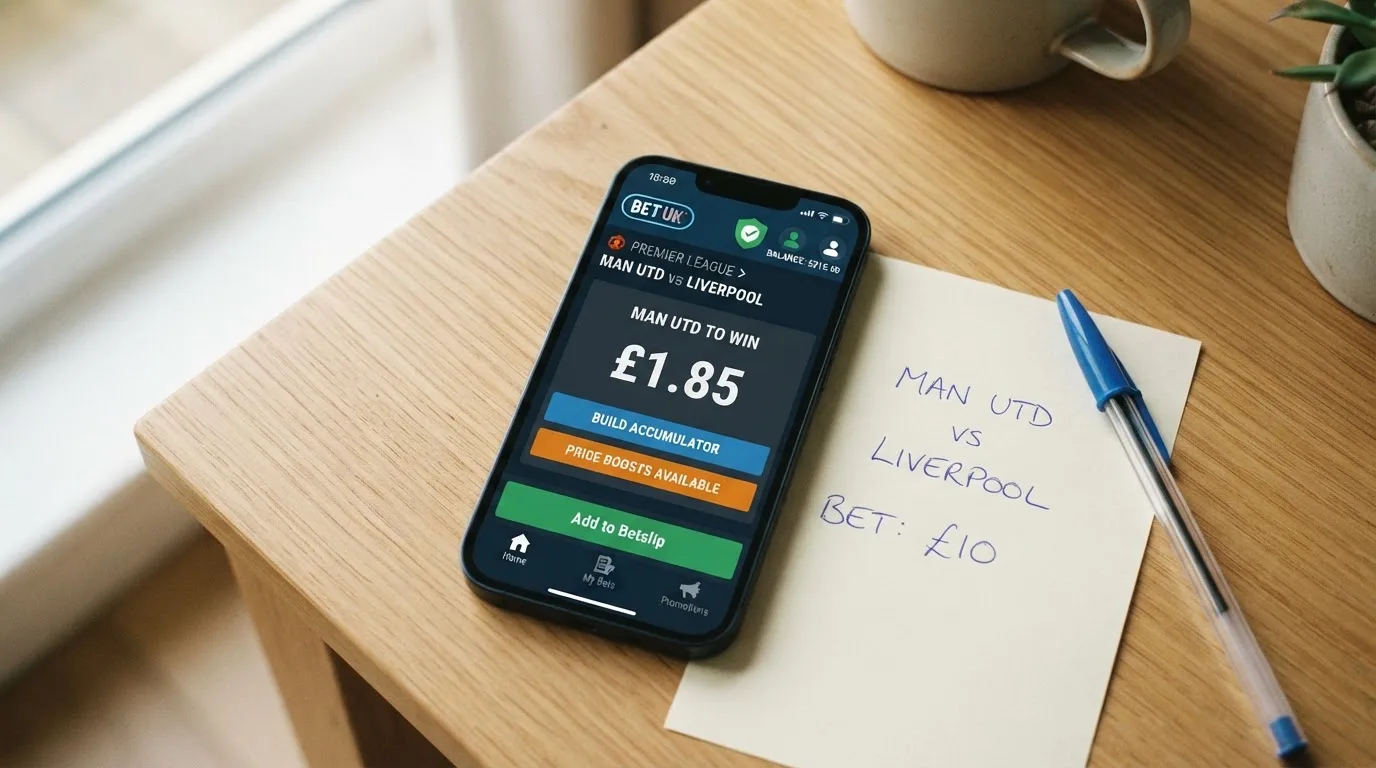
An accumulator multiplies the prices of its legs into one price, and the stake rides once on the combined outcome. A £10 treble at 2.00, 3.00 and 4.00 carries decimal odds of 24.00 — a £240 return on a winning night, nothing at all on a losing one. A bet builder stitches markets from one fight into a single price the same way, which is why a builder with five legs reads as a short accumulator even when the betting slip calls it a single. Boxing lends itself to builders: method of victory, round of stoppage, total rounds over or under a line, fighter to score a knockdown — all of them can be tied together, all of them multiply their margins together, and the price the punter sees is rarely as generous as the leg-by-leg prices would suggest.
Where the price moves
Three things shift a boxing price between the open and the first bell. Weigh-in news — a fighter missing weight, looking drawn, looking heavy — moves the line as soon as the news lands. Late money — a respected punter or a syndicate laying the favourite — moves the line the other way. Late rule changes — a contestant substitution, a venue move, a commission ruling — move the line sharply because the underlying information changes. UK bookmakers handle weigh-in moves with a mixture of price-line changes and, in extreme cases, suspension of the market; the punter who took an early price on a fighter and watched him fail the weigh-in usually sees the bet voided under the operator’s rules, not paid out at the original price.
Spread betting versus fixed odds
Spreadex runs two products under one roof. Fixed-odds boxing is regulated by the Gambling Commission and behaves like any other bookmaker’s price. Spread betting on boxing is regulated by the Financial Conduct Authority, and the unit staked is multiplied by how wrong the spread is when the fight ends, in either direction. A losing spread bet on a heavyweight favourite can cost more than the original deposit — the FCA requires Spreadex to flag that point plainly, and the rule is that a spread account must be funded to cover the maximum possible loss before the bet is placed. A punter who only ever wants a price and a payout should stay on the fixed-odds side; a punter who wants to trade the fight in-running can use the spread side, with eyes open.
The legal frame a UK punter actually bets under
Great Britain does not keep a list of permitted sports. Boxing sits inside the same regime as football, tennis and darts: an operator serving customers in Great Britain needs a Gambling Commission licence, and the Commission’s public register is the whole test of who holds one. The Gambling Act 2005 — as amended by the Gambling (Licensing and Advertising) Act 2014 — sets the rule: an operator whose remote facilities are used in Great Britain needs a Commission licence wherever it is based. A Curaçao licence, a Maltese licence, a Gibraltar licence is not a substitute; it does not put the operator on the register and it does not give the punter any of the protections the Act attaches to a licence.
The licence categories on the register that matter for boxing are remote general betting standard (real events) for ordinary bookmakers and remote betting intermediary for exchanges like Matchbook. Both categories let the holder post prices on real sporting events under the operator’s own house rules and the Licence Conditions and Codes of Practice. There is no statutory list of markets: a Commission-licensed bookmaker decides which fights it prices and which method-of-victory markets it offers, and the Commission’s role is to police the licence conditions, not the catalogue.
A spread betting licence for non-financial products sits with the General Betting Duty regime; a financial spread betting licence sits with the Financial Conduct Authority and is a separate regulatory track. A punter betting with Spreadex on a boxing fight on its fixed-odds product is dealing with a Commission-licensed bookmaker; the same punter betting on the spread product is dealing with an FCA-regulated firm, and the rules are different. Both are legitimate; both are open to UK customers; the licence behind the product is the one that decides which rules apply.
Northern Ireland is outside the Gambling Act 2005 and runs on older legislation; a “GB-licensed” bookmaker is licensed for England, Scotland and Wales, not for Northern Ireland, and the page should be read on that basis. Most major operators either hold a separate Northern Irish licence or restrict NI customers to certain products; the Commission’s register is the place to check, and the punter is the one who checks it.
What a licence actually does for the punter
A Commission licence gives the punter four things an unlicensed site does not. GAMSTOP coverage — every GB-licensed online operator is part of the national self-exclusion register, and a punter who has self-excluded cannot deposit, bet or claim a bonus at any of them until the exclusion runs out. Dispute resolution — a licensed operator belongs to an approved alternative dispute resolution (ADR) body, and a complaint that the operator’s own service cannot resolve can be escalated. Source-of-funds protection — the operator must follow anti-money-laundering rules, verify identity before the first deposit, and ask further questions when spending patterns warrant. Bonus discipline — since 19 January 2026, the Commission’s marketing rules cap wagering requirements on bonuses at 10x the bonus amount and ban mixed-product promotions (an offer that ties betting to casino, bingo or lottery activity).
A licence also takes things away. Identity verification before the first deposit is mandatory under the Commission’s rules and has been since 7 May 2019; a punter cannot deposit anonymously at a licensed site, and a free bet or bonus is treated as gambling for verification purposes. Credit cards are banned for gambling since 14 April 2020; debit cards, bank transfers and most e-wallets are fine. Financial vulnerability checks — public-record checks such as county court judgments and bankruptcy orders, not credit reference checks — apply once a customer’s net deposits in a rolling 30 days exceed £150 (in force since 28 February 2025). None of this is a reason to avoid a licensed site; it is the cost of the protection.
What an unlicensed site costs the punter
The Commission does not license every operator that serves a UK punter. An unlicensed site that accepts UK customers breaks section 33 of the Gambling Act 2005; the offence is aimed at the operator, not at the punter. A punter using such a site gives up the four protections above — no GAMSTOP, no ADR route, no Commission complaint, no British consumer redress if funds are withheld — and inherits the operator’s own house rules on bonus terms, payout times and dispute handling. The Commission’s enforcement is disruption, not blocking: cease-and-desist notices, search-engine referrals, work with registrars, hosts and payment providers; the Commission has, or is about to receive, court-order DNS blocking powers, but ISP-level blocking is not the picture at the moment.
Crypto-only and other unlicensed sportsbooks that accept UK customers do not state anything useful for the reader beyond their own terms. The page covers crypto deposits as a payment topic below; the legal point here is the binary one: GB-licensed, with all four protections; unlicensed, with none.
Safer gambling tools a UK punter can use today
The Commission’s player-protection regime is built around three layers. GAMSTOP is the national multi-operator online self-exclusion scheme; periods are six months, one year, five years, or five years with auto-renewal, and after the minimum period the exclusion stays in place for a further seven years unless the customer asks GAMSTOP to remove it. GAMSTOP covers online sites and apps; betting shops use a separate service. Deposit limits are mandatory on a fixed-time-frame basis since 31 October 2025; a second phase was postponed to 30 September 2026 and whether it is live at the time of reading needs to be checked. There is no state-set deposit or loss ceiling — the limits are the customer’s choice, set in the operator’s safer-gambling settings. Financial vulnerability checks — public-record checks for county court judgments, bankruptcy orders and similar — apply once net deposits in a rolling 30-day window exceed £150; financial risk assessments (the “affordability checks” of the press) were announced by the Commission on 7 July 2026 in a staged plan with no start date, so the page records them as announced, staged, no start date, not in force.
Help is independent of the operator. GamCare runs the National Gambling Helpline. GambleAware funds treatment and the NHS clinics. Gamblers Anonymous runs peer-support meetings. NHS gambling clinics offer cognitive behavioural therapy on referral. None of these is a substitute for a service in the bookmaker’s safer-gambling tab, but the page should record them as the route a punter takes when those settings stop being enough.
The frame a sober gambler reads this in: the tools exist, they work, they are mandatory at licensed operators, and they are not the only layer. The punter who recognises the early signs of harm — chasing losses, hiding spend, betting not for entertainment but for relief — has a path to help that runs through GamCare first and the operator’s safer-gambling team second.
Crypto and boxing: what the UK market actually allows
UK-licensed bookmakers do not take cryptocurrency deposits. The Commission’s payment rules cover debit cards, bank transfers, e-wallets and a few niche methods; the only payment method explicitly banned for gambling is the credit card. Crypto sits outside that list, but it also sits outside the licensed bookmakers’ deposit pages; the licensed operators in this comparison all deposit in sterling through regulated payment service providers. A punter who holds bitcoin, ethereum or any other coin and wants to bet on a boxing fight has three paths in front of him.
Path one is the GB-licensed bookmaker with a normal sterling deposit. The punter buys the coin, sells it for pounds through a UK-regulated exchange, and deposits the pounds. The punter pays capital gains on the disposal if the coin has appreciated, which is a tax fact, not a gambling fact. The bookmaker sees a sterling deposit from a UK payment method, verification happens under the Commission’s rules, and the punter gets every protection the licence carries.
Path two is the offshore sportsbook that takes crypto and accepts UK customers without a Commission licence. The punter sends bitcoin from a self-custody wallet, settles in bitcoin or in a stablecoin, and bets on the same fights at broadly similar prices. The punter gives up GAMSTOP, the ADR route, the Commission’s complaint route, the bonus cap and the £150 vulnerability check. The punter also takes the exchange-rate risk: a winning bet paid in bitcoin that drops 5% against the pound before withdrawal pays less than the betting slip suggested. This is the path the rest of the page describes as “unlicensed” — it is open, it is not illegal for the punter, and it is not what the page recommends.
Path three is the betting exchange. Matchbook, a Commission-licensed betting intermediary, accepts pound deposits through normal UK payment methods and lets the punter back or lay a fight at prices set by other users. The punter who wants the “exchange” feel without the offshore exposure can get it from Matchbook, with the licence behind it.
The mechanics the punter should know, regardless of path: crypto transactions settle on a public ledger, but the punter’s identity on that ledger is a wallet address, not a name. A licensed operator that took crypto would still have to verify identity under the Commission’s rules, and the verification breaks the ledger’s pseudonymity at the deposit point. The punter who wants pseudonymity has to use an operator that does not verify identity — and that is precisely the operator without a Commission licence.
Bonuses and free bets on a boxing card
UK bookmakers do not publish bonus terms in plain English on the front page. The Commission’s marketing rules, in force since 19 January 2026, cap wagering requirements on bonuses at 10x the bonus amount — a £10 bonus at 50x wagering needed £500 of qualifying bets, which is now banned; under the cap no more than £100 of qualifying bets is needed. The rules also ban mixed-product promotions: an offer that requires gambling on two or more product types such as betting, casino, bingo and lottery — for example, “bet £10 on football to get free spins” — is no longer allowed at GB-licensed operators. Free bets without a wagering condition are outside that cap, and no cap on the money value of a bonus itself was found in the published rules.
What the punter sees on a boxing card is one of four shapes. A fixed-odds free bet — the operator credits the punter’s account with a free bet token, the punter places a bet with the token, and a winning bet pays the winnings only (the stake is not returned). The headline “£40 in free bets” on Unibet’s sports welcome offer for new GB customers is a fixed-odds free bet of that shape: a deposit and sports bet of £20 or more at minimum odds of 2.0 (1/1), with the free bets expiring within 7 days of issue. A stake-back free bet on a losing first accumulator — Hollywoodbets’ sports welcome offer pays the stake back as a free bet of up to £30 on a first qualifying losing accumulator (stake £10+, three or more legs, odds of 4/1 or greater, settled within 7 days), one free bet per customer. An enhanced-odds or price-boost offer — the operator offers a bigger price than the screen price for one specific fight or one specific accumulator; the boost usually caps the stake at a small number and pays the boost in cash, not as a free bet. An accumulator insurance offer — a refund as a free bet if one leg of an accumulator loses; the refund is usually capped and is a free bet, not cash.
The maths behind each shape is worth doing. A £10 free bet at decimal odds of 4.00 pays £40 in winnings, not £50, because the stake is not returned; a winning £10 cash bet at the same odds pays £50. The “free” bet is worth £30 on a winning night, in that single bet, and is worth £0 on a losing one. The expected value of the free bet over a long run is the free-bet amount times (odds minus 1) divided by odds times the payout share of the market — for a £10 free bet at 4.00 on a market with a 95% payout share, that works out to roughly £7.13. The punter who uses a free bet on a long price gets more from it than the punter who uses it on a short price, because the stake-not-returned rule hurts more on a short price.
The marketing word “free” deserves a flat reading. The free bet is free to take — the punter does not pay for the token — but the punter pays for it in the stake-not-returned rule, the expiry, the minimum odds, and the market the operator routes the book onto. A £40 free-bet bundle with a 7-day expiry on minimum-odds 2.0 markets is a £40 headline and a smaller value in the punter’s pocket.
The expiry is the silent cost
Every free bet in the comparison expires. Unibet’s sports free bets expire within 7 days of issue; Coral’s expire 7 days after issue; Hollywoodbets’ stake-back free bet is on a first qualifying bet settled within 7 days. The punter who opens an account on the morning of a fight and forgets to use the free bet by the following Saturday has lost the bundle in full. The expiry is the silent cost of every welcome offer: the punter pays for the bonus in attention, not just in wagering.
Mobile apps and the boxing card
UK boxing punters bet on phones more than on any other device. The Commission’s app rules are the same as the website rules — the licence covers both — but the practical experience differs. bet365 is described in its UK app store listing as the most downloaded sports betting app in the UK and as the official global betting partner of the UEFA Champions League. DragonBet publishes its own app with Welsh football, Welsh rugby, racing, American football, in-play betting and bet builder markets. Betfred publishes an app that covers 21 sports plus over 2,000 casino-style games under one Done Brothers (Cash Betting) Ltd login. Lottoland UK runs an app that combines casino, lottery betting, sports betting and scratchcards under one Gambling Commission licence.
The features a boxing punter actually uses on a phone are four. In-play betting — placing a bet between rounds, or after a knockdown, at the new screen price. Cash out — closing a bet early at a price the operator offers, locking in a profit or a smaller loss. Live streaming — watching the fight inside the app while the bet rides. Bet builder — combining markets from one fight into one bet, useful on cards with a few short-priced favourites and a long method-of-victory tail.
bet365’s app carries Bet Builder+, which combines markets from one event into a single bet pre-match or in-play; Winnings Boosts on Bet Builders and selected singles; Super Boosts and daily Bet Boosts; in-play betting with live streaming; Bet Track, Match Live and a Live Golf Tracker for following bets in play. The reader should read that list as a feature catalogue rather than a value judgement; other apps carry similar features in different shapes, and the deciding factor for a punter is usually the price on the fight he wants to bet on.
The browser-versus-app split
A punter who bets once a month on a PPV fight usually uses a browser. A punter who bets weekly on undercards and in-play usually uses an app for the live picture, the cash-out button and the biometric login. The Commission’s rules do not prefer one over the other; the punter’s pattern picks. The page should not pretend the app is “better” — it is faster for in-play, slower for research, and that is the trade-off.
Live betting and cash out on a boxing night
Live betting on boxing is sharper than live betting on most sports because the action is not continuous. Rounds are three minutes long; rests are one minute; between rounds the bookmaker re-prices the fight; after a knockdown the price moves dramatically; a corner stoppage between rounds closes the fight and the market settles. Midnite shows in-play events, an acca builder, popular accas and price boosts with maximum-stake limits on its UK site, and is licensed by the Commission under account 101839. bet365 carries in-play betting and live streaming on events worldwide. Matchbook runs in-play on its exchange with customers betting against each other rather than against the book.
The mechanics of a live bet on a boxing fight are the same as the mechanics of a pre-fight bet at a smaller price. The price offered between rounds reflects the action so far; a fighter who lost a round clearly is a bigger price than he was at the bell; a fighter who scored a knockdown is a smaller price. The punter who backs a fighter at a bigger price after a knockdown is betting on a recovery; the punter who lays a fighter at a smaller price after a knockdown is betting on a stoppage. Both are legitimate; both depend on the punter reading the action more accurately than the trader who set the price, which is harder than it sounds.
Cash out is the operator’s offer to close the bet early at a price that reflects the current state of the market minus the operator’s slice. A £10 bet at 4.00 on a fighter who is winning on the cards might cash out at £15 — the operator pays the punter £15, the bet is closed, and the punter does not need the fighter to win. The cost is the operator’s margin: the cash-out price is worse than the true market price, by enough to make the cash-out button profitable for the operator over a long run. A punter who uses cash out as a discipline tool — locking in a profit on a bet he would otherwise let ride — pays for it in margin; a punter who uses cash out to dodge a loss he suspects is coming pays for it in the same way.
The fight-night sequence the page describes
The punter places a pre-fight bet. The fight starts. The punter watches in-play, the trader moves prices. After a key moment — a knockdown, a cut, a point deduction — the punter either lets the bet ride or uses cash out to close it. The fight ends. The bet settles. The punter’s account is credited. The page describes this in plain prose because the practical order is what a punter learns the hard way, not the marketing description of the feature.
Predictions, tipsters and the punter who is better off without them
There is no honest tipster service for boxing. A punter pays a subscription for a tip; the tip is someone’s opinion; the opinion is sometimes right and sometimes wrong; the price on the opinion is set by the bookmaker, who has more information than the tipster. The market for tipsters on boxing is the same shape as the market for tipsters on football or tennis: the headline record is the tipster’s wins only, the losing tips are quietly dropped, and the punter who follows the tips pays subscription fees for a record the tipster has had years to curate.
The honest framing the page can offer: a tip is an opinion, a price is the market’s view of the same opinion, and a value bet is a price the punter thinks is wrong. The punter who wants to find value bets reads the action, reads the form, reads the weigh-in, and reads the market. The punter who wants tips can buy tips; the page will not advertise any, and the punter who follows a tip is paying for a curated opinion, not for a guaranteed winner.
The Commission’s marketing code applies to tipster services as it does to bookmakers: no tipster may advertise in a way that appeals strongly to under-18s, no one who is or seems to be under 25 may feature in the marketing, and the tipster is responsible for the accuracy of any claim. The code is the floor; the honest tipster stays well above it.
Stats and form a punter can read himself
A punter who wants to read a fight for himself has more information than any tipster. The boxer’s record: wins, losses, draws, knockout ratio. The opponent’s record: same shape. The weight they fought at last time; the weight they weighed in at this time. The sanctioning body’s title history. The judges’ scorecards from the last three fights. The number of rounds the fighter has gone in his last three fights. The corner team and the trainer. None of this is secret, and the punter who reads it for an hour has a better picture than the punter who reads a tip.
The page’s verdict on tipsters: useful as one input among many, dangerous as a substitute for the punter’s own reading. The punter who follows a tip without checking the price takes the tipster’s view and the bookmaker’s price together; the punter who checks the price against the tip takes the tip only when the price looks wrong.
Markets, bet types and how to read a boxing betting slip
A boxing betting slip carries more markets than a football slip, and the markets are structured differently. The three-way moneyline — fighter A to win, draw, fighter B to win — is the headline line. The two-way moneyline drops the draw and prices only the two fighters; it is common on heavyweight cards where a draw is statistically rare. Method of victory prices knockout, technical knockout, decision, technical decision and draw; the line can run to 12 outcomes on a championship fight. Round of stoppage prices each round as a separate outcome, often grouped (rounds 1–3, 4–6, 7–9, 10–12) to keep the line manageable. Total rounds prices over under a line such as 8.5 rounds; the bet is on whether the fight goes past that line. Go the distance is a yes/no market on whether the fight is decided on the judges’ scorecards. Knockdown scored is a yes/no market on whether either fighter scores a knockdown. Fighter to win inside the distance is a yes/no market on a knockout or technical knockout, with separate prices for each fighter. Bet builder combines any of the above into a single price at the punter’s risk.
The settlement rules matter. A knockout stops the fight; the method-of-victory market settles on the round the fight was stopped. A technical knockout is a stoppage by the referee, doctor or corner; the method-of-victory market settles on technical knockout, not knockout, and the round of stoppage market settles on the round the fight was stopped. A decision is the judges’ scorecards; the method-of-victory market settles on decision, and the round of stoppage market settles on “decision” — a “no” on every round. A disqualification settles on disqualification; the bet on a slip inside the distance is a loser.
A draw is when the judges give both fighters equal scores. The three-way moneyline has a draw as a third outcome; the two-way moneyline treats a draw as a push and refunds the bet under most operators’ rules. A push is the punter’s friend; the punter’s stake returns and the bet is closed.
The settlement order on a fight with a late rule change — a substitution, a catchweight, a venue move — is operator-specific. The punter who takes an early price on a fighter and watches the fight move to a catchweight usually has the bet voided under the operator’s rules; the punter who takes the price after the rule change takes the new price and the new risk together.
A short reading guide for a boxing slip
The punter reads the headline price on the three-way line first. The punter reads the margin on that line by adding the implied probabilities; if the total is below 100%, the margin is in the punter’s pocket and the punter should look elsewhere. The punter reads the method of victory market next and checks that the prices look plausible against the form. The punter reads the round of stoppage market and checks that the prices look plausible against the fighters’ typical finishing rounds. The punter reads the bet builder price last and checks it against the leg-by-leg prices; a builder with five legs at 2.00, 3.00, 4.00, 5.00 and 6.00 should read at 720, not 600, and the difference is the operator’s slice.
The punter who reads the slip this way takes longer to place the bet, places fewer bets, and pays less margin on each one. The page records this as the standard reading order and leaves the punter to decide how strictly to follow it.
Boxing tournaments and what to bet on this season
Professional boxing runs year-round under the four sanctioning bodies: the WBA, WBC, IBF and WBO. Each body sanctions a world championship in each of the seventeen weight classes from strawweight to heavyweight, plus a few “super” and “interim” titles that complicate the picture. The bodies do not run a single global tour; promoters and broadcasters stage the fights, the sanctioning body approves the title, and the operator prices the fight the same way it would price any other match.
A professional boxing bout usually runs 10 to 12 rounds, with four-round fights common for newer fighters. Each round lasts three minutes with a one-minute rest between rounds. The number of rounds matters for the punter: the total-rounds market settles on the round the fight ends, the round-of-stoppage market settles on the same round, and a fight scheduled for four rounds has a much narrower range of total-rounds outcomes than a fight scheduled for twelve.
Major UK-facing cards
The UK-facing card the punter sees depends on the broadcaster and the promoter. Sky Sports, TNT Sports, DAZN and BBC broadcast fights from the four bodies; the punter who wants to bet in-play usually needs a subscription to the broadcaster because most operators do not stream fights inside the betting app. The card the punter bets on is the card the punter can watch; a punter with a Sky Sports subscription can bet in-play on Sky Sports fights through a bookmaker that streams them, and the in-play experience is much sharper than betting blind.
The page records the structure rather than the schedule: fights happen, the four bodies sanction them, the promoters stage them, bookmakers price them, and the punter bets on what he can see.
Top UK boxing bookmakers and how they compare
The ten operators below hold a Gambling Commission remote betting licence and are licensed for real-event betting in Great Britain. Every licence number is a public record on the Commission’s register, and the reader should verify the licence on the register before depositing — the Commission is the only authority that grants these licences and the register is the only place the licence is recorded. The reader should also check the licence holder’s name; several brands run under one licence holder (LC International Limited runs Coral, for example) and the reader should know which legal entity sits behind the brand he is betting with.
The table below sets out the operator, the Commission licence number, the licence holder, and the operator’s own terms on the key topics this page covers. Where a fact could not be confirmed, the cell is left blank rather than dressed up.
| Operator | Gambling Commission licence | Licence holder | What the operator’s own terms state |
|---|---|---|---|
| BoyleSports | 039469-R-319383-025 (account 39469) | Boylesports Enterprise | Sports welcome offer for UK players: £20 in free bets when a £10 bet is placed (€30 in free bets for a €10 bet for Irish players). |
| Hollywoodbets | 053028-R-330019-013 (account 53028) | Hollywoodbets International UK Limited | Sports welcome offer: new players who deposit £10 or more by card get their stake back as a free bet of up to £30 on their first qualifying losing accumulator (stake £10+, 3+ legs, odds of 4/1 or greater, settled within 7 days); one free bet per customer. |
| Bet600 | 044731-R-323941-016 (account 44731) | Tyche Tech Limited | Pays Best Odds Guaranteed on horse racing: if the starting price is bigger than the early or show price taken, the bet is paid at the SP. |
| Tote | 054779-R-331321-008 (account 54779) | TDCO Limited | Pays Best Odds Guaranteed on UK and Irish horse racing from 8 AM on the day of the race, on single and multiple bets; not on ante-post, tote or pari-mutuel bets. |
| Unibet | 045322-R-324275-019 (account 45322) | Platinum Gaming Limited | Operated since 1999. Sports welcome offer for new GB customers: £40 in free bets when you bet £20 (deposit and sports bet of £20+ at minimum odds of 2.0/1/1, debit card or instant bank transfer), free bets expire within 7 days of issue. |
| Coral | 054743-R-330863-014 (account 54743) | LC International Limited | Sports welcome offer for new GB customers who opt in: £40 in free bets when you bet £20 (deposit and sports bet of £20+ at minimum odds of 2.0/1/1), £40 free bets issued within 7 days and expire 7 days after issue. |
| DragonBet | 064908-R-339041-003 (account 64908) | DragonBet Ltd | App published by DragonBet Ltd; markets include Welsh football and rugby, racing, American football, in-play and bet builder. |
| DAZN Bet | 048756-R-327274-019 (account 48756) | DZBT Limited | Deposits start at £5 by debit card, Apple Pay, Paysafecard, Trustly and Skrill, and at £20 by PayPal, with no processing fees. |
| Matchbook | 039504-R-319407-024 (account 39504) | Triplebet Limited | Betting exchange where customers bet against other users; Bet Builder, multiples, in-play betting and live streaming of horse racing and greyhounds. |
| Betfred | 039544-R-319290-010 (account 39544) | Petfre (Gibraltar) Limited | App covers 21 sports plus over 2,000 casino-style games; published by Done Brothers (Cash Betting) Ltd. |
The ten operators sit in three rough groups, and the punter’s choice depends on which group fits his pattern. The big-brand group — bet365, William Hill, Coral, Ladbrokes, Paddy Power, Betfair, Betfred — runs the deepest cards, the slickest apps and the most aggressive welcome offers, and trades on volume rather than margin. The specialist group — BoyleSports, Hollywoodbets, DragonBet, DAZN Bet — runs narrower cards with sharper prices on the markets they cover, and trades on a regional or sport-specific audience. The exchange group — Matchbook — runs prices set by users rather than by traders, with a commission on net winnings instead of a margin baked into every price. Each group suits a different punter, and the comparison below reads them in that order.
BoyleSports
BoyleSports holds a Commission licence under account 39469 and the licence holder is Boylesports Enterprise. The sports welcome offer for UK players is £20 in free bets when a £10 bet is placed; Irish players get €30 in free bets for a €10 bet. The shape of the welcome offer is a fixed-odds free bet of modest value — £20 in free bets is at the lower end of the comparison, and the qualifying bet is a £10 single at minimum odds the operator sets in its terms. BoyleSports is a long-established Irish bookmaker that serves UK customers through its .co.uk site; the punter who wants a familiar Irish-UK product and does not need a deep in-play catalogue will find it here, and the punter who wants the deepest possible card will look elsewhere. The licence check is the same as for any other operator on the comparison: the Commission’s public register, account 39469, licence holder Boylesports Enterprise.
Hollywoodbets
Hollywoodbets holds a Commission licence under account 53028 and the licence holder is Hollywoodbets International UK Limited. The sports welcome offer is a stake-back free bet of up to £30 on a first qualifying losing accumulator: new players deposit £10 or more by card, place an accumulator with stake £10+, three or more legs, odds of 4/1 or greater, settled within 7 days; if the bet loses, the stake comes back as a free bet, capped at £30, one free bet per customer. The shape is unusual — most welcome offers pay free bets for a winning first bet, not for a losing one — and it suits a punter who likes accumulators and is willing to risk the first one for a stake-back. Hollywoodbets is a South African bookmaker with a strong UK presence on horse racing and a growing sports catalogue; the punter who wants a stake-back accumulator offer and a familiar product will find it here. The licence check is the same: account 53028, holder Hollywoodbets International UK Limited.
Bet600
Bet600 holds a Commission licence under account 44731 and the licence holder is Tyche Tech Limited. The operator pays Best Odds Guaranteed on horse racing: if the starting price is bigger than the early or show price taken, the bet is paid at the SP. The shape is a BOG-only operator on horse racing, with a sports book on top; the punter who bets primarily on horse racing and wants the BOG promise will find it here, and the punter who wants the deepest boxing card will look elsewhere. BOG is a horse-racing feature rather than a boxing one, but the operator’s pricing on boxing sits in the same book and the licence covers the same products. The licence check: account 44731, holder Tyche Tech Limited.
Tote
Tote holds a Commission licence under account 54779 and the licence holder is TDCO Limited. The operator pays Best Odds Guaranteed on UK and Irish horse racing from 8 AM on the day of the race, on both single and multiple bets; it does not apply to ante-post, tote or pari-mutuel bets. Tote is the pool-betting brand the punter sees on UK and Irish racing; the BOG promise runs alongside the pool product, and the sports book sits underneath. The punter who wants a familiar pool product on UK and Irish racing with a BOG safety net on singles and multiples will find it here; the punter who wants a deep boxing card will look elsewhere. The licence check: account 54779, holder TDCO Limited.
Unibet
Unibet holds a Commission licence under account 45322 and the licence holder is Platinum Gaming Limited, Gibraltar. The brand states it has operated since 1999. The sports welcome offer for new GB customers is £40 in free bets when you bet £20: a deposit and sports bet of £20 or more at minimum odds of 2.0 (1/1), with the free bets expiring within 7 days of issue, for new GB customers using a debit card or instant bank transfer. The shape is a standard fixed-odds free bet bundle — £40 in free bets for a £20 qualifying bet at evens or bigger — and the 7-day expiry is the silent cost a punter should plan around. Unibet is a long-established European bookmaker with a deep in-play catalogue and a polished app; the punter who wants a familiar product and a £40 welcome bundle will find it here. The licence check: account 45322, holder Platinum Gaming Limited.
Coral
Coral holds a Commission licence under account 54743 and the licence holder is LC International Limited — the same licence holder that runs Ladbrokes, and the reader should know that several brands can sit behind one holder. The sports welcome offer for new GB customers who opt in is £40 in free bets when you bet £20: a deposit and sports bet of £20 or more at minimum odds of 2.0 (1/1), with the £40 in free bets issued within 7 days and expiring 7 days after issue. The shape is identical to Unibet’s headline — £40 for £20 at evens — and the two are competing offers on the same shape. Coral is a long-established UK high-street bookmaker with a deep sports catalogue and a polished app; the punter who wants a £40 welcome bundle and a familiar high-street brand will find it here. The licence check: account 54743, holder LC International Limited.
DragonBet
DragonBet holds a Commission licence under account 64908 and the licence holder is DragonBet Ltd. The app is published by DragonBet Ltd and carries Welsh football, Welsh rugby, racing, American football, in-play betting and bet builder markets. The shape is a regional bookmaker with a Welsh identity and a sports book on top; the punter who wants a regional product with a Welsh focus and a bet builder will find it here, and the punter who wants the deepest boxing card will look elsewhere. The punter should read the licence holder — DragonBet Ltd — as the entity he is dealing with, and the Commission’s register as the place to verify it. The licence check: account 64908, holder DragonBet Ltd.
DAZN Bet
DAZN Bet holds a Commission licence under account 48756 and the licence holder is DZBT Limited. Deposits start at £5 by debit card, Apple Pay, Paysafecard, Trustly and Skrill, and at £20 by PayPal, with no processing fees. The shape is a broadcaster-backed bookmaker with low deposit minimums across most methods and a £20 minimum on PayPal; the punter who wants a low deposit floor and a broadcaster-backed product will find it here. DAZN is a sports broadcaster with a betting arm, and the integration between the two is the operator’s selling point. The licence check: account 48756, holder DZBT Limited.
Matchbook
Matchbook holds a Commission licence under account 39504 and the licence holder is Triplebet Limited. The operator is a betting exchange where customers bet against other users; the products include Bet Builder, multiples, in-play betting and live streaming of horse racing and greyhounds. The shape is fundamentally different from the rest of the comparison: the punter backs or lays at prices set by other users, pays a commission on net winnings instead of a margin baked into every price, and gets the exchange’s depth on liquid markets. The punter who wants to lay a favourite, who wants a sharper price on a liquid fight, or who wants the exchange feel without going offshore, will find it here. The licence check: account 39504, holder Triplebet Limited.
Betfred
Betfred holds a Commission licence under account 39544 and the licence holder is Petfre (Gibraltar) Limited. The Betfred Sports, Casino & Games app is published by Done Brothers (Cash Betting) Ltd and covers 21 sports plus over 2,000 casino-style games. The shape is a high-street bookmaker with a deep sports catalogue and a casino product underneath the same login; the punter who wants a familiar UK high-street brand with a one-login product will find it here. The licence check: account 39544, holder Petfre (Gibraltar) Limited, and the reader should know that the Gibraltar holder is a separate legal entity from the Done Brothers (Cash Betting) Ltd that publishes the app.
Where the comparison lands
The punter who wants the deepest card and the slickest in-play product should look at the big-brand group; the punter who wants a regional or specialist product with sharper prices on the markets they cover should look at the specialist group; the punter who wants to back and lay at user-set prices should look at Matchbook. The welcome offer is a poor guide to long-run value: every offer in the comparison is a fixed-odds free bet of modest value with a 7-day expiry, and the punter who chases the biggest bundle pays for it in the qualifying bet, the minimum odds and the market the operator routes the bundle onto.
The honest verdict the page can offer: BoyleSports, Hollywoodbets, Unibet, Coral and Betfred are interchangeable on the welcome-offer shape, with different qualifying terms and different catalogues underneath; DragonBet and DAZN Bet are regional or broadcaster-backed products with different emphases; Bet600 and Tote are horse-racing-led operators with a sports book on top; Matchbook is the exchange. The punter’s choice is the catalogue and the licence holder, not the welcome bundle.
Frequently asked questions on boxing betting odds
How do you bet on boxing?
Pick a licensed UK bookmaker, register an account, verify your identity before the first deposit, deposit by debit card or bank transfer, navigate to the boxing section, pick a fight, pick a market (three-way moneyline, method of victory, round of stoppage, total rounds), enter a stake, and place the bet. The bet settles when the fight ends; a winning bet pays the stake plus winnings, a losing bet pays nothing, and a push (a draw on a two-way line) refunds the stake under most operators’ rules.
How does boxing betting work in the UK?
Boxing betting in Great Britain sits inside the Gambling Act 2005 and the Commission’s remote betting regime. An operator serving UK customers needs a Gambling Commission licence wherever it is based; the licence covers remote general betting standard (real events) for ordinary bookmakers and remote betting intermediary for exchanges. Bonuses are capped at 10x wagering since 19 January 2026, credit cards are banned for gambling, identity is verified before the first deposit, and GAMSTOP self-exclusion covers every licensed online operator.
How do you bet on boxing online?
The same way as above — through a licensed online bookmaker or exchange, on a browser or through the operator’s app. The Commission’s rules apply to both channels. In-play betting on a boxing fight is sharper than on most sports because the action is not continuous: prices move between rounds, after knockdowns and on corner stoppages, and the punter who bets in-play needs a smartphone, a funded account and a fast connection.
How can a punter check that a bookmaker holds a Gambling Commission licence?
The Commission’s public register is the whole test. Search by business name, trading name, domain or account number; the register lists the licence number, the licence holder, the licence categories and the licence status. The punter should check the licence holder’s name against the brand name on the betting site, and the licence categories against the products the site offers. A licence that does not appear on the register is not a Commission licence, and an operator claiming one without a register entry is making a false claim.
How is the return on a bet worked out from the stake and the odds?
At decimal odds of O and a stake of S, the return is S × O and the net profit is S × (O − 1). At fractional odds of a/b, the decimal price is a ÷ b + 1, so 5/1 is 6.00, 11/4 is 3.75, and evens is 2.00. For a combination bet the odds of the legs multiply into one price and the stake rides on the combined outcome; a treble at 2.00, 3.00 and 4.00 carries decimal odds of 24.00 and pays 24 × the stake on a winning night.
What is the bookmaker’s margin and how can it be seen in the odds?
The margin is the slice of every pound staked that the bookmaker keeps on average, no matter who wins. It is the difference between 100% and the payout share of the book. The payout share on a two-way market is 1 ÷ (1 ÷ odds on outcome 1 + 1 ÷ odds on outcome 2); the margin is 1 minus that. On an illustrative two-way line at 1.90 against 1.90, the implied probability on each side is roughly 52.6%, the payout share is 95.0%, and the margin is 5.0%. On a three-way line the band rises to 7% to 10%; on a long-tail method-of-victory market it rises again, often past 12%. The punter reads the margin by adding the implied probabilities across all outcomes of that market on that event; a total below 100% is the operator’s edge.
Combat & motorsport – Best betting
Content created by the «Best betting» team
