
A bettor's guide to online handball betting in Great Britain
 Available in US
Last checked against the Gambling Commission’s public register and the operators’ own terms on 27 October 2026. The data covers licence status, welcome-offer mechanics and market shape; it does not include fixture-by-fixture prices, which move from the moment the trader publishes them.

Handball is a small-ball sport in a small market. The big UK bookmakers price it, the smaller ones leave gaps, and the betting exchange sits beside both as a third way in. Where a punter lands depends less on a single price than on the shape of the menu: which match outrights appear, how deep the totals and handicaps run, whether in-play actually functions on a Tuesday night German Bundesliga fixture, and what the welcome and recurring offers really cost once the small print is read. This page works through that ground.
The legal frame: who is licensed, and what that licence buys the customer
Every commercial bookmaker taking bets from customers in Great Britain needs a Gambling Commission licence. That has been the position since the Gambling (Licensing and Advertising) Act 2014 amended the Gambling Act 2005: the test is where the customer is, not where the operator is based, so a Gibraltar- or Malta-based brand serving GB customers must hold a GB licence. A Curaçao or similar offshore licence is not a substitute, and advertising to GB customers without one is an offence aimed at the operator under section 33 of the 2005 Act.

What the licence actually buys is a defined bundle of duties. The Commission’s public register is the whole test of who holds one: it can be searched by business name, trading name, domain or account number, and a brand listed against a category such as remote general betting standard (real events) is licensed for the activity the licence names. No statutory list of permitted sports or markets exists, so a licensed bookmaker’s menu of handball leagues, handicaps and outrights is governed by its own terms and the Licence Conditions and Codes of Practice (LCCP), not by a list the Commission publishes. There is also no statutory cap on stakes, no ceiling on winnings, and no state-set deposit limit: each operator decides those, and any cap on a bonus’s wagering requirement is itself a licence-condition rule, set at 10x since 19 January 2026.
The licence holder’s identity is sometimes the surprise. A single licensee can run several consumer brands: Ladbrokes and Coral sit under LC International Limited, and Paddy Power and Betfair sit under PPB Counterparty Services Limited. The same brand can also move between licensees over time. The check that matters is the one on the register on the day a punter looks, not the one from last year’s terms page.
What the licence does NOT do is make one brand “the only” licensed one. The Commission’s register lists far more operators than any comparison can feature; ten are on this page because they are the ones with a working GB remote licence and a handball market worth a punter’s time, and the rest sit on the register in their own right.
Identity checks and what they mean for the welcome offer
Identity verification runs before the first deposit or bet at every GB-licensed site. The test has been the standard since 7 May 2019: name, address and date of birth, and a free bet or bonus is not a route around it. In practice, the first £10 free bet, the acca insurance and the deposit match all sit behind the same sign-up and verification flow, and a punt on an unlicensed site that skips verification is also a punt outside the Commission’s complaints route, the GAMSTOP self-exclusion scheme and any approved dispute-resolution body. The trade is honesty for anonymity.
In-play betting and what controls it
In-play betting on handball is offered by GB bookmakers, and the controls are operator-level licence conditions plus customer-protection duties, not a statutory prohibition and not a free-for-all. The category the licence names is what governs the activity: a remote general betting standard (real events) licence covers in-play handball, and the bookmaker’s own trading and risk functions decide what stays open between the 30-minute halves. A bookmaker that suspends a Bundesliga match at half time is not breaking the law; it is exercising what the licence lets it do.
Spread betting on handball — a different licence regime
Financial spread betting in Great Britain is regulated by the Financial Conduct Authority, not by the Gambling Commission. Spreadex, for example, runs both fixed-odds sports betting under a Commission licence and spread betting under the FCA, and the firm states that spread betting losses can exceed the deposit. The distinction matters because FCA-regulated spread betting sits outside the Commission’s complaints and redress channels and outside GAMSTOP; a punt on a spread-priced handicap is a contract with the firm, not a bet on a betting exchange.
Safer gambling: what every GB-licensed bookmaker has to do
GAMSTOP is the national multi-operator online self-exclusion scheme and a mandatory licence condition for online operators. Self-exclusion can be set for six months, one year, five years, or five years with auto-renewal, and after the minimum period it stays in place for a further seven years unless the customer asks GAMSTOP to remove it. GAMSTOP covers online sites and apps; betting shops run a separate service. Every brand on this page is a GAMSTOP member, and the brands on the register that are not are not online bookmakers for GB customers in the legal sense.
Since 30 August 2024 a financial vulnerability check has applied to licensed remote betting when a customer’s deposits minus withdrawals exceed £150 in a rolling 30 days (in force since 28 February 2025). The check is a public-record one — bankruptcy, county court judgments — not an income check and not a credit reference check. Wider financial risk assessments (the so-called affordability checks) have been announced in a staged plan with no start date, and writing them as if they were in force would be wrong.
Deposit limits sit on a different rail. Under Remote Technical Standard 12, operators must offer a gross deposit limit on a fixed time frame, and the first changes have applied since 31 October 2025, with a second phase postponed to 30 September 2026. Whether that second phase is live today is not established. The principle is older than the rule: limits are the customer’s, and a punter who wants to cap deposits at £50 a week can set that today on any brand on this page.
Help exists whether the punter uses it or not. GamCare runs the National Gambling Helpline, GambleAware funds treatment and education, the NHS runs regional gambling clinics, and Gamblers Anonymous runs peer-support meetings. A number of the brands on this page, including Fitzwilliam Sports, link to all three on their safer-gambling pages.
Crypto, anonymity and the licensed line at GB
Handball betting with bitcoin, with ether, with USDT and with other cryptocurrencies is a real thing on offshore sites; it is not a real thing on GB-licensed ones. The reason is structural, not ideological. Identity verification runs before the first deposit at every licensed site, which rules out the pseudonymous play that makes crypto attractive, and the licensed banks and payment processors a GB bookmaker relies on do not clear crypto on the way in. A punter who wants to bet on handball from a wallet rather than a bank account is, in practice, betting at an unlicensed site, and that is the line that decides what protections apply.
What that line costs is the rest of the picture. No GAMSTOP coverage, no Commission complaints route, no approved dispute-resolution body, no British consumer redress if funds are held, no bonus wagering cap and no £150 vulnerability check. The argument an unlicensed brand makes for itself is that those checks are exactly what the punter does not want; the argument for the licensed side is that the same checks are exactly what the punter needs when something goes wrong. The honest framing is that neither side is “the safe choice” by default: licensed means checks, limits, GAMSTOP and the bonus cap; unlicensed means none of those protections and a real risk of losing funds the punter cannot recover. Enforcement is not blocking. The Commission issues cease-and-desist notices, works with search engines, registrars, and hosts, and has been given, or is about to receive, court-order DNS blocking powers, but ISP-level blocking of unlicensed sites is not in operation.
Bonuses and free bets on handball: what the headline actually offers
A welcome offer for a new sports customer is one of three shapes. A free bet is paid in bet credits: stake usually not returned, sometimes returned, depends on the terms. A deposit match is paid in bonus funds, which carry a wagering requirement before they become withdrawable cash. A risk-free first bet is most often refunded as a free bet on a loss, not paid back in money; the marketing word “risk-free” should be read with that in mind. Several welcome offers also gate on payment method, qualifying odds, qualifying markets, and a deadline measured in days rather than weeks.
The bonus wagering cap sits at 10x since 19 January 2026, and mixed-product promotions — offers that require gambling on two or more product types such as betting, casino, bingo and lottery — are banned. A £10 bonus at 50x wagering used to mean £500 of qualifying bets; under the cap, no more than £100 of qualifying bets clears that bonus. Whether the cap applies to free bets with no wagering condition, and whether any cap sits on the money value of a bonus, are not established. The number that matters on any individual welcome offer is the unit stake × qualifying bets required, at the minimum price the offer names, with the deadline that the terms name.
What a welcome offer really costs is the expected loss on the qualifying bets, which depends on the margin of the markets the offer steers the punter to. A free bet with no wagering condition has a different cost from a deposit match with the same headline number, and the same headline in pounds does not mean the same offer. The recurring offers — acca insurance, price boosts, free-bet clubs — carry the same logic in miniature, with a smaller stake and the same minimum price, and a punter who reads the small print before the landing page saves the arithmetic twice.
Live betting and cash out: how handball behaves in-play
Handball is a high-scoring, fast-turnover sport: professional teams typically score 20 to 35 goals each across two 30-minute halves, with substitutions and two-minute penalties reshaping the run of play every few minutes. That makes it a natural in-play sport, and the GB bookmakers that price it well run a live menu on the bigger leagues (German Bundesliga, French Starligue, Spanish Liga Asobal, the men’s and women’s Champions League) with markets updating between possessions. The bookmakers that price it thinly run an in-play feed that is a few seconds behind the video, or that suspends at half time and never reopens on a low-tier fixture.
Cash out has its own logic on a live sport. One-click, auto and partial cash out all let a punter close a position before the event settles, and the price offered is the bookmaker’s mid-price less its own commission, with a haircut that is heaviest on volatile markets and tightest on the bigger events. On a sport like handball, where a 3-2 lead can become a 28-25 lead in twelve minutes, cash out has real value as a stop-loss discipline; the same haircut also turns a cash-out-first strategy into a slow bleed of the bookmaker’s margin, and the punter who uses cash out as a default rather than a discipline usually finishes behind.
The streaming question is its own. Several GB bookmakers stream live tennis, NFL and selected football; the bigger ones stream handball video on the bigger fixtures, and the smaller ones do not. Streaming is gated by account status (a positive balance, a settled bet in the last 24 hours, or both) and by geography; a stream that works in London is not guaranteed to work in Scotland. The check that matters is on the specific match page on the day.
Predictions, strategy, and what the tipsters really sell
Handball betting tips, predictions and best bets are a real search category and a crowded one. The honest read is that the edge in any single fixture sits with the trader pricing it, not with a tipster publishing a list, and the long-run return to a tipster’s followers is the margin of the bookmakers they use, less the tipster’s subscription, plus the variance of a small sample. A subscription model that charges for picks is selling access, not certainty.
What a punter can do without a tipster is more useful. Bankroll discipline — a fixed unit stake, a fixed percentage of bank per bet, a stop-loss at a level that ends the week — is the closest thing to an edge that does not depend on knowing who will win. Market selection is the next: a league where the bookmaker prices thinly has a wider margin than a league where four firms compete, and a bet on the cheaper league costs more than the headline odds suggest. Total-goals markets in handball, where the line is set in steps of 1.5 or 2.5 goals, are priced off models that are easier to copy than match-outright models, and a punter with a view on team pace can find an edge there. Handicaps, where the bookmaker sets the line, are priced off the same models and offer the same opportunity.
What none of this is, is a forecast. A strategy does not name the winner; it manages the cost of being wrong.
Bet types and odds on handball
The menu on a settled GB bookmaker’s handball page runs: match outright (1X2 where the draw is offered, or two-way where it is not — handball two-way markets drop the draw and price home and away); totals (over/under on the combined score, lines usually 50.5, 51.5, 52.5 or 55.5); handicaps (a goal-line applied to one side, lines usually ±2.5 or ±3.5); half-time / full-time; race to 20 goals; race to 30 goals; first-half total; player totals at the bigger events. Outrights sit at the tournament level: World Championship winner, European Championship winner, national league winner, Champions League winner. The depth varies; the bigger bookmakers run all of these, the smaller ones run the match outright and a totals line.
Odds appear in fractional and decimal form on most GB sites. Fractional 5/1 means a £1 stake returns £5 profit plus the £1 stake; decimal 6.00 is the same price. A 9/10 shot is decimal 1.90: a £10 stake returns £19, of which £9 is profit. The conversion is a/b → a ÷ b + 1, and a single check on a calculator settles any disagreement.
The bookmaker’s margin is what is built into the price. For a two-way market at decimal 1.90 / 1.90, the payout share is 1 ÷ (1/1.90 + 1/1.90) = 0.95, and the margin is 1 − 0.95 = 0.05, or 5%. A 5% margin means 95 pence of every pound staked returns to the winning side across the long run, and the bookmaker keeps 5 pence. The same 1.90 / 1.90 on a real fixture today would carry a higher margin — most GB bookmakers run 5% to 8% on big-event two-way markets, more on the smaller leagues, more still on props — and the margin is the floor on what the bookmaker earns regardless of the result. The closing line on a Bundesliga match is usually the tightest; the opening line on a Slovenian league match is usually the loosest.
The calculation is statistical, not predictive. A bookmaker with a 5% margin pays out 95% of stakes across the long run on that market; over a small sample, the result can be anything. The margin is a description of the price, not a forecast of the result.
Sports and tournaments: the handball calendar a UK punter actually prices
Men’s and women’s handball world championships run in odd-numbered years under the International Handball Federation, and the men’s event has been held every two years since 1995. Denmark holds the 2025 men’s title and France the 2023 women’s title. The men’s Olympic handball tournament debuted at the 1936 Berlin Games (outdoors), returned indoors at the 1972 Munich Games, and the women’s tournament was added in 1976. European championships sit in even years between world championships; the Champions League runs annually at club level.
What that calendar means for a UK punter is that the menu runs year-round, with peaks at the world championships in January of odd-numbered years, the European championships in January of even-numbered years, the Olympics in the summer of leap years, and the Champions League knockouts in the spring. Between peaks, the German Bundesliga, the French Starligue, the Spanish Liga Asobal, the Hungarian Nemzeti Bajnokság, and the IHF-run national-team windows carry the volume. The English domestic game is a smaller corner: the English Handball Association runs a league structure below the European leagues in TV coverage and in bookmaker depth.
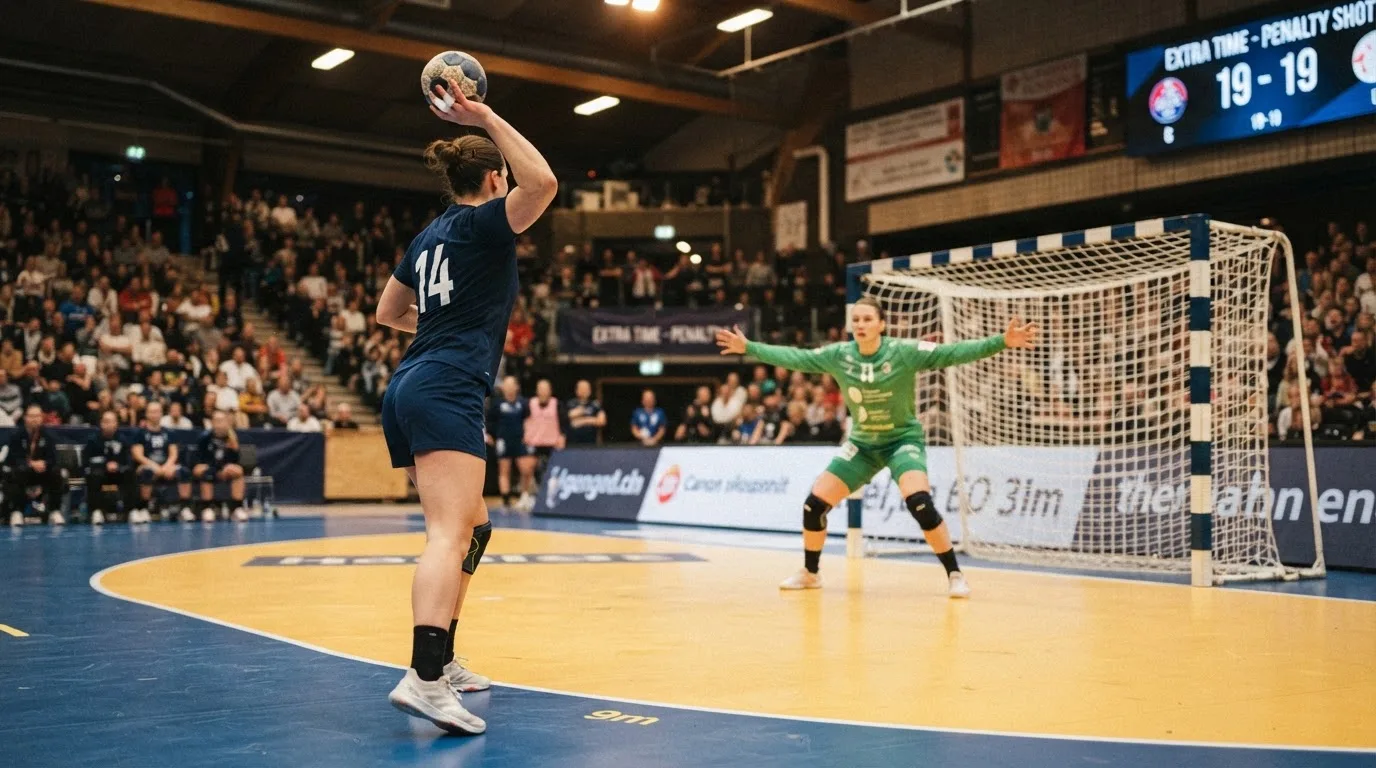
A match is two 30-minute halves, played indoors on a 40 by 20 metre court, with goals 2 metres high and 3 metres wide. In decisive matches a draw leads to up to two 5-minute overtime periods and then a penalty shootout. Settled markets treat the full-time score as the result; outright markets on a knockout match treat the result after overtime and shootout as the result. The seven-player court — six outfield plus a goalkeeper — is the rule for the whole match, with substitutions unlimited and frequent in modern handball.
The ten licensed bookmakers, compared on the terms that matter
The set is fixed by the Gambling Commission’s public register: ten remote general betting standard (real events) licensees with a GB-facing site and a working handball product. The order is the order of presentation, not a ranking. Several brands can run under one licensee — Paddy Power and Betfair sit under PPB Counterparty Services, Ladbrokes and Coral under LC International — so they are never presented as independent. No unlicensed brand is listed.
| Brand | Licence account | Licence holder | What the operator’s own terms state on the relevant subject |
|---|---|---|---|
| Betway | 039372 | Betway Limited | Free Bet Club pays up to £10 in free bets weekly on £25+ of qualifying sports spend; 2 × £5 free bets |
| Paddy Power | 039439 | PPB Counterparty Services Limited | App covers football, horse racing, boxing, rugby, tennis, golf, darts, snooker, F1; no sport-specific exclusion named |
| BetMGM | 039198 | LeoVegas Gaming PLC | UK sports welcome: deposit £10+, place one sports bet within 7 days, four £10 free bets (2 × 4+ accas, 2 × 2+ multiples), 7-day validity, minimum odds, opt-in |
| VBet | 044662 | SCGO Limited | UK sports welcome: stake £10+ on a first-ever bet that loses, get a £10 free bet |
| bet365 | 055148 | Hillside (UK Sports) ENC | Official global betting partner of the UEFA Champions League; Bet Builder+, Winnings Boosts on Bet Builders and selected singles, daily Bet Boosts; in-play, live streaming, Bet Track, Match Live, Live Golf Tracker; described as the most-downloaded sports betting app in the UK |
| Kwiff | 044448 | Eaton Gate Gaming Limited | UKGC-licensed, 17+ App Store rating, trademark of Spryme Ltd |
| Matchbook | 039504 | Triplebet Limited | Betting exchange: customers bet against other users; Bet Builder, multiples, in-play, live streaming of horse racing and greyhounds |
| Hollywoodbets | 053028 | Hollywoodbets International UK Limited | UK sports welcome: deposit £10+ by card, stake returned as a free bet up to £30 on a first qualifying losing accumulator (stake £10+, 3+ legs, odds 4/1+, settled within 7 days); one free bet per customer |
| Ladbrokes | 054743 | LC International Limited | App published by Entain Operations Limited; betting intermediary licence also held; 4.66 average rating from 101,255 GB App Store ratings |
| Spreadex | 008835 | Spreadex Limited | Combines fixed-odds and spread betting; one-click, auto and partial cash out; Bet Builder across fixed odds or spreads; live streaming of UK and Irish horse racing, greyhounds, tennis, NFL, selected football; FCA-regulated for spread betting |
The licence account is what a punter enters on the Commission’s register to confirm the brand is licensed for the named activity, on the day the punter looks. The licence holder is the company behind the brand; the brand and the holder are not always the same name. The third column is what the brand’s own terms page states on the relevant subject: welcome offers, betting features, market coverage, or safer-gambling tooling. What a column of cells cannot say is the depth of the handball menu itself — a brand with a thin handball product is not described as such on its own terms page — and that is what the per-brand reviews below address.
Betway
Betway is licensed for UK remote general betting, account 039372, operated by Betway Limited. The headline recurring offer is the Free Bet Club: an opt-in that pays up to £10 in free bets every week after £25 or more of sports spend, delivered as two £5 free bets. The terms name a minimum odds threshold on the qualifying bets and a stake-not-returned rule on the free bet itself; the qualifying spend is on settled bets, not on voided ones, and the seven-day window starts on opt-in. The brand is one of the more established GB-licensed bookmakers and runs a settled handball product on the European leagues.
For a punter who bets weekly rather than only on a welcome offer, the Free Bet Club is the more valuable product than the headline welcome bonus, and the qualifying spend needed to unlock it sits at the kind of stake a small-stake recreational punter would place anyway. For a punter who bets only on welcome offers, the headline is the right comparison.
Paddy Power
Paddy Power operates under a GB remote general betting standard (real events) licence, account 039439, held by PPB Counterparty Services Limited. The Paddy Power and Betfair brands both sit under PPB Counterparty Services, so a punter who holds an account with one holds it with the licensee who also runs the other; the two are not independent operators for any practical purpose. The app’s stated coverage is football, horse racing, boxing, rugby, tennis, golf, darts, snooker and F1; the sports listed are the ones the App Store description names, and handball is not on that list, which is a notable absence rather than a confirmed exclusion. The brand’s price-boost and money-back specials on the bigger football fixtures are its commercial centre of gravity, and the handball product sits as a tool rather than a headline.
For a punter whose betting is on football and horse racing with the occasional handball punt, Paddy Power’s app and pricing are competitive, though handball is a secondary menu. For a punter whose betting is handball-first, the brand’s depth is more limited than on football, and a more focused operator will often price the same fixture more tightly.
BetMGM
BetMGM maintains a GB remote general betting standard (real events) licence, account 039198, through LeoVegas Gaming PLC. The headline UK sports welcome offer is a deposit-and-bet unlock: a new customer who deposits £10 or more and places one sports bet within 7 days receives four £10 free bets, delivered as two football accumulators of 4+ selections and two sports multiples of 2+ selections, valid for 7 days with minimum odds and opt-in required. The structure is offer-shaped rather than cash-shaped: the free bet is paid in bet credits, the stake not returned, and the four-bet split is football-weighted, which is a tilt toward football rather than toward a punter whose betting is handball.
The 7-day deadline and the football tilt are the two numbers that matter. A punter who bets handball as a habit will use the two sports multiples and may not use the two football accumulators, which makes the headline four-bet value worth less than the headline number suggests.
VBet
VBet is licensed for GB remote general betting standard (real events), account 044662, under SCGO Limited. The UK sports welcome is a single £10 free bet on a first-ever losing bet of £10 or more. The shape is the simplest on this page: a £10 stake, a loss, and a £10 free bet back. The brand runs a handball product; the welcome offer is handball-agnostic, which means the qualifying bet can be on any sport the brand prices.
VBet offers a straightforward welcome path for the punter who prefers a simple loss-reimbursement model. Those seeking a multi-part deposit match or a complex accumulator offer will find this structure less suitable for their strategy.
bet365
bet365 conducts its UK operations via a GB remote general betting standard (real events) licence, account 055148, held by Hillside (UK Sports) ENC. The brand is the official global betting partner of the UEFA Champions League, runs Bet Builder+ (combining markets from one event into a single bet, available pre-match and in-play), Super Boosts, Winnings Boosts on Bet Builders and selected singles, and daily Bet Boosts. The in-play product covers events worldwide with live streaming, plus Bet Track, Match Live and a Live Golf Tracker for following bets in play. The App Store listing describes the app as the most downloaded sports betting app in the UK, which is a usage claim rather than a feature claim.
The product is the deepest on this page on a settled fixture, and the depth carries into the smaller leagues: a Bundesliga relegation six-pointer, a Starligue Tuesday night game, a Liga Asobal Friday match — all run with a settled in-play product and a settled pre-match menu. For a punter whose betting is handball-first, bet365 serves as a reference price on the marquee fixtures. The price-boosts and acca-insurance offers are a welcome addition, yet the depth of the live offering remains the primary draw.
Kwiff
Kwiff is licensed by the UK Gambling Commission for remote general betting, account 044448, held by Eaton Gate Gaming Limited. The brand describes itself as a trademark operated by Spryme Ltd and the App Store rating is 17+. The commercial proposition is “surprise” pricing: the brand’s headline product is that odds on selected markets can be boosted randomly after a bet is placed, and the boost is paid on the win. The model is unusual and means a punt on Kwiff is priced at the headline odds until a boost lands or does not.
Kwiff provides a unique ‘surprise’ pricing model that may appeal to novelty-seeking punters. For those who require price certainty before placing a bet, however, the structure lacks the transparency found in fixed-odds alternatives.
Matchbook
Matchbook holds a UK Gambling Commission remote general betting licence and intermediary licence, account 039504, held by Triplebet Limited. The brand is a betting exchange where customers bet against other users, with Bet Builder, multiples, in-play and live streaming of horse racing and greyhounds. The exchange model means the prices on Matchbook are set by other customers rather than by a trader, and the commission is paid on net winnings rather than built into the margin.
Matchbook serves as an excellent ‘third way’ for punters seeking the flexibility of backing or laying bets, often at tighter market prices. It does not, however, replace the fixed-odds sportsbook experience for those who prefer straightforward match outcomes.
Hollywoodbets
Hollywoodbets runs a remote general betting standard (real events) licence under Hollywoodbets International UK Limited, account 053028, on hollywoodbets.co.uk. The UK sports welcome is a stake-returned-as-free-bet offer on a first qualifying losing accumulator: deposit £10 or more by card, place a stake of £10 or more on an accumulator with 3+ legs at odds of 4/1 or greater that settles within 7 days, and on a loss the stake returns as a free bet of up to £30. One free bet per customer. The 4/1 minimum and the 3-leg minimum shape the offer around accumulators rather than singles, and the card-only deposit gate excludes several payment routes.
For a punter who bets accumulators anyway, the 4/1 and 3-leg shape is workable. For a punter who bets singles, the offer is not built for them.
Ladbrokes
Ladbrokes holds a UK Gambling Commission remote general betting licence and intermediary licence, account 054743, held by LC International Limited. The app is published by Entain Operations Limited and the GB App Store listing carries a 4.66 average rating across 101,255 ratings, which is a usage claim rather than a price claim. The Coral brand sits under the same licensee; the two brands are not independent operators for any practical purpose.
Ladbrokes is a settled, reliable choice for the football and horse racing punter, with a betting-exchange option providing an alternative to the main sportsbook. For those focused exclusively on handball, however, the depth is more constrained than at specialist sites.
Spreadex
Spreadex is licensed by the UK Gambling Commission for remote general betting, account 008835, under Spreadex Limited. The brand is the only firm on this page that holds both a Commission licence for fixed-odds betting and an FCA authorisation for spread betting, and the FCA route is the one the firm is best known for. The fixed-odds product runs one-click, auto and partial cash out, Bet Builder across fixed odds or spreads, and live streaming of UK and Irish horse racing, greyhounds, tennis, NFL and selected football. Spread betting losses can exceed the deposit, which is the FCA-regulated risk the firm names on its own homepage.
For a punter who wants spread betting on financial markets alongside fixed-odds sports, Spreadex is the only integrated option on this page. For a punter whose betting is fixed-odds sports only, the FCA route is not relevant, and the fixed-odds product is one of many.
How to read a bookmaker’s margin on a handball match
The bookmaker’s margin is what is built into every price. For a two-way market at decimal 1.90 / 1.90 — an even-money shot in fractional form (9/10) — the payout share is 1 ÷ (1/1.90 + 1/1.90) = 1 ÷ 1.0526 = 0.95, and the margin is 1 − 0.95 = 0.05, or 5%. For the same market at decimal 1.85 / 1.95, the payout share is 1 ÷ (1/1.85 + 1/1.95) = 1 ÷ 1.0530 = 0.9497, and the margin is just over 5%. The general point is that two-way markets sit in a 5% to 8% band at the bigger events and a wider band at the smaller ones; three-way markets (where the draw is offered) carry a higher margin, usually 7% to 12%, because three outcomes are being priced. Outrights and tournament winner markets sit at a much wider margin, sometimes 20% to 40%, because the field is long and the result is rare.
What this means for a punter is straightforward. A bet at 1.90 / 1.90 with a 5% margin pays out 95 pence of every pound staked across the long run; a bet at 1.85 / 1.95 with the same margin pays out the same. The punter who wants to compare two bookmakers’ prices on the same fixture compares the decimal odds at the same snapshot, and the bookmaker with the higher decimal price on each side has the lower margin, all else equal. The numbers are statistical, not predictive: over a season of bets, the punter who backs at a 5% margin will be behind 5 pence in the pound; over a single weekend, anything can happen.
The calculation sits behind a sharper observation. A welcome offer that requires £100 of qualifying bets at a 5% margin costs the punter £5 in expected value, all else equal; the same offer at a 10% margin costs £10; the same offer at a 15% margin costs £15. The headline £10 free bet is the same in pounds; what changes is what the qualifying bets cost on the way to claiming it.
Where this leaves a UK punter
The headline number that decides the comparison is rarely the welcome offer. It is the depth of the handball product on a Tuesday night Bundesliga fixture, the price the bookmaker pays on the bigger events, the cash-out haircut on a volatile live match, and the speed of the withdrawal on a settled win. Welcome offers are the second decision; market depth and price are the first. A punter who holds two or three accounts on this page, prices the same fixture across them, and reads the small print on each offer before claiming has done what this page can do.
The wider frame holds. GB licensing buys a defined bundle of duties: identity verification, GAMSTOP, the bonus wagering cap, the financial vulnerability check at £150 of net deposits in a rolling 30 days, the Commission’s complaints route, and the approved dispute-resolution bodies. Offshore crypto betting buys anonymity and the loss of those protections. The choice is the punter’s, and the price of each side is what it is.
Frequently asked questions about online handball betting in Great Britain
What does “handball” mean in betting?
In betting, “handball” refers to the indoor team sport with seven players on court (six outfield plus a goalkeeper), played on a 40 by 20 metre court with goals 2 metres high and 3 metres wide, in two 30-minute halves. In decisive matches a draw leads to up to two 5-minute overtime periods and then a penalty shootout. The term is not used in betting to mean a football handball foul, which is settled as a match event by bookmakers but is not a market in its own right.
Is a handball a foul in betting?
In football, a “handball” is a foul (or an infringement, depending on the competition’s laws) and bookmakers settle markets such as “handball against” or “penalty awarded” from the match official’s decisions. In the handball betting market itself, the word refers to the sport, not to a footballing offence. Settled markets on a handball match include match outright, totals, handicaps, half-time / full-time and outright tournament winner, with no market named for a “handball foul” within the match.
How is a bookmaker’s licence checked?
The Gambling Commission’s public register is the whole test. It can be searched by business name, trading name, domain or account number, and a brand listed against a remote general betting standard (real events) licence category is licensed for the activity the licence names. The licence holder named on the register may differ from the brand name, and a single licensee can hold several consumer brands. The register should be checked on the day, since licences change hands and brands move between licensees over time.
How is a return worked out from a stake and the odds?
Return = stake × odds (decimal). For a £10 stake at decimal 1.90, return = £10 × 1.90 = £19. The net profit is return minus stake, which is stake × (odds − 1) = £10 × 0.90 = £9. For a combination bet, the odds of the legs multiply into one price: a treble at 1.50, 2.00 and 3.00 has combined odds of 1.50 × 2.00 × 3.00 = 9.00, and a £10 stake returns £90. The result of one bet does not predict the next; the arithmetic is per-bet.
What is the bookmaker’s margin and how is it seen?
The margin is the share of every pound staked that the bookmaker keeps across the long run. For a two-way market at decimal 1.90 / 1.90, the payout share is 1 ÷ (1/1.90 + 1/1.90) = 0.95, so the margin is 1 − 0.95 = 0.05, or 5%. For a three-way market the same calculation runs over three outcomes. The margin is statistical: it describes what the bookmaker keeps over many bets, not what any single bet costs. Two bookmakers quoting the same fixture at different decimals carry different margins, and the higher decimal on each side has the lower margin.
US & other team sports – Best betting
Content created by the «Best betting» team
