
Curling betting, priced into the odds: a GB-licensed look at the markets, the rule book and the costs
 Available in US
Curling sits low on the betting card at most British bookmakers. The Winter Olympics and the World Curling Championships get a mention, then the calendar drops back to a thin fixture list for months. That thinness is not the main story, though — it is the reason curling odds behave the way they do, and why a beginner reading two prices on the same market needs to know what is sitting inside them. This page walks through how curling is bet on at licensed GB bookmakers: the sportsbook categories curling actually shows up in, the markets most operators offer on those events, the price of a bet the moment it is placed, and the licences, limits and safer-gambling tools that sit over the top.

Data current as of 27 October 2026 and cross-checked against the Gambling Commission’s public register of remote operating licences.
The statute book that opens before any price does
A bookmaker serving customers in Great Britain needs a Gambling Commission licence wherever the operator itself is based, since the Gambling (Licensing and Advertising) Act 2014 closed the point-of-supply loophole. The Commission issues licences under the Gambling Act 2005, which covers England, Scotland and Wales; Northern Ireland runs separately, so a GB licence does not stretch there. A Curaçao or Malta-only licence is not a substitute for betting with a British customer — it is a stand-alone arrangement in another jurisdiction, recognised by no one for GB purposes.
There is no statutory list of permitted events. A bookmaker decides what to offer under its own licence category, and the Commission’s test for offering a market is the operator’s own rules plus the Licence Conditions and Codes of Practice (LCCP), not a green light from Whitehall. That is why curling sits on most major British sportsbooks even though it is a minor sport: it is real, it is on the calendar, it fits under “remote general betting standard (real events)”, and no one is obliged to keep it on the menu. Each operator can trim it back without notice.
Who must verify you, when. Since 7 May 2019 a licensed operator must verify name, address and date of birth before a customer deposits or gambles, including before staking a free bet or working through a bonus. A punter who opens a fresh account on a Saturday morning for an Olympic semi-final has already passed an age and identity check. That single rule kills anonymous betting at every GB-licensed site on this page; the offshore sites outside the register carry on regardless.
What the licence categories look like. The five that matter for online sportsbook customers are: remote general betting standard (real events); remote general betting standard (virtual events); remote general betting limited; remote pool betting; and remote betting intermediary, which is the licence exchanges run under. Curling falls under the first of those, and the same licence covers the in-play, ante-post and bet-builder markets an operator may layer on top.
Minimum age and the credit-card rule. The minimum age is 18 across all licensed betting products. Credit cards have been banned for gambling in Great Britain since 14 April 2020, and the ban reaches credit-card-funded top-ups through e-wallets as well; debit cards and direct bank transfers are unaffected. The ban sits inside LCCP condition 6.1.2, which is an operator-side rule, and an attempt to fund with a credit card at a licensed site fails at the cashier rather than at the bank.
The licence you can check. The Commission’s public register is searchable by business name, trading name, domain or account number, and is the test of who actually holds a licence. A brand running on a .com is no less licensed than one on .co.uk, because the licence is held by the operating company, not by the address bar. None of the ten operators reviewed here is “the only” licensed brand — there are several hundred. Their licence numbers are on the register, and the short codes below identify them there.
What the rule book does to a customer before the first bet
What a GB licence actually gives, and what it takes away
The deal a licensed operator offers is not “safety”; it is a set of obligations that cut both ways. The customer gets the safer-gambling machinery — GAMSTOP self-exclusion, vulnerability checks, deposit-limit tooling, an ADR route if a dispute is not resolved at the operator, and the Commission’s complaints line if the ADR route fails — and in exchange accepts identity verification before the first deposit, the bonus rules, and the LCCP’s social responsibility code that shapes how the operator markets to them. None of those are optional at a licensed site. They are the price of the protections underneath them.
A punter who values the constraints more than the protections will end up at an unlicensed site. Doing so forfeits each of the above. The punter keeps no GAMSTOP coverage, no Commission complaints route, no approved dispute-resolution body, and no guarantee of redress if funds are withheld; the operator is not bound by the 10x bonus cap or the £150 vulnerability check. The Act makes it an offence for an operator to provide unlicensed gambling facilities in Great Britain (section 33 of the 2005 Act); a customer-side offence for using one was not found. “Not illegal to use” is not the same as “recommended”.
The protective machinery that runs over every account
GAMSTOP is the national multi-operator self-exclusion scheme and is a mandatory licence condition for online operators since 31 March 2020. Self-exclusion periods run six months, one year, five years, or five years with auto-renewal. After the minimum period the exclusion stays for a further seven years unless the customer asks GAMSTOP to remove it. Betting shops use a separate, land-based scheme; the online scheme covers sites and apps only.
Financial vulnerability check. Since 28 February 2025 a licensed remote operator must run a public-record vulnerability check once a customer’s deposits net of withdrawals exceed £150 in any rolling 30 days. The check looks at records such as bankruptcy and county court judgments. It is not an income check, not a credit-reference check, and the value used to flag it is on the gross side of withdrawals, not a profit and loss figure. Financial risk assessments — the deeper “affordability” checks the press writes about — sit in a staged plan announced in July 2026 with no start date yet. Do not write that they are live.
Deposit limits. From 31 October 2025 a first phase of deposit-limit rules has applied; a second phase was pushed to 30 September 2026 and its live status is not established. Until the detail is settled, the practical position is unchanged for most punters: there is no state-set ceiling on deposits or losses. The customer’s own chosen limit, set in the cashier, is the only binding cap. A bettor who has not picked one can deposit whatever the operator’s own ceiling allows.
How the betting duty sits inside the odds
The player pays no tax on betting winnings in Great Britain. General Betting Duty is the operator’s tax and is charged on gross profits — the gap between stakes taken and winnings paid — at 15% for the moment. From 1 April 2027 a new remote betting rate of 25% applies within the same duty, covering remote bets other than those on UK horse racing, on self-service betting terminals in licensed premises, on pool betting, and on in-person betting, which stay at 15%. Until that date the remote rate remains 15%. Whether operators pass the duty on through worse prices is not established, and there is no rule they must. Spread betting sits outside: 3% on financial spread bets, 10% on other spread bets.
The promotion cap that shapes every welcome offer on this page
Promotion rules in force since 19 January 2026 cap wagering requirements on bonuses at 10x: a £10 bonus with a 50x requirement would need £500 in qualifying bets, and after the cap no more than £100. Mixed-product promotions — offers that require play across betting, casino, bingo and lottery in a single chain — are banned. The cap covers bonuses with a wagering condition; whether it touches free bets without one, and any money-value cap on bonuses, are not established. The practical effect is that welcome offers involving free bets are paid back as free bets whose stake is usually not returned with a win, and the headline face value reads more generously than what the offer usually pays out at.
Where help is actually available
GamCare runs the National Gambling Helpline. GambleAware funds treatment and education. The NHS runs gambling clinics in several regions. Gamblers Anonymous runs peer support meetings; it is the list most licensed operators link from their safer-gambling pages, alongside the rest. Each of these is reachable without an account, without paying, and from inside the licensed betting environment a punter is trying to step away from.
The fixtures a curling punter actually sees
The seasonal shape of the calendar
Curling’s sporting year runs on two crests. The first is the World Curling Championships, which sit early in the calendar for the senior men’s and women’s events and later for mixed doubles. The second is the Winter Olympics every four years, where curling has been an official medal sport since 1998. Between those peaks the calendar thins: the Continental Cup, the European Championships for European-level competition, the World Mixed Doubles, and tour events that not every sportsbook prices up. The bonspiel-style domestic competitions in Canada, Scotland and Scandinavia sit inside a different ecosystem the major British books rarely list, because most of their audience is not betting on club-level northern hemisphere play in November.
The Olympic fact does not move with the publication year. Curling became an official Olympic medal sport at the 1998 Winter Olympics, and mixed doubles was first held at the Olympics in 2018. Those are pinned to specific Games; the year on this page refers to the season the reader is reading this in, not to those events themselves.
The fundamentals that drive a curling market
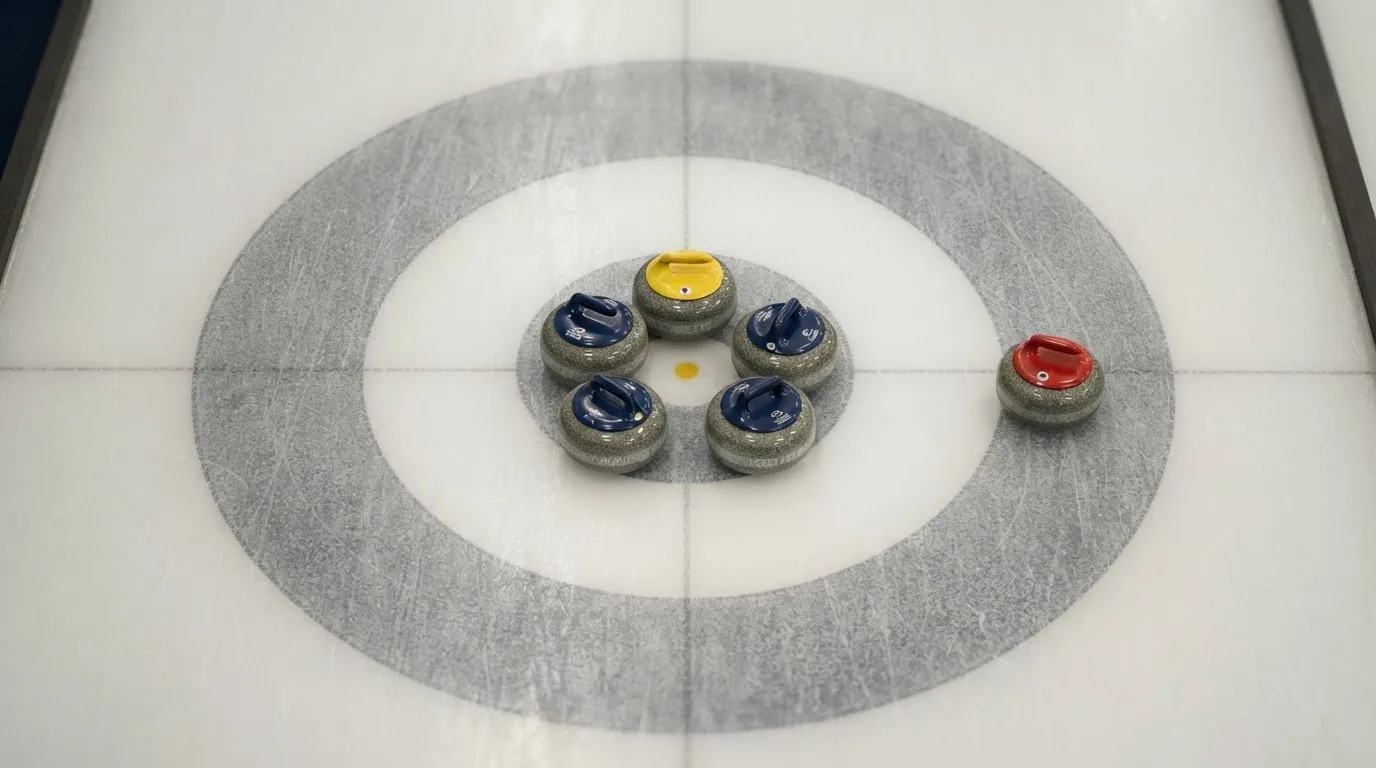
Eight stones per team, four ends per game in club play and ten at international level. A four-player team throws two stones each, and the standard format at international level is ten ends; club and recreational games most often run eight. Mixed doubles uses two players per team and eight stones each. Stones weigh between 17.24 and 19.96 kg (38 to 44 lb) under World Curling Federation rules — a heavy stone on a pebbled ice surface, with the granite’s running life and curl shaped by the ice maker, the sweeping, and the stone’s own wear pattern. Tied games go to extra ends; there is no shootout. The hammer — the prized last stone of an end — passes to the team that did not score in the previous end, and stays with the same team if the end is blanked. That single rule explains why most curling markets favour the team with the hammer when the end is close.
The markets on a typical curling event
The standard markets on a major curling event at a GB bookmaker are a winner-of-match line (most often priced at the two-way moneyline with the draw effectively priced in via a third outcome in some books), the outright winner of the championship, the spread on the ends (“handicap lines” such as -1.5 ends), and totals on ends scored. Map markets — “to score first”, “to score in end N” — show up on marquee fixtures. The outrights are where most liquidity sits for a tournament bettor, because curling match markets thin out the further down the draw you go.
The fixtures book at this set of operators
The calendars look similar — and they are similar. World Curling Championship outrights sit at every major British sportsbook from late in the season. Olympic outrights open roughly a year out and run until the morning of the final. Mixed-doubles outrights run at half of them in a given season. What differs is which subsidiary lines each bookmaker stages. A marble-and-ice sport with a relatively narrow betting calendar means a punter who wants same-game multis, end-by-end in-play, or a curling-specific bet builder will pay attention to the operator’s track record on similar minor sports — darts, snooker — rather than to the operator’s stated curling offering alone.
Reading a curling price before placing the bet
A curling price has two things inside it: the probability the bookmaker attaches to the outcome, and the margin the bookmaker keeps. Both move together, and the easier way to read them is the second. A two-way market at 1.90 / 1.90 is an exactly fair book with a 5.26% margin — the bookmaker keeps about 5p out of every pound staked across both outcomes — and a long way from the 12% to 18% margins most major British sportsbooks run on Premier League football. Curling, with thinner liquidity, tends to come out nearer the higher end of the margin scale than the lower; the outline of why is in the worked example below.
The GB-licensed bookmakers running curling outrights right now
The ten brands below all sit on the Commission’s public register, each under a remote general betting standard (real events) licence. The set is not a ranking: it is a curated shortlist of brands that, at the time of checking, hold the licence and offer enough breadth on minor sports to price up a curling event. The table that follows this section sets the licences and the curling-relevant offering each operator’s own terms state. The order is the order the operators appear on the Commission’s register sorted by licence account number, beginning with the lowest.
| Brand | Gambling Commission licence | Licence holder | What the operator’s own terms state for curling |
|---|---|---|---|
| BetGoodwin | 002927-R-327985-008 (account 2927) | Goodwin Racing Limited | Sports welcome offer is structured as a £5 sports bet, a £5 acca and a £5 Sub-Cover bet after a £10 qualifying stake; no curling-specific term was found |
| Fitzdares | 000400-R-103839-030 (account 400) | Fitzdares Limited | App offers cash out, accumulators, Lucky 15s, specials and antepost markets on horse racing, football, tennis, rugby, cricket, golf and American football, with in-play live odds; the published sport list does not name curling |
| Fafabet | 057385-R-333191-006 (account 57385) | Taichi Tech Limited | Pays Best Odds Guaranteed on UK and Irish horse racing win and each-way bets from 9am on race days; the stated horse-racing focus leaves curling to its general sportsbook pass |
| BetMGM | 039198-R-319450-029 (account 39198) | LeoVegas Gaming PLC | Sports welcome offer is four £10 free bets (two football accumulators of 4+ selections and two sports multiples of 2+), valid for 7 days after a £10 deposit and a qualifying sports bet within 7 days; minimum-odds and opt-in conditions apply |
| Kwiff | 044448-R-323408-017 (account 44448) | Eaton Gate Gaming Limited | Licensed by the UK Gambling Commission; described as a trademark operated by Spryme Ltd, with a 17+ App Store age rating; no curling-specific term was found |
| Lottoland | 038991-R-319408-020 (account 38991) | EU Lotto Limited | App combines casino, lottery betting, sports betting and scratchcards for customers in Great Britain under its Commission licence |
| Midnite | 101839-R-342850-001 (account 101839) | Midnite Limited | Site cites licence 101839 and shows in-play events, an acca builder, popular accas and price boosts with maximum-stake limits; the sports welcome offer is structured as free bets plus free spins for new customers |
| Octobet | 062545-R-337248-006 (account 62545) | Octopus Game Limited | Sportsbook welcome offer is 50% back as a free bet up to £50, plus a £10 casino bonus for new customers |
| Unibet | 045322-R-324275-019 (account 45322) | Platinum Gaming Limited | Has operated since 1999 under its GB-licensed UK site; the sports welcome offer is structured around a qualifying £20 sports bet at minimum odds of 2.0 (1/1), with £40 in free bets that expire within 7 days |
| Bet600 | 044731-R-323941-016 (account 44731) | Tyche Tech Limited | Pays Best Odds Guaranteed on horse racing: if the starting price is bigger than the early or show price taken, the bet is paid at the SP |
The table is a snapshot of those brands on the Commission’s register at the access date of this page; a licence status can change. The check is yours to do — the Commission’s search by business or trading name returns the current licence class.
The shortlist logic, named in plain English
A first-tier group sits at the top of any curling list. It is made up of operators whose general sportsbook is priced on minor sports week to week: BetMGM, Kwiff, Midnite, Unibet. These are the brands a punter is most likely to find a curling outright on at any given time, because their pre-match engines have been trained on the wider sport catalogue. The second tier groups brands with strong niche offerings but a thinner minor-sports calendar: Octobet, Lottoland, Fitzdares. A third group is the racing-led brands — Fafabet, Bet600, BetGoodwin — whose strength is horse racing but whose general sportsbooks still stage curling for the World Championships and the Olympics.
The offers, named in their own terms
Every offer in the table is described in the operator’s own terms. Welcome offers at GB bookmakers tend to be paid back in free bets whose stake is not returned with a win; they are flatly different from a cash bonus even when the headline number is the same. The wagering cap (10x on bonuses with a wagering condition, in force since 19 January 2026) is a separate, harder ceiling: a £10 bonus with a 50x condition would have asked for £500 of qualifying bets, and the cap now sets the ceiling. Free bets that arrive without a wagering condition sit in a grey zone the Commission’s terms have not closed; what matters to a customer is whether the free bet returned is a free bet or a withdrawable balance.
How to read the licences for what they say, not for what they imply
All ten run under the same licence class. The differences between them are downstream of the licence, not visible in the licence number: a betting-intermediary licence is a different class again, and an exchange runs under it; the brands reviewed here are bookmaker-class. The licence holder’s company name is the entity the regulator holds accountable, and several brands can sit under one holder — so two trade names here could resolve to one operating company if a later check finds that out. None of that changes what the customer is offered; it changes whose complaint the regulator logs.
The verdict to take from the shortlist
A punter looking for a curling outright at a GB-licensed sportsbook has a thin-but-real choice in late autumn and widens into a deep one around the World Championships and the Olympics. The first decision is whether the brand needs to hold a strong antepost book on curling specifically — in which case the first-tier group’s wider sportsbook exposure matters — or whether a generic major-sports sportsbook is enough. In either case, the licence is a precondition, not a tiebreaker. The tiebreaker is what the operator’s general minor-sports pass looks like, and that is where the table above gives the only honest answer.
A worked example of the margin inside a curling price
A two-way curling market priced at decimal odds 1.90 / 1.90 is the cleanest illustration available. The implied probabilities are 1 ÷ 1.90 = 52.63% on each side, which sum to 105.26%. The fair book would be 100%; the 5.26% gap is the overround, sometimes called the bookmaker’s margin. On a £10 stake split equally across both outcomes — £5 on each side — a perfect-fairbook punter would have £10 returned: £5 × 1.90 × 0.5263 ≈ £5, and the same again on the other outcome. A perfect-fairbook operator keeps nothing; an operator charging the 5.26% margin keeps 52.6p out of every £10 staked in the round, before considering how the bets are split.
Real-world curling does not live at 1.90 / 1.90. A heavy favourite in a one-sided round-of-16 game sits nearer 1.20 / 4.50, and the implied probabilities sum to 1 ÷ 1.20 + 1 ÷ 4.50 = 0.8333 + 0.2222 = 1.0556, a margin of about 5.30%. A two-horse outright with a strong favourite at 1.40 / 2.75 sums to 1 ÷ 1.40 + 1 ÷ 2.75 = 0.7143 + 0.3636 = 1.0779, a margin of about 7.39%. The pricing of an event with two reasonably matched sides and tight liquidity tends toward 6% to 8% for curling outrights and curling match markets at GB sportsbooks, against 3% to 5% for a deep, liquid Premier League match. The band sits where it sits because the liquidity does.
The cost of beating the margin. A punter who backs every outcome on every market at 6% margin and pays the same stake loses about 6p per pound staked over the long run. The only way to beat it is to back only where the punter’s own probability model says the implied probability is too low; a “system that wins” is not what this is.
A quick reference to the mechanics that govern a curling bet
The mechanics of an outright bet at a GB bookmaker
A curling outright is a single bet on which team wins the tournament, with the stake returned plus winnings at the price taken at placement time. The price moves with bets in and money out; an early price backed 10 months out is rarely the same price offered an hour before the final. A punter who backs early is taking on the risk that a key player withdraws or the team fails to qualify from a qualifier — the bookmaker’s ante-post terms usually treat “non-runner, no bet” or “tournament outright” rules distinctly from race-by-race ante-post betting, and the specific carve-out is in each operator’s terms.
The mechanics of a curling match bet
A curling match bet pays out at the end of the regular ends, with extra ends included in the final score. Ties after extra ends are extremely rare, but a draw-tied-after-extra-ends marker exists; the operator’s settlement rules state how a game shortened for any reason is graded. A live-in-play bet is graded at the score at the moment the bet is confirmed, with the markets offered mid-game described on the operator’s in-play page.
The mechanics of a curling handicap bet
Curling handicap bets pin a number of ends to one side — “Team A -1.5 ends” means the backer needs Team A to win by at least two ends after the handicap is applied. The stake on a handicap bet does not carry a free-bet return in the same way an outright does; the payout is stake × decimal odds if the handicap beats the actual end margin, and a stake returned on a handicap-equal result only when stated in the operator’s settlement terms. The exact handicap bands available move with the operator.
Where each operator fits on curling in particular
The first-tier sportsbooks present a deeper curling book most weeks of the year. The second-tier group stages curling around the major tournaments but thins mid-season. The third group — the racing-led sportsbooks — generally price curling during the World Championships and the Olympics only. The point of knowing which group a brand sits in is not that one group is “better”, but that the punter sets expectations against the calendar rather than against a single fixture.
How the costs of a free bet stack up against a cash bonus
The headline face value is not what the offer usually pays. A £20 free bet at 2.0 (1/1) returns £20 of winnings in a withdrawable balance if the bet wins (the £20 stake is not returned). The expected value of that free bet depends on the market’s margin. On a Premier League match market at 5% margin the free bet’s expected value is £20 × (2.0 – 1) ÷ 2.0 × 0.95 = £9.50; on a curling outright at 7% margin the expected value is £20 × 1 ÷ 2.0 × 0.93 = £9.30. A cash bonus, by contrast, returns stake plus winnings: a £20 cash bonus staked at 2.0 returns £40 total, of which £20 is profit. The headline numbers look similar; the mechanical difference is whether the stake comes back.
A welcome offer with a wagering condition sits under the 10x cap from 19 January 2026. A £10 bonus with a 5x condition requires £50 of qualifying bets; a £10 bonus with a 20x condition would have required £200 and a 50x would have required £500 — the cap sets both at £100. The clearing cost is the turnover × the margin of the market the bonus is cleared through. At 5% margin the £50 turnover costs £2.50 in expected loss; at 7% margin the same turnover costs £3.50. The deposit-gating + wagering-trail is exactly what the cap shapes, and exactly what a customer should read before they claim.
The picture across the British betting market
A snapshot of the offshore side
The Commission’s record shows several hundred remote operators on the British register; the unauthorised market outside it is several thousand brands, mostly Curaçao-licensed, accessible through a UK IP but operating on no GB licence. The Act makes offering a GB-facing product without the right licence a criminal offence, but enforcement runs through cease-and-desist, search-engine referrals and, increasingly, court-ordered DNS blocking — not blanket ISP blocking. Most offshore sites that target British punters keep their marketing angled at bonuses rather than at safer-gambling tools; the wagering caps and bonus rules of a GB site do not bind them.
A customer comparing the two does not pick “the safe choice”. Picking the licensed side is choosing the constraints in exchange for the protections. Picking the unlicensed side is removing the constraints at the cost of the protections, and the Act aims that trade at the operator.
A snapshot of the economics of a British sportsbook
General Betting Duty at 15% (rising to 25% on remote gross profits from 1 April 2027) is the visible operator tax; the Commission’s statutory levy is a separate charge; advertising is run through the ASA codes rather than through the Commission; safer-gambling and compliance teams sit inside each operator. None of that is free. The cost enters the price in the form of a margin between what is offered and what is fair, and on minor sports — curling, mixed-doubles qualifiers, mid-tier darts, second-tier snooker — the margin is wider than on the deep Premier League or Champions League markets where volume carries the cost.
Where curling sits in that wider picture
A curling punter choosing a bookmaker is choosing one of three positions. A wide sportsbook with a curling outright line all season; a tier-one sportsbook with a curling line at the World Championships and the Olympics; or a niche bookmaker whose curling offering is incidental. None of them is “the curling bookmaker”; none of them is “the only” licensed brand. The set is curated, not a hierarchy.
A punter’s framework for choosing at the curtain-raiser
Step one: sort by licence, not by headline offer
The licence is a precondition. The Commission’s public register is the test. A punter who has not bookmarked it yet is welcome to do so. A brand that does not appear on it cannot be recommended for GB customers, and the ten brands below all do.
Step two: sort by what the offer actually pays
A £20 face-value free bet is not £20 of value; the expected value calculation above shows the trade. A welcome offer with a high face value and a stiff wagering condition has a lower expected value than a smaller face value with no condition. A punter who wants to know what they are getting reads the promo page, checks the wagering multiple, checks the expiry of the free bets, and reads which market the free bet is restricted to.
Step three: sort by what the operator stages on minor sports
The curly-card calendar is predictable: the World Championships, the Olympics, the European Championships, the Continental Cup. A bookmaker that stages curling on each of those is a bookmaker whose minor-sports engine is wired up; a bookmaker that stages curling only at the Olympics is a bookmaker whose engine is selectively activated. A punter whose betting calendar is minor-sports-led chooses the former.
Step four: sort by what the operator does when a customer runs into trouble
GAMSTOP self-exclusion is a licence condition, so it is present across the set. Deposit-limit tooling, timeouts, and access to safer-gambling information are the same. The differences sit downstream: how easy each operator makes it to set a limit, how clearly they signpost the support services, whether they run their own reality-check prompter, and whether their self-exclusion pathway is one click or five.
Step five: read the small print before staking
A curling bet placed outside the terms — on a market the operator has suspended, on a player the operator has withdrawn from the outright, on a tournament the operator has cancelled — is settled under the operator’s house rules. The settlement is not the price; the settlement is what the operator’s own terms say happens in that case. That is what the small print is for, and a punter who reads the small print places fewer bets they later wish they hadn’t.
A note on the older ways of reading curling odds
The British fractional odds format expresses a £10 winning stake at 5/1 as £50 profit; the same price in decimal reads 6.00 (5 ÷ 1 + 1). A price quoted as 9/10 in fractional form reads 1 ÷ 9/10 + 1 = 1 ÷ 0.9 + 1 = 1.111 + 1, wait — that gives 2.11. The right conversion is: decimal = a/b + 1, where the numerator a is the profit and the denominator b is the stake. So 9/10 in fractional form means a £10 stake wins £9; in decimal the same price is 9 ÷ 10 + 1 = 0.9 + 1 = 1.90. The two-way curling market at decimal 1.90 / 1.90 sits at 9/10 / 9/10 in fractional form, which most British sportsbook lists will quote as 9/10 evens the two ways. Decimal is the format for calculations; fractional is the format the British high street uses.
A curling outright offered at 5/1 in fractional form is 6.00 in decimal; at 11/4 it is 11 ÷ 4 + 1 = 2.75 + 1 = 3.75; at evens (1/1) it is 1 ÷ 1 + 1 = 2.00. Converting one to the other is mechanical — adding 1 to the fractional as a decimal — and most modern sportsbooks let a punter choose the display format at the top of the page. The conversion matters because a punter thinking in fractions who sees a price of 6/4 reads it as “£6 profit on a £4 stake”, then later realises the same price reads 2.50 in decimal. Either way the price paid is the same; the only difference is which language the punter reads it in.
Where this leaves a curling punter at 2026
The fundamentals have not changed. The GB sportsbook market sits on a Commission licence, the bonus rules run inside the 10x cap, the safer-gambling tools run through GAMSTOP and the LCCP, and the operator’s own terms shape every welcome offer and every settlement. Curling as a sport sits inside that machine the way every other sport does — through an outright winner market, a match winner market, a handicap market, and a totals market — with each market priced under the operator’s margin and settled under the operator’s rules.
The punter who reads this page has a framework, not a pick. A licensed brand, an offer understood in its own terms, a market priced at the margin it carries, a settlement rule read before the stake is placed — those are the four pieces the punter carries into a curling bet and the four pieces that decide what that bet is worth. What specific price is on the menu when the punter sits down to place their bet, only the bookmaker’s own board can say, and the price moves right up until placement time.
The bet to place is the bet the punter understands. Where that bet happens to be priced in margin doesn’t matter to the punter as a matter of safety; what matters is that the punter knows what the bet is. This page is the read-through; the bet itself is the punter’s own.
Common questions on curling betting and the GB rules around it
What does a curling bet actually pay out?
A curling bet pays out the stake plus winnings at the decimal odds taken. A £10 single at 2.50 returns £25 total (£15 profit); an each-way £10 bet costs £20 and returns the win part at full price and the place part at the place terms the operator publishes. Free bets whose stake is not returned are different — the stake is not paid back with a win.
Is it legal to bet on curling in Great Britain?
Yes, at a Gambling Commission-licensed operator. There is no statutory list of permitted events, and the operator decides what to stage under its licence. A bookmaker can trim curling from its menu without warning. A GB-licensed operator is the venue in which betting on curling is supported by the protections the Act provides.
How can a customer check that a bookmaker is licensed?
The Gambling Commission’s public register. It is searchable by business name, trading name, domain or account number. A brand that is not on it cannot claim to be licensed. The register is the test, not the brand’s marketing or its footer.
How is a bet’s return worked out from the stake and the odds?
For decimal odds the return is stake × odds, and the profit is stake × (odds − 1). A £25 single at 1.80 returns £45 total (£20 profit). Each-way bets settle the win part at full price and the place part at the operator’s place terms, and the each-way stake is twice the unit stake.
What is the bookmaker’s margin and how does it show in the odds?
It is the gap between 100% and the sum of implied probabilities (1 ÷ odds) across all outcomes of a market. The bigger the gap, the more the bookmaker keeps per pound staked. A two-way curling market at 1.90 / 1.90 has a margin of about 5.26%; a heavy favourite line of 1.20 / 4.50 carries a margin of about 5.30%; a tighter curling outright of 1.40 / 2.75 carries a margin of about 7.39%.
How do fractional odds of 5/1 convert to decimal odds of 6.00?
Decimal odds equal the fractional numerator divided by the fractional denominator plus one. So 5/1 becomes 5 ÷ 1 + 1 = 6.00, and 11/4 becomes 11 ÷ 4 + 1 = 2.75 + 1 = 3.75. The British high street reads fractional; the calculation reads decimal, and most sportsbooks let the punter pick the format at the top of the page.
Tennis, darts & cue sports – Best betting
Content created by the «Best betting» team
