
Where to bet on basketball online in 2026: UK-licensed bookmakers and the markets that pay
 Available in US
A punt on a basketball game is no longer a niche punt. The NBA season runs from October to June and the league draws more bets worldwide than any other basketball competition, with EuroLeague, the Spanish ACB, the Italian Lega Basket and the Greek Basket League all running at the same time and FIBA national-team windows slotting in around them. College basketball in the United States runs from November to April with March Madness a single three-week period, so the basketball calendar barely has an off-switch once November starts.

Betting on it from Great Britain sits inside one of the more crowded sportsbooks in Europe. A customer does not need a separate licence for basketball: a bookmaker licensed by the Gambling Commission under a remote general betting standard licence can list any basketball event it wants to list, from the NBA Finals to a third-tier European cup, because there is no statutory list of permitted sports. That is the frame every other paragraph on this page hangs from.
The line directly below sits under the lead on every page of this guide: current as of 27 October 2026, cross-checked against the Gambling Commission’s public register and each operator’s own published terms.
What a basketball bet actually is
A basketball match is five players per side on court, unlimited substitutions during stoppages, a ten-foot rim, and a clock that in the NBA runs four twelve-minute quarters and in FIBA competition runs four ten-minute quarters. A field goal is worth two points, three if the shooter stands beyond the three-point line, and a free throw is worth one. Overtime is five minutes and is played until a winner is decided. The structure of the game is what gives a basketball bettor a market: the quarters are short enough that a single bad three minutes can flip the price on a live market, and the unlimited substitutions mean a coach can decide the pace of the game from the bench.
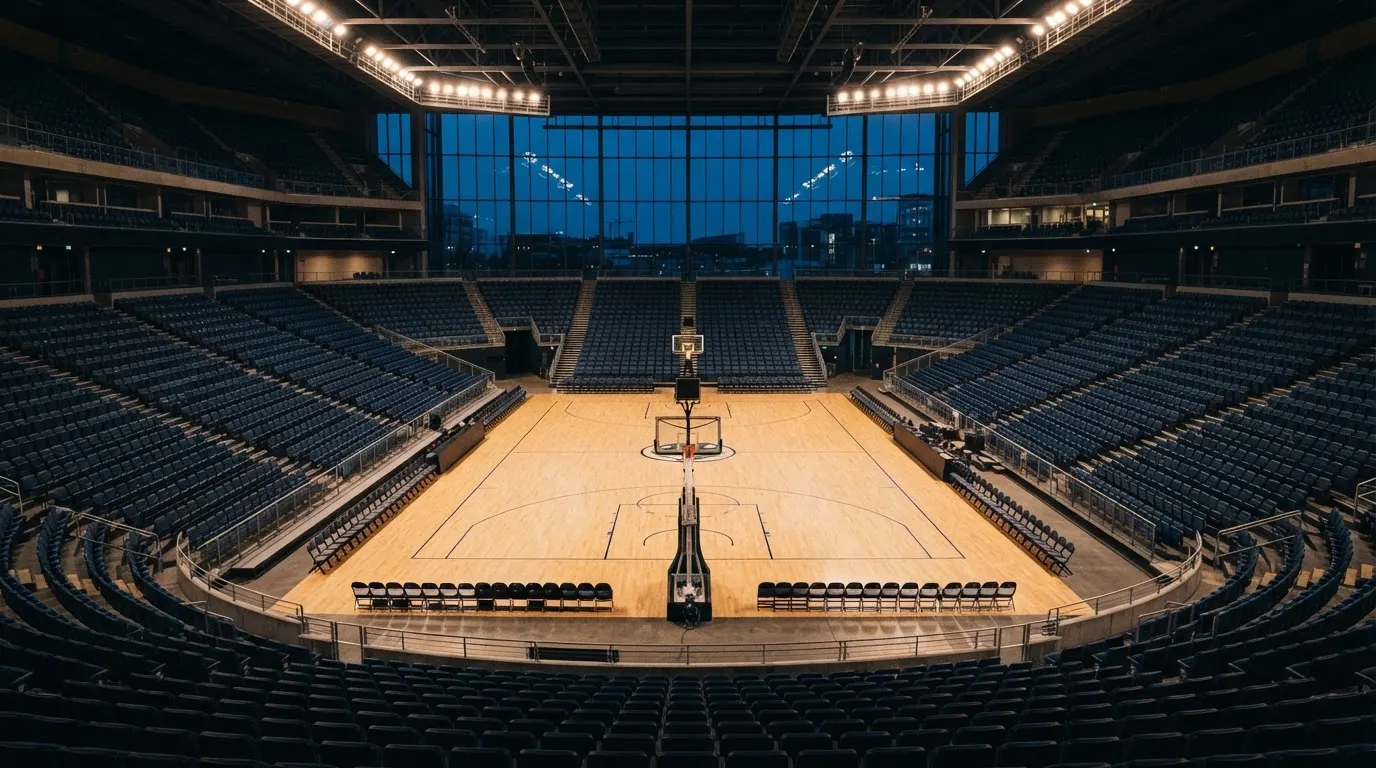
James Naismith invented the game in Springfield, Massachusetts in 1891. The first game is dated 21 December 1891. Men’s basketball was first included at the Olympics at Berlin in 1936 and women’s in 1976, with 3×3 basketball joining the programme from 2020. Those origins matter only to the extent they shape the season: a calendar that runs across two calendar years, a tournament structure that ends in single-elimination play, and a winter window when the major leagues play back-to-back nights. A punter who bets on basketball in November and a punter who bets on it in April are betting on a different sport in everything but the rules.
How the UK market is organised
The Gambling Commission licenses the whole commercial betting market in Great Britain under the Gambling Act 2005, with the Gambling (Licensing and Advertising) Act 2014 closing the loophole that let an operator base itself offshore and still serve British customers. Northern Ireland sits outside the 2005 Act and runs its own older regime, so a “GB licence” covers England, Scotland and Wales and not Northern Ireland. There is no state monopoly on sports betting and no statutory cap on the number of licences: the test is the licence, not the size of the field.

A bookmaker serving British customers online needs a remote licence, and the categories that matter for a basketball punter are remote general betting standard (real events) for any genuine sporting fixture and remote general betting standard (virtual events) for simulated fixtures such as a virtual NBA game. A pool betting licence covers tote-style products on horse and dog racing, and a betting intermediary licence covers betting exchanges. A licence under one of these categories is the legal frame for offering the markets that follow, and the categories are written into the Commission’s public register against each licensee.
The public register is searchable by business name, trading name, domain or account number and is the only place to confirm that a brand holds a licence. The Commission publishes no count of active licensees without an access date, and licensed operators use .com as well as .co.uk, so a domain proves nothing. A single brand is never “the only” licensed one: any licence register lists more brands than any review can feature.
Identity checks and the price of staying licensed
A licensed bookmaker has to verify a customer’s name, address and date of birth before the first deposit or gamble, since 7 May 2019, and the rule extends to free bets and bonuses. There is no anonymous play at a licensed site. A punter who has had a deposit or withdrawal problem with one operator can expect to be asked about source of funds at higher spend, under the Commission’s money-laundering rules. A financial vulnerability check applies to remote betting once a customer’s deposits minus withdrawals pass £150 across a rolling 30 days: it is a public-record check, looking at county court judgments and the like, and it is not a credit reference check and not an income check. A broader financial risk assessment — the “affordability checks” of the press — has been announced by the Commission in a staged plan, with no start date.
Deposit limits are the customer’s choice on the betting side. The Commission’s Remote Technical Standards require a gross deposit limit on a fixed time frame, with the first changes applied since 31 October 2025 and a second phase postponed to 30 September 2026. There is no state-set ceiling on stakes, deposits or losses in sports betting; an operator sets its own maximum stake and may restrict customers it sees as high-risk. Credit cards have been banned for gambling in Great Britain since 14 April 2020, including credit-card-funded payments through an e-wallet, and debit cards and bank transfers are not covered by that ban. A state list of permitted payment methods does not exist, and there is no rule for or against cryptocurrency deposits at licensed operators in the published material.
Bonuses, marketing and the 10x rule
Wagering requirements on bonuses are capped at 10x the bonus amount since 19 January 2026 — a £10 bonus at 50x would have needed £500 of qualifying bets and is now unlawful past £100. Mixed-product promotions are also banned: an offer that asks a customer to bet on football to get free spins, or to bet on basketball to enter a casino prize draw, falls foul of the rule. Whether the cap applies to a free bet with no wagering condition, and whether there is a cap on the money value of a bonus, is not established in the published material. Marketing is not licensed by the Commission: it runs through the CAP Code for non-broadcast and the BCAP Code for broadcast, enforced by the ASA, alongside the LCCP. The whistle-to-whistle ban keeps betting advertisements off UK television from five minutes before a live sporting event to five minutes after, before the 9pm watershed, with horse and greyhound racing excluded; that is an industry code, not a statute.
The tax on the operator, and what it means for the price
The player pays no tax on betting winnings in Great Britain; that is general information rather than tax advice, and a professional gambler owes it to themselves to ask HMRC or an adviser. General Betting Duty is the operator’s tax on gross profits and is currently 15%, with a remote betting rate of 25% scheduled to apply from 1 April 2027 while remote bets on UK horse racing, self-service betting terminal bets, pool betting and in-person betting stay at 15%. Until 1 April 2027 the remote rate is 15%. Whether operators pass duty on through their odds is not established in the published material and is not something to write as fact; the page never says a customer pays duty.
How a basketball market settles
The simplest basketball market is the moneyline: pick the team that wins the game, including overtime. The point spread is the next step: the bookmaker sets a handicap, the underdog bets on the team to lose by less than the spread or win outright, the favourite bets on the team to win by more than the spread, and the spread is set so that both sides come close to evens. A spread of -6.5 on the favourite at 10/11 and +6.5 on the underdog at 10/11 means the favourite has to win by seven or more and the underdog has to win or lose by six or fewer. The total is points over or points under a line, also set so that both sides come close to evens.
A typical two-way basketball market, used here only to show how the margin sits inside the price, has decimal odds of 1.90 against each side. The payout share works out at 1 ÷ (1/1.90 + 1/1.90), or roughly 1 ÷ 1.0526, which gives a payout share of about 95.0% and a margin of about 5.0%. That is the bookmaker’s cut of every pound bet on this market, taken before the bettor sees any winnings. The calculation gives a band rather than a single figure because a real basketball bookmaker does not always price both sides at 1.90: a heavy favourite might be priced at 1.30 against an underdog at 3.40, and the margin on that line lands closer to 6% than 5%. The point of the calculation is not the number but the shape: the margin is the difference between the price the bettor would see on a “fair” market and the price the bookmaker offers, and it shows up on every line, on every game, on every bookmaker.
A bet builder, or same-game multi, combines markets from one match into a single bet: favourite minus the spread, over the total, and a player to score twenty-plus points, all rolled into one price whose odds multiply. A bet builder at 1.60, 1.80 and 2.00 has combined odds of 1.60 × 1.80 × 2.00 = 5.76, and a £10 stake returns £57.60 if all three legs win, with net profit of £47.60. A cash-out settles the bet before the final whistle: the bookmaker offers a price that reflects the current state of play and the bettor takes it or lets the bet ride.
Live betting on basketball
In-play markets on basketball turn fast. A single possession can flip the spread on a quarter-total market, and the bookmaker’s trader can suspend the market, reprice and reopen it in a few seconds. GB-licensed bookmakers offer live basketball, and the controls on what is offered are the operator’s licence conditions and customer-protection duties; the published material does not support a claim that in-play is “unrestricted” as a legal conclusion. A live price is a snapshot of the market at a moment in the game, not a guarantee that the price will be available on the next possession, and the bettor sees a delay between the broadcast and the price on the slip. A bettor who has set up a cash-out on a bet builder at half-time and sees the favourite down by twelve will be offered a much smaller cash-out than the bettor who backed the underdog and is now looking at a six-point swing.
Spread betting, exchanges and financial products
Spread betting on sports is a different product and is regulated by the Financial Conduct Authority when the underlying market is a financial index, and by the Gambling Commission when it is a sports event or any other non-financial market. A financial spread betting firm licensed by the FCA can offer spread bets on sports events, and those bets can lose more than the original deposit. Spreadex is regulated by the FCA for spread betting and by the Gambling Commission for fixed-odds betting, and its published material states that spread betting losses can exceed the deposit. A spread bet is not the same product as a fixed-odds bet, and the punter who wants a stake-limited wager on the NBA needs a fixed-odds bookmaker rather than a financial spread betting firm.
Betting exchanges run under a betting intermediary licence and let a punter back or lay a selection at a chosen price. Back and lay are two sides of the same bet: the backer bets on the selection to win and the layer bets on it to lose. Rates and rules on exchanges come from each exchange’s terms, and a lay bet at a short price can require a larger liability than the backer’s stake. A bookmaker licensed as a general betting standard operator is not licensed as an intermediary, and the two categories appear separately on the Commission’s public register.
Bonuses and free bets on basketball
A basketball free bet is a stake the bookmaker gives the punter, not a refund of a stake the punter has risked. The stake is almost never returned with a winning free bet, so a £10 free bet at decimal odds of 4.00 returns £30 of profit, not £40, and the free bet’s expected value is the size of the free bet times the probability of winning times the odds minus one, all divided by the odds. A £10 free bet at 4.00 on a market with a 95% payout share has an expected value close to £10 × (4.00 – 1) ÷ 4.00 × 0.95, or roughly £7.13. That is what the free bet is worth on average across many bets; a single bet either wins or loses, and the average is not a promise.
A book bonus is different: the book pays a matched amount into the punter’s real-money balance, the bonus carries a wagering requirement, and the punter has to turn the bonus over a set number of times before any winnings can be withdrawn. The Commission’s wagering cap of 10x sits on top of that, so a £50 bonus at 10x needs £500 of qualifying bets before the bonus and any winnings are withdrawable. Mixed-product promotions are banned: an offer that requires a basketball bet to unlock a casino free spin is unlawful. The combination of those two rules has pushed most GB-licensed bookmakers to clean up the small print on their basketball offers.
A price boost is a one-off enhancement on a named selection: the bookmaker lifts the price on, say, the Lakers to beat the Celtics from 2.10 to 3.00 for new customers, and the boosted price carries its own settlement rules. An accumulator insurance refunds the stake as a free bet if one leg of an accumulator loses, on a named sport and a named minimum number of selections. Cashback refunds a slice of net losses over a period as a free bet or as bonus funds, and the slice is small.
What a basketball offer usually requires
The conditions attached to a basketball offer are what decide whether it is worth taking. A minimum odds rule on the qualifying bet — 3/5 (1.60) or higher, evens (2.00) or higher — closes off the cheap options. A minimum stake for the qualifying bet is normal. A deadline is normal: free bets expire in seven days, bonus turnover must clear in fourteen, an offer runs from a Friday to the following Monday. A cap on free-bet winnings is the rule on some bookmakers and not on others, and a cap on bonus winnings before withdrawal is the rule on most.
The calculation belongs to the punter. A £25 matched free bet with a minimum qualifying bet of £5 at 3/5 (1.60) or higher, on a bet with at least three selections, has a market-payout share of about 95% if the selections are spread evenly across basketball and football. The free bet’s expected value on the worst-case qualifying bet — three favourites at 1.60 each — is roughly £25 × (1.60 × 1.60 × 1.60 – 1) ÷ (1.60 × 1.60 × 1.60) × 0.95, or roughly £14.79. That is what the free bet is worth on average across many qualifying bets, before any consideration of whether the punter would have placed the qualifying bet anyway.
Mobile and apps
A basketball punter who bets on a phone has three options: a bookmaker’s native app from the App Store or Google Play, the bookmaker’s mobile site in a phone browser, or a betting app built into a sports data product. The native app is the most common path: Betfred’s app covers 21 sports alongside over 2,000 casino-style games; 888sport’s app offers pre-match and in-play betting, Cash Out, Bet Builder, racing streams, BetFinder form tools, a live bet feed and daily boosted odds; Ladbrokes’ app is rated 4.66 from 101,255 ratings in the GB App Store. The DragonBet app, published by DragonBet Ltd, leans on Welsh football and rugby markets, racing, American football, in-play betting and bet builder markets. Midnite’s app offers in-play events, an acca builder, popular accas and price boosts with maximum-stake limits.
bet365 is described in its App Store listing as the most downloaded sports betting app in the UK, offers Bet Builder+ combining markets from one event into a single bet available pre-match and in-play, and runs Super Boosts, Winnings Boosts on Bet Builders and selected singles, alongside daily Bet Boosts. The native app gets the live scoreboard, the cash-out button and the bet slip in the right places for a thumb, the mobile site gets the same markets in a longer column, and a phone-betting punter who has not used the cash-out button is leaving a tool on the table.
The Midnite sports welcome offer is illustrative of the new shape: a new customer who bets £5 or more on pre-match odds of evens (2.0) or greater within fourteen days of sign-up receives £25 in free bets and fifty free spins, valid for seven days. The free bet stake is not returned, the free spins have their own expiry, and the qualifying bet’s minimum odds close off the favourites-only route. The bonus value is in the free bets and the free spins, not in any cash refund, and the turnover on the free bet sits on top of the qualifying bet’s £5 stake.
Live betting and cash out
Live basketball is the loudest in-play product on a GB-licensed bookmaker. A basketball game has roughly one hundred possessions per side in an NBA game, the score changes hands every few seconds, and a single three-minute scoring run can change the spread by half a dozen points. The bookmaker’s in-play trader keeps the market open by repricing constantly, suspending the market on a timeout or a foul, and reopening it on the next possession. The punter who backs a total of 220.5 points at half-time with 110 already scored has a much shorter route to the result than a punter who backs the same total at the start of the game.
Cash out turns the live bet into a market of its own. The bookmaker offers a price that reflects the current state of play, the bettor takes it or lets the bet ride, and the price depends on the original odds, the current state of the game and the bookmaker’s own view of the remaining variance. A bet builder that needs the favourite to win by more than the spread, the total to go over, and a player to score twenty-plus points is more difficult to cash out cleanly than a single market, and the published material notes that some bookmakers restrict cash-out on bet builders. A bettor who has set up a stop-loss on a lay bet at a betting exchange can do the same job the cash-out button does on a fixed-odds bookmaker, and the two layers have very different rules.
A bookmaker’s in-play product has three parts: the markets on offer, the depth of those markets, and the speed at which the markets are repriced. The depth is what separates a bookmaker that offers moneyline, spread and total on every NBA game from a bookmaker that offers moneyline on every NBA game and the spread and total only on the marquee matchups. The speed is what separates a bookmaker that suspends a market on every foul from a bookmaker that suspends only on a timeout. None of this is in the licence register; it is in each bookmaker’s trading desk, and the punter can compare them by opening three apps at the same time on a Friday night.
Tips, predictions and strategy
A basketball betting tip is a forecast on a match outcome, and a betting strategy is a rule for sizing stakes across many bets. The two are different products with different costs: a tip has a price on the tipping service, a strategy costs the punter’s discipline. A strategy that wins on paper can still lose money in practice because the strategy’s edge is small and the variance is large. A strategy that promises a guaranteed return is selling something that does not exist: bookmaker margins are positive, the punter’s edge over the bookmaker is negative on average, and the only edge a punter can carry is the edge of doing the homework.
The homework is bookmaker-specific: each bookmaker prices a game differently, each bookmaker offers different markets, and each bookmaker’s price on the favourite might be better than the next bookmaker’s price on the underdog. A punter who backs the favourite with one bookmaker and the underdog’s spread with another has built an arbitrage, and the arb is the cleanest way to make money on a market without taking a view on the game. The arbs close fast, the bookmakers restrict customers who take them, and the strategy is its own kind of work. A punter who wants to bet on basketball for entertainment and not for income should set a budget, set a stake per bet that is small enough to absorb a losing run, and stop when the budget is gone.
A basketball betting prediction service is a different product and the published material does not endorse one. The punter who wants a tip should treat the tipster’s record as a sales pitch: ask for the tipster’s settled history, ask for the tipster’s stakes, ask for the tipster’s bookmaker, and check the answer against the tipster’s own marketing. A tipster whose record is one-sided — every tip a winner, no losing months — has either edited the past or has not picked enough tips. A punter who follows a tip is still taking the bet at the bookmaker’s price, and the bookmaker’s margin is still inside the price.
Bet types and odds in detail
A single is one selection, a double is two selections whose odds multiply, a treble is three, and an accumulator (“acca”) is four or more. The odds of an accumulator multiply into one price, and the stake is lost if any one leg loses. A Trixie is four bets across three selections: three doubles and a treble, with a stake per bet. A Patent is seven bets across three selections: three singles, three doubles and a treble. A Yankee is eleven bets across four selections: six doubles, four trebles and a four-fold accumulator. A Lucky 15 is fifteen bets across four selections: four singles, six doubles, four trebles and a four-fold accumulator. A Canadian or Super Yankee is twenty-six bets across five selections. A Heinz is fifty-seven bets across six selections. A Goliath is two hundred and forty-seven bets across eight selections. The total stake on each combination is the unit stake multiplied by the number of bets in the combination.
Each-way betting is two bets of equal stake: one on the selection to win, one on the selection to place. The place terms vary by sport and by bookmaker: each-way on a golf major is a quarter the odds for the first four places, each-way on a horse race is a fifth the odds for the first three places, and each-way on a basketball game is a settled market that some bookmakers offer and others do not. A punter who backs a basketball team each-way at 5/1 is betting on the team to win at 5/1 and on the team to place at a fraction of 5/1, with the place terms written into the bookmaker’s rules. The stake on an each-way bet is twice the unit stake, because there are two bets.
Odds in Great Britain are written in fractional form by tradition and in decimal form by the betting apps. The conversion is a/b in fractional terms to (a ÷ b) + 1 in decimal terms: 5/1 is 6.00, 11/4 is 3.75, evens is 2.00. Odds-on (shorter than evens) carry the stake risk without the long-tail upside: 4/6 (1.67) is the kind of price that pays a small return on a confident favourite. SP, or starting price, is the price the bookmaker settles the bet at if the punter took an early or show price and the SP at the off is bigger; this is the basis of best odds guaranteed, which Bet600 and BetVictor both publish for UK and Irish horse racing, and which does not apply to basketball. Enhanced odds are price boosts on named selections, and acca insurance refunds the stake as a free bet if one leg of an accumulator loses, on a named minimum number of selections.
Reading the odds on a basketball game
A basketball game at the start of the season has the favourite at around 1.40 to 1.70 on the moneyline and the underdog at around 2.30 to 3.00, depending on the bookmaker and the form. The spread sits at favourite minus 3.5 to minus 7.5 points, and the total sits at 215 to 230 points. The favourite at 1.50 on the moneyline and the underdog at 2.75 gives a margin of about 1 ÷ (1/1.50 + 1/2.75), which is 1 ÷ 1.0303, or a payout share of about 97.1% and a margin of about 2.9%. The favourite at 1.30 and the underdog at 3.40 gives a payout share of 1 ÷ (1/1.30 + 1/3.40), or 1 ÷ 1.0633, which is 94.0% payout share and a 6.0% margin. The margin is higher on the bigger favourite because the bookmaker is taking more risk on the underdog.
The punter who wants to compare two bookmakers on the same game looks at the spread, the price on each side, and the total. The bookmaker with the smallest margin on the spread is the cheapest place to back the favourite, and the bookmaker with the smallest margin on the total is the cheapest place to back the over. The bookmaker with the deepest live product is the best place to back the in-play market, and the bookmaker with the best welcome offer is the cheapest place to open the account. A punter who opens three accounts on three GB-licensed bookmakers has more markets than a punter who opens one account on one bookmaker, and the cost of opening the second account is the verification step and the deposit.
Tournaments and where to bet
The NBA is the biggest basketball league in the world by betting handle, with the regular season running from late October to mid-April and the playoffs running through April, May and June to the NBA Finals. The WNBA runs from May to October with the playoffs in September and October. EuroLeague runs from October to May with the Final Four in May. The Spanish ACB, the Italian Lega Basket, the Greek Basket League and the Turkish BSL run from October to May. The British Basketball League runs from September to April. FIBA national-team windows run in late November, late February and late June, with the FIBA Basketball World Cup held every four years, the FIBA EuroBasket held every two years, and the Olympics held every four years in the summer.
College basketball in the United States runs from November to April with the NCAA Division I men’s basketball tournament, March Madness, played across the same window. The field is 68 teams, the format is single elimination, and the first round cuts the field to 32 over two days. The bets on March Madness that are any different from a regular-season bet are the futures bets on the national champion and the conference winner, the spread on every round of the tournament, and the live product on the late games when the early games have already gone through. A bookmaker with deep college basketball markets — every team, every spread, every total — is a different product from a bookmaker that offers only the headline games.
Esports basketball is a separate product: a simulation league run on a video game engine, with the matches played by humans using controllers or by an AI. Bets on esports are treated like bets on any other event at a GB-licensed bookmaker, and the markets are the same: moneyline, spread, total, and the occasional player prop. Virtual basketball is a separate licence category on the Commission’s register and is the simulated version of the same product, with the outcomes generated by a random number generator rather than played by humans.
Top 10 UK-licensed bookmakers for basketball
A basketball punter in Great Britain has more licensed bookmakers to choose from than the page can name. The ten below are GB-licensed under a remote general betting standard (real events) licence and appear in alphabetical order of brand, not in any order of preference. The licence number is the only thing that decides whether a brand is on this list, and the comparison below sets out what each operator’s own terms say about basketball, the welcome offer, and the products around it.
Betboro
Betboro’s licence (Gambling Commission account 44181) is held by Webmedia Development N.V. The site’s sports welcome offer is a 100% matched free bet of up to £25 on the first qualifying wager, requiring a debit card deposit of at least £10 and a first bet of £5 to £25 with at least three selections at 3/5 (1.60) or higher. As the free bet stake is not returned, this offer is tailored for general sports bettors rather than basketball specialists.
DragonBet
DragonBet’s licence (Gambling Commission account 64908) is held by DragonBet Ltd. The operator’s app highlights Welsh sports, horse racing, and American football, offering a standard sportsbook experience for basketball punters. Note that the published terms do not feature a basketball-exclusive sign-up promotion.
Midnite
Midnite’s licence (Gambling Commission account 101839) is held by Midnite Limited. New customers who bet £5 or more on pre-match odds of evens (2.0) or greater within fourteen days receive £25 in free bets plus fifty free spins, subject to stake-not-returned terms. The sportsbook includes in-play markets, acca builders, and price boosts for basketball, marking it as a strong option for modern bettors.
Bar One Racing
Bar One Racing (licence account 56516, Bar-One Racing Limited) has rebranded as BAR 1 Betting, maintaining a strong Irish retail presence alongside its digital offering. Its marketing focus remains largely on Irish horse racing, meaning dedicated basketball-specific offers are not a primary feature of its current sportsbook profile.
Dabble
Dabble’s licence (Gambling Commission account 65677) is held by Dabble Sports UK Ltd. Its welcome offer, “Bet £10, Get £10 in Free Bets,” applies to first deposits, with standard expiry terms and stake-not-returned conditions. The platform is generalist in nature, with no specific focus on basketball-centric welcome packages.
Bet600
Bet600 (licence account 44731, Tyche Tech Limited) focuses its promotional efforts on horse racing, specifically Best Odds Guaranteed. As such, the operator does not market dedicated basketball-specific welcome offers, making it more suited for racing enthusiasts.
Betfred
Betfred (licence account 39544, Petfre (Gibraltar) Limited) provides a massive app featuring 21 sports and over 2,000 games. Given the sheer breadth of its sports catalogue, the operator does not prioritise niche basketball market depth, preferring to offer a broad experience.
888sport
888sport (licence account 39028, 888 UK Limited) provides a feature-rich app with Bet Builders, Cash Out, and live feeds. While it lacks a basketball-specific welcome offer, its tools for live basketball betting serve as a functional alternative.
BetVictor
BetVictor (licence account 39576, BV Gaming Limited) is heavily oriented toward horse racing, notably through its Best Odds Guaranteed feature and live streaming. Consequently, the operator does not feature dedicated basketball sign-up promotions, focusing instead on its racing-centric utility tools.
Ladbrokes
Ladbrokes (licence account 54743, LC International Limited) operates a widely-rated app covering a vast array of sports and betting exchange products. The brand differentiates itself through the sheer variety of its sports coverage rather than by tailoring welcome offers specifically for basketball punters.
Comparison of UK-licensed basketball bookmakers
The table below sets out the brand, the Gambling Commission account number that holds the licence, the licence holder named on the public register, and a short summary of what each operator’s own terms say about the headline features. The licence number is the fact to verify first; everything else is a published term.
| Brand | Gambling Commission account and licence type | Licence holder on the public register | What the operator’s own terms state |
|---|---|---|---|
| Betboro | 44181 — remote general betting standard (real events) | Webmedia Development N.V. | 100% matched free bet up to £25 on the first qualifying wager, with a £10 minimum debit card deposit and a £5 to £25 first bet with three or more selections at 3/5 (1.60) or higher |
| DragonBet | 64908 — remote general betting standard (real events) | DragonBet Ltd | App covers Welsh football and rugby, racing, American football, in-play betting and bet builder markets |
| Midnite | 101839 — remote general betting standard (real events) | Midnite Limited | £5 qualifying bet at evens (2.0) or greater within 14 days returns £25 in free bets and 50 free spins, valid 7 days; in-play, acca builder, popular accas and price boosts with maximum-stake limits |
| Bar One Racing | 56516 — remote general betting standard (real events) | Bar-One Racing Limited | Irish independent bookmaker, shops across Ireland, horse racing sponsorships at Dundalk, Fairyhouse, Navan, The Curragh, Curraheen Park and Cork |
| Dabble | 65677 — remote general betting standard (real events) | Dabble Sports UK Ltd | “Bet £10, Get £10 in Free Bets” on first deposit for new customers, minimum odds apply, 7-day free bet expiry, stake not returned |
| Bet600 | 44731 — remote general betting standard (real events) | Tyche Tech Limited | Best Odds Guaranteed on horse racing; bet paid at SP if SP is bigger than the early or show price taken |
| Betfred | 39544 — remote general betting standard (real events) | Petfre (Gibraltar) Limited | App covers 21 sports and over 2,000 casino-style games, published by Done Brothers (Cash Betting) Ltd |
| 888sport | 39028 — remote general betting standard (real events) | 888 UK Limited | Pre-match and in-play betting, Cash Out, Bet Builder, racing streams, BetFinder form tools, live bet feed and daily boosted odds |
| BetVictor | 39576 — remote general betting standard (real events) | BV Gaming Limited | Best Odds Guaranteed on UK and Irish horse racing, enhanced live race streaming, BetFinder and Smart Stats |
| Ladbrokes | 54743 — remote general betting standard (real events), remote betting intermediary | LC International Limited | App published by Entain Operations Limited, rated 4.66 from 101,255 GB App Store ratings |
What the licence means in practice
Every brand on this page holds a remote general betting standard (real events) licence from the Gambling Commission, and every one of them takes part in GAMSTOP. The licence means the operator can offer any real-event basketball market it chooses to list, has passed the Commission’s checks on its fitness and its finances, and is bound by the Licence Conditions and Codes of Practice. The licence does not mean the operator offers the deepest basketball product, the best price, or the best welcome offer — the licence is the floor, and the floor is the same on every brand.
A punter who wants the cheapest price on the spread looks at every bookmaker’s line on the same game, picks the smallest margin, and places the bet there. A punter who wants the deepest in-play product looks at every bookmaker’s live product on the same game, picks the bookmaker with moneyline, spread, total, player props and a fast-trading desk, and places the bet there. A punter who wants a welcome offer picks the bookmaker with the offer that costs the least in qualifying bets, places the qualifying bet, and moves on. The three decisions are independent: a punter who wants the best price and the deepest product opens two accounts, places the price bet on one bookmaker and the in-play bet on the other, and the verification step at the second bookmaker is the cost.
Responsible gambling on basketball
Basketball’s calendar runs almost year-round, and a punter who bets on every NBA night is betting on roughly 250 nights a year. The discipline that stops a recreational punter from sliding into a problem is the same discipline that stops any punter from sliding into a problem: a budget set before the season, a stake per bet that is small enough to absorb a losing run, a stop-loss at the end of a session, and a deposit limit set on the bookmaker’s safer-gambling page.
GAMSTOP is the national multi-operator online self-exclusion scheme and is a mandatory licence condition for online operators since 31 March 2020. A punter who registers with GAMSTOP is excluded from every GB-licensed online bookmaker for the period they choose — six months, one year, five years, or five years with auto-renewal. After the minimum period the exclusion stays in place for a further seven years unless the punter asks GAMSTOP to remove it. GAMSTOP covers online sites and apps; betting shops use a separate service. A punter who wants to bet on a GB-licensed bookmaker while a GAMSTOP exclusion is in force cannot do so at any licensed operator in Great Britain.
GamCare runs the National Gambling Helpline. GambleAware funds treatment and research. The NHS runs gambling clinics across Great Britain. Gamblers Anonymous runs peer-support meetings. Fitzwilliam Sports links to GambleAware, GamStop and Gamblers Anonymous from its site, and that linking is normal across the licensed market. A punter who is betting more than they can afford, who is chasing losses, who is hiding their betting from family or colleagues, who is borrowing to bet, or who is finding it hard to stop, should reach out to one of those services before the betting gets worse.
A financial vulnerability check applies once a customer’s deposits minus withdrawals pass £150 across a rolling 30 days, and the check is a public-record check, not a credit reference check. A punter who passes the £150 threshold can expect a check, can expect a question about source of funds at higher spend, and can expect the operator to apply a deposit limit if the check flags a concern. The punter’s response is to engage with the check, to set a deposit limit that is consistent with their budget, and to use the safer-gambling tools the operator offers. A punter who does not engage with the check is the punter the operator restricts.
Crypto and unlicensed basketball sites
A punter who wants to bet on basketball with bitcoin, ethereum or any other cryptocurrency has the same choice as a punter who wants to bet with pounds: a licensed bookmaker that accepts the deposit, or an unlicensed bookmaker that accepts the deposit. A GB-licensed bookmaker is not barred from accepting cryptocurrency deposits by the published material, but is required to verify the customer’s name, address and date of birth before the first deposit or gamble, which means the deposit is not anonymous in the sense a punter who wants privacy and speed usually means. A punter who wants pseudonymity on a deposit will end up at a bookmaker licensed outside Great Britain, and a bookmaker licensed outside Great Britain does not offer the British protections set out above.
An unlicensed bookmaker does not have a Gambling Commission licence, does not take part in GAMSTOP, is not bound by the 10x bonus cap, is not subject to the £150 financial vulnerability check, and does not offer the British complaints process if funds are withheld. The Commission’s enforcement is disruption rather than blocking: cease-and-desist notices, search-engine referrals, work with registrars, hosts and payment providers, and court-order DNS blocking powers that have been granted or are about to be granted. The punter who uses an unlicensed bookmaker takes the bet on those terms, and the punter who uses a licensed bookmaker takes the bet on the licensed bookmaker’s terms. Neither is “the safe choice” by default, and a punter who values the British protections will pick the licensed bookmaker.
What to look at before placing a basketball bet
The punter who has settled on a bookmaker and a market still has to look at the price, the market, and the conditions on the offer. The price is what the bookmaker is offering on each outcome, and the price carries the margin inside it. The market is what the punter is betting on: a moneyline, a spread, a total, a player prop, a bet builder. The conditions are the bookmaker’s rules on settlement, void bets, abandoned games, and the offer’s small print.
A basketball game abandoned before the end of regulation time settles differently across bookmakers: some void all bets, others settle on the score at the time of abandonment, others settle on the result if a certain minimum has been played. The punter who places a spread bet on an NBA game that is abandoned at half-time should check the bookmaker’s rules before the bet settles. A basketball game that goes to overtime is settled on the final score, including overtime. A bet on the result after overtime is the same bet as a bet on the result at the end of regulation, and the punter who wants a bet on regulation only has to look for a market that excludes overtime.
The punter who places a player prop on a basketball player to score twenty-plus points should check whether the prop includes overtime, whether the player must start, and whether the prop is void if the player does not play. The punter who places a bet builder should check whether each leg is independent, whether the bet builder is void if one leg is void, and whether the bookmaker offers cash-out on the bet builder. The punter who places a live bet should check the bookmaker’s suspension rules: a bet placed during a suspension is usually void, and a bet placed after the suspension is a new bet at the new price.
Final read on the UK basketball market
A basketball punter in Great Britain in 2026 is betting into a market that is licensed, regulated, and crowded. The bookmakers on this page are ten of the licensed operators on the Commission’s public register; the register has more, and a punter who wants a deeper comparison can search the register for more brands. The Commission’s public register is the test of who holds a licence, and a punter who wants to confirm a licence before opening an account should search the register rather than trust a marketing claim.
The NBA season, the EuroLeague season, the Spanish ACB, the Italian Lega Basket, the Greek Basket League and the British BSL are all running at the same time, March Madness is approaching for the college punter, the FIBA windows are booked, and the Olympics is in the cycle. A punter who wants a market has a market. A punter who wants a price has a price. A punter who wants a free bet has a free bet, with the small print that goes with it. The discipline that turns the market into a working budget is the same discipline that turns any market into a working budget: pick a bookmaker, pick a stake, pick a budget, and stop when the budget is gone.
Frequently asked questions
How is a basketball bet placed?
A basketball bet is placed by choosing a market — moneyline, spread, total, player prop, or bet builder — on a bookmaker’s site or app, choosing the stake, and confirming the bet. The bookmaker verifies name, address and date of birth before the first deposit at a GB-licensed operator, and the bet is settled on the final score including overtime unless the bookmaker’s rules say otherwise.
How does spread betting on basketball differ from a fixed-odds bet?
A fixed-odds basketball bet pays a set return at a set price. A spread bet on a basketball game pays a multiple of the difference between the spread and the actual outcome, and can lose more than the stake. Spreadex is regulated by the FCA for spread betting and by the Gambling Commission for fixed-odds betting.
How is it checked that a bookmaker holds a Gambling Commission licence?
The Commission’s public register can be searched by business name, trading name, domain or account number, and is the only place to confirm a licence. A licensed operator’s entry names the account number, the licence categories, and the licence holder; a brand not on the register does not hold a GB licence.
What does a decimal odds price mean for the return on a stake?
A decimal odds price multiplied by the stake is the return on a winning bet, and the stake is included. Decimal odds of 2.50 on a £10 stake return £25, with profit of £15. The fractional equivalent is 3/2.
How is the bookmaker’s margin visible in the odds?
The bookmaker’s margin is the difference between the “fair” price on each outcome and the price the bookmaker offers. A two-way market at 1.90 on each side carries a margin of about 5%, a market at 1.30 and 3.40 carries a margin of about 6%, and the punter can compare margins across bookmakers by adding up the implied probabilities on each side of the same market.
US & other team sports – Best betting
Content created by the «Best betting» team
