
MMA Betting Odds in Great Britain — Where the Numbers Actually Come From
 Available in US
Current as of 27 October 2026 · verified against the Gambling Commission’s public register
The odds on a UFC card tell a story in numbers, but only for anyone who knows how to read them. Two prices on the same fighter at two different bookmakers are never the same; the difference is called margin, and every punter pays it on every bet they place. This page works through how MMA odds are built at licensed UK bookmakers, what the headline price leaves out, and where each of ten operators sits once the marketing copy is set aside. It is a working tool for a reader who already plans to bet on the sport, not a guide to the fights themselves — no one knows who wins UFC 320, and no review that pretends to know should be trusted with a stake.
Mixed martial arts sits in an unusual spot on a UK sportsbook. Horse racing draws the biggest handle and football handles the largest volume of bets, but MMA brings a different rhythm: cards are scheduled tightly, the action unfolds round by round, and the in-play market opens for almost every televised bout. That mix rewards a reader who knows what an MMA bookmaker can do — and what it cannot — before putting money on the line.
How MMA Odds Actually Get Built at UK Bookmakers
An MMA fight ends in one of three ways at most licensed sites: a fighter wins on points (decision), inside the distance by knockout, technical knockout or submission, or the bout is declared a no contest or a draw. A market that lists only two outcomes — fighter A versus fighter B — collapses those into price-to-beat-A and price-to-beat-B, ignoring the methods of victory. A method-of-victory market splits them: KO/TKO, submission, decision. Method-of-victory betting carries longer prices because the chance of picking the right method and the right fighter shrinks at the same time.

Every price a bookmaker offers has a margin baked in. On a two-way UFC fight priced 1.91 / 1.91, the overround works out to roughly 4.7% and the margin to 4.5% — close to the tight end of what mainstream UK operators run on a head-to-head market. Looser is the rule than the exception once the method markets open, and the same can be true of round-grouping bets and “goes the distance” lines, where a bookmaker faces more uncertainty about the shape of the result and prices accordingly.
A reader who compares prices across the ten brands ranked further down will see the same fighter quoted anywhere from 1.83 to 1.95 on a card headliner. The difference is not skill — it is margin and the bookmaker’s read on the betting public. That gap is where value lives for the sharper eye, and where the operator’s edge sits for everyone else.
The Markets UK Bookmakers Actually List
UFC fight cards in Great Britain typically produce six to eight separate betting lines on the main event alone:
- Moneyline (to-win): the simplest bet, who wins irrespective of method.
- Method of victory: a three-way bet — KO/TKO, submission, or decision. Some books add the draw and the no contest as further selections.
- Goes the distance: yes or no on whether the fight reaches the judges’ scorecards.
- Round grouping: which group of rounds the stoppage arrives in, usually 1, 2 or 3-plus for non-title bouts.
- Total rounds over/under: set at 0.5, 1.5 or 2.5 depending on the format and the bookmaker.
- Either fighter inside the distance: a derivative line built on top of the method market.
Bellator, PFL, ONE Championship and KSW events get thinner coverage. Not every brand in the ranking carries every promotion on a given week, and a fight card headline event rarely opens more than four markets deep at smaller shops. UFC is the centre of gravity; everything else orbits around it.
A Practical Worked Example: What a Two-Way Price Costs
Take a matchup priced at decimal odds 1.90 against 1.90 — decimal form of the British 9/10, the price a punter calls “evens the field”. On a £10 stake:
- The bookmaker takes in £10 if outcome A wins, and £10 if outcome B wins — for a total handle of £20.
- It pays out £19 in either case: £10 × 1.90 = £19.
- Margin sits at roughly 5% (1 − (1 ÷ (1/1.90 + 1/1.90)) = 0.05), expressed as the share of every pound wagered the book keeps on average across the market.
That 5% is what the operator earns over many bets on this market — not a charge on any single stake, but the floor under what the punter keeps across a session.
The shape changes once a market opens a third outcome. A method-of-victory line priced 3.50 / 4.50 / 1.66 carries more margin than the headline moneyline because the bookmaker’s pricing error compounds across three outcomes and the book cannot move any one price without shifting the others. This is why sharp bettors chase the simplest markets on each card.
Who Can Legally Offer MMA Odds in Great Britain
A bookmaker taking bets from a customer in Great Britain needs a Gambling Commission remote licence wherever the company itself sits. The Commission’s public register is the whole test — search by business name, trading name, the brand’s domain, or the account number printed in any operator’s terms. There is no whitelist of sports, no list of approved markets and no separate permit for MMA; the same licence covers bets on UFC, Bellator, PFL, ONE, KSW and any other promotion the operator chooses to list.
Every brand in this ranking is on that register. Account numbers — 62545 for Octobet, 54779 for Tote, 39198 for BetUK, 56859 for LiveScore Bet, 27343 for Sporting Index, 8835 for Spreadex, 55148 for bet365, 65677 for Dabble, 57385 for Fafabet and 44448 for Kwiff — match each licence holder against the Commission’s record. The non-routine case among them is Sporting Index, whose fixed-odds side sits with the Commission while its financial spread betting products sit with the Financial Conduct Authority. Spreadex runs both regimes too. For MMA moneyline and method markets the relevant licence is the Commission’s; the FCA is irrelevant to a punt on a UFC main event.
A common mistake is to read a .co.uk domain as proof of a British licence. Domains tell nothing about licensing. The Commission’s own register is the only place a check belongs. Operators using a .com domain can still hold a full GB licence — most of the brands ranked here do.
What the Licence Costs the Punter
Holding a Commission licence is not free for the customer. Three rules shape the experience of betting on MMA at a licensed site:
- Identity is verified before the first deposit. Name, address and date of birth are checked, and a customer who fails the check cannot place a single bet, even with a free bet token.
- Credit cards are banned for gambling across every licensed UK brand. Debit cards, bank transfers and most e-wallets are unaffected.
- GAMSTOP enrolment blocks the account entirely — once registered, a punter cannot open a new account at any licensed operator for the chosen period.
Each rule exists for reasons the regulator sets out, but together they explain why an MMA punter at a UK-licensed bookmaker often finds a smoother betting experience but a heavier onboarding step than the offshore alternative.
Responsible Gambling and the Tools Around MMA Betting
MMA betting has a built-in risk factor most other sports do not: cards run back-to-back over a Saturday night, with the headline event the culmination of eight or nine earlier fights. A punter who loses on the opener may double-down on the next bout in a way a 3pm Saturday football kick-off rarely invites. That structure — pace, repetition, short cycles — is exactly the rhythm a self-exclusion tool is meant to interrupt.
GAMSTOP is the scheme every licensed UK operator plugs into. A punter who registers for six months, one year, five years, or five years with auto-renewal, blocks themselves at every GB-licensed online bookmaker and app — including all ten brands ranked here. Once registered, even an existing account at one of the operators closes. The earliest period is six months; after that the registration stays active for seven more years unless the punter asks to lift it.
For day-to-day friction, three tools sit with every licensed operator:
- Deposit limits. A punter sets their own ceiling — daily, weekly or monthly — and the operator enforces it without argument. The operator is also required by the Commission’s Remote Technical Standards to make deposit limits easy to find at sign-up.
- Time-outs. A short break ranging from 24 hours to several weeks, requested from the account page.
- Reality checks. Pop-up reminders during a session, showing how long the punter has been logged in and what they are up or down.
Beyond the operator, GamCare runs the National Gambling Helpline, NHS gambling clinics offer face-to-face support, Gamblers Anonymous runs peer-led meetings, and GambleAware funds the broader research and treatment ecosystem. None of these replaces the others; the operator’s tools handle friction, and the external services handle anything past friction.
Crypto and Anonymity — Where It Stands at UK-Licensed Operators
No licensed UK bookmaker accepts cryptocurrency in a routine, deposit-the-Bitcoin-and-bet sense. The Commission’s anti-money-laundering regime — set out in the Money Laundering Regulations and the operator’s own licence conditions — requires verified identity before the first deposit and source-of-funds checks at higher spend. Bitcoin, Ethereum and stablecoin deposits sit awkwardly with that, because the issuer of any address is not always knowable from the blockchain alone.
What tends to exist instead is indirect exposure: an e-wallet or payment service funded from a crypto sale, then deposited as pounds or euros. The licensed bookmaker never holds crypto on the punter’s behalf. The scheme sits inside the Commission’s framework rather than outside it; the e-wallet’s KYC stands in for the exchange’s.
That route is not pseudonymity in any meaningful sense. The e-wallet runs an account under the punter’s real name, the bank link is visible to the operator’s payments team, and the same GAMSTOP and source-of-funds controls apply. A punter chasing anonymity on the way into a bookmaker will not find it at any of the ten brands in this ranking. The offshore route does still exist in the wider market, but it drops the Commission’s protections on the way out — no GAMSTOP coverage, no complaints to an alternative dispute resolution body, no British consumer redress where funds are withheld. MMA punters who already know what that tradeoff looks like will not need this page to tell them whether to take it.
Bonuses, Free Bets and Refund Offers — What the Words Are Worth
Marketing at UK bookmakers uses a small vocabulary of reassurance: free bet, boosted price, risk-free, 100% bonus. The regulator has tightened the screws since 19 January 2026: any bonus or promotion carrying a wagering requirement is capped at 10× the bonus amount, so a £10 free bet carries at most £100 of qualifying turnover before withdrawal. Mixed-product promos — those requiring gambling on two or more product types in order to unlock the offer — are now banned outright.
Most MMA offers at the brands ranked here are free-bet-led. Two patterns dominate:
- A matched first bet that pays a fixed free-bet credit on loss or settlement.
- A short-window stake-back or refund in free-bet tokens after a qualifying loss.
The structure matters because free bets and bonuses are not the same thing. A free bet is a one-shot token: stake it, and if it wins the punter keeps the winnings only — the original stake is not returned. The value of a £10 free bet at decimal odds 2.00, on a market running at 95% payout share, works out to roughly £5 of expected return — about half its face value, despite the £10 the marketing email bills it at. A bonus that adds real cash to the account behaves differently, but the Commission’s 10× wagering cap limits how heavy a bonus can be in any case.
Each brand section below states what the operator itself publishes in its terms: Octobet’s 50% back as a free bet up to £50 with a £10 casino side, BetUK’s four £10 free-bet pack on qualifying single and multiple bets within seven days of registering, Dabble’s £10-in-free-bets-on-£10-stake offer with a seven-day expiry and no stake return, Midnite’s in-app price boosts with maximum-stake limits, William Hill’s Best Odds Guaranteed on UK and Irish horse racing from 8 AM race day, Fafabet’s similar Best Odds Guaranteed from 9 AM. The comparator the punter should run is not which offer is biggest — it is which carries the lighter wagering condition or the less restrictive minimum-odds floor.
Best Odds Guaranteed and “Risk-Free” in MMA Terms
Best Odds Guaranteed is a horse-racing product at the operators that offer it — it does not apply to UFC or Bellator cards. The same is true of the indexed price boosts on most books; MMA prices move under different mechanics than a horse-race SP, and the BOG-style guarantee is rarely extended to the cage.
Framing an offer as risk-free on MMA bets almost always means a refund in free-bet tokens, not cash. Read the terms: a refund paid in a free bet returns the stake only as credit, not money, and the credit often expires within seven days.
Mobile Apps and the MMA Punter’s Day
An MMA card is a Saturday-night product, and the in-play market runs through the night for events scheduled in the US prime time. Most MMA betting now happens on a phone, not a desktop. The UK App Store listings for the ten brands in this ranking are mostly functional, with one notable outlier: the bet365 app, which Apple’s UK store has listed as the most downloaded sports betting app in the country, sits behind the rest in raw install terms by a wide margin.
The features punter-side that affect an MMA bet:
- One-click stake entry on the betting slip.
- Cash-out, partial cash-out and auto cash-out options during a fight.
- Live streaming on the app, where the rights allow — bet365 streams events worldwide, Spreadex streams UK and Irish horse racing, greyhounds, tennis, NFL and selected football (not MMA), most others stream whatever their media partners permit.
- Bet builder / same-game multi for fights with deep coverage.
The MMA-angled gap on most apps is live-streaming rights. UFC events stream through ESPN+ in the United States, and UK bookmakers do not hold sub-licences for those broadcasts the way the bigger shops hold sub-licences for Premier League football. A punter watching a UFC main event on TV is usually watching via the broadcaster the operator has cut a deal with, not the operator’s own player. A few shops carry their own live odds for fights not on UK television — useful for Bellator and PFL cards where the rights are looser.
Live Betting and Cash Out on UFC Cards
UFC fights unfold in rounds of five minutes with a one-minute rest between rounds. The in-play market re-opens between rounds when a stoppage or a one-sided first round changes the picture; it freezes during the active round because the action is too fast to price cleanly. A bookmaker running a serious MMA live product updates the betting app at every break and pushes markets to lay the next round-grouping or the “goes the distance” line back open.
Cash out is the inverse tool. The bookmaker quotes a price on an open bet before the fight ends, locking in profit (or limiting loss) on a wager whose circumstances have changed. Spreadex offers one-click, auto and partial cash-out; Sporting Index offers auto cash-out. LiveScore Bet’s Bet Builder allows up to 10 selections across match result, both teams to score, corners, total goals, player scoring and card markets — not directly an MMA product, but indicative of how deep the operator is willing to go across a single event. For an MMA punter, the practical question is whether the bookmaker’s cash-out offers cover method-of-victory bets at all, or only the headline moneyline.
The shape of MMA in-play pricing is volatile. A one-punch KO in round one collapses every pre-fight method market, and a competitive five-round decision turns long-shot “finish inside the distance” bets into losses. Cash out absorbs that swing for the punter who wants the certainty, but at the cost of a margin the bookmaker charges on the cash-out price itself. Read the operator’s terms to see whether cash-out is offered on the market the punter actually bet.
Predictions, Tips and the Honest Position
A reader searching for “top value MMA bets this weekend” is asking for predictions — which fighter will win, and at what price. This page cannot answer that question, and a page that tried to would be failing its reader. The reasons line up:
- An MMA bout is decided inside a cage, not on a spreadsheet. Reach, style, weight-cut weight on fight night, camp changes and late injuries shape a result that form alone does not capture.
- Bookmakers’ own traders — who set the opening line and move it through fight week — have access to a wider information feed than any single tipster site, and their lines reflect that feed.
- Even a probabilistic call would be wrong often enough to wipe out any staking model built on it.
What a reader can do is read the numbers, follow the line moves through fight week, and decide whether the price on offer is a fair shape relative to the punter’s own estimate. A move from 1.83 to 1.65 on a fighter across five days, with no news from either camp, usually means the public has piled into the shorter price and the book has moved to balance the book. A savvy MMA punter reads the line as a story; a tipster site reads it as a signal.
The honest framing: no review of “top value” bets this weekend survives the next fight card. Read the betting markets, follow closing-line value, and avoid any site that names winners with confidence.
Bet Types and the Mechanics Behind the Price
The MMA punter faces four main bet categories at UK-licensed bookmakers:
- Singles. One selection, one outcome. The headline product; the book holds its tightest margin here.
- Accumulators (“accas”). Multiple selections on one slip, all of which must win. Stakes multiply: a £1 treble at three winning 2.00 legs pays £8 (£1 × 2 × 2 × 2). The combined margin grows as selections pile up — two 1.95 prices do not combine into 3.80 but rather something close to 3.65 once the operator takes its share across both legs.
- Bet builders (same-event multiples). A specialist accumulator on markets from a single fight. LiveScore Bet allows up to 10 selections per builder.
- Each-way bets. Standard on horse racing, where the place side pays a fraction of the win price; unusual in MMA, where most books do not offer it at all.
The mechanics carry their own costs. A treble of three 1.95 legs, if the bookmaker prices each leg with a 5% margin, pays £6.65 on a £1 stake instead of the £7.34 a margin-free combination would produce. That gap is the operator’s edge on the multiple, and it grows with every additional leg.
Reading a Decimal Price and a Fractional Price
UK bookmakers show decimal odds by default on most modern apps, but a £10 win at 5/1 (fractional) means a punter pockets £50 plus their £10 stake back, while 6.00 (decimal) does the same arithmetic: 6 × 10 = £60 returned. The conversion is fractional-odds + 1 in decimal terms. Evens is 1/1 in fractional or 2.00 in decimal; 9/10 — the price used in the worked example above — is 1.90 decimal. A punter who reads both is never lost on whichever page a bookmaker’s design team has chosen.
The shorter the decimal price, the more likely the outcome and the smaller the profit; 5.00 is a five-bagger, 1.20 is a heavy favourite. A 1.91 / 1.91 line is essentially a coin-toss once the bookmaker’s margin is paid for.
UFC, Bellator, PFL and the Tournament Calendar
The UFC was founded on 12 November 1993, when UFC 1 was held at McNichols Sports Arena in Denver, Colorado. The organisation’s modern card structure — eleven weight divisions, eight men’s and three women’s, an event almost every Saturday of the year — is what makes it the centre of any MMA punter’s calendar. Bellator’s tournament nights, PFL’s season format and ONE Championship’s title fights run alongside it, with KSW and Cage Warriors carrying smaller cards into the UK and European market.
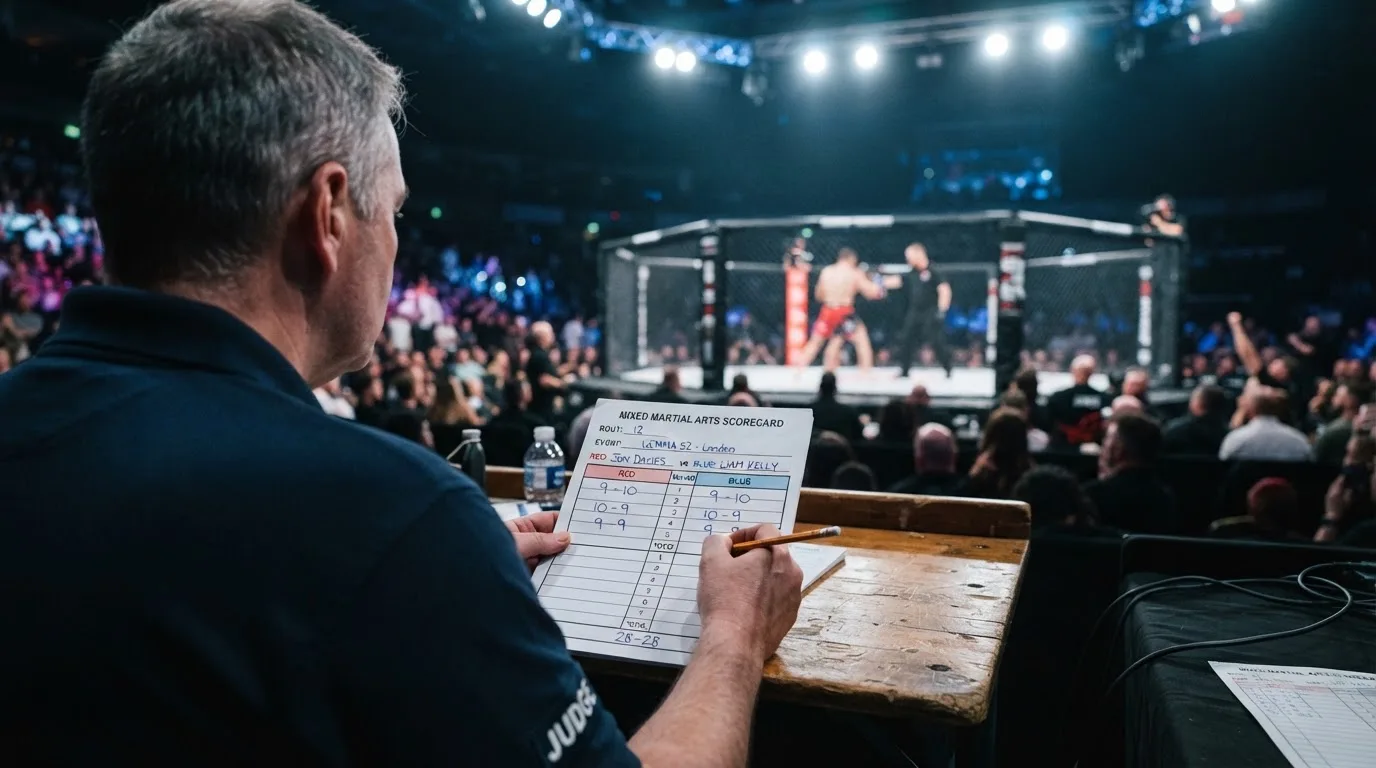
Title fights run five rounds under the Unified Rules of Mixed Martial Arts. Non-title bouts run three. Each round lasts five minutes with a one-minute rest between rounds. Three judges score every round on the 10-point must system: the round winner gets 10 points, the loser 9 or fewer, and an even round is scored 10–10. The fight ends when one fighter is knocked out, submitted or — at the referee’s discretion — stopped via technical knockout, after which the judges’ scorecards are no longer needed; in a bout that goes the distance the judges’ collective verdict decides the winner.
A unanimous decision has all three judges agreeing on the fighter; a majority decision has two for one fighter and one scoring it a draw; a split decision has two judges disagree. The same three terms describe the three forms a draw can take. A disqualification ends a fight when an intentional foul has incapacitated a fighter; an unintentional foul that does the same produces a no contest. Punters betting on method markets need to know the difference: “by disqualification” is a method-of-victory line distinct from “by KO/TKO”.
The Schedule and the Betting Window
UFC Fight Nights run weekly. Numbered events — UFC 320, 321 and so on — typically carry five main-card fights and form the bulk of a punter’s Saturday-night menu. The interim window between the close of pre-fight markets and the start of round one is short, often minutes, with the live market opening seconds after the cage door closes. A bettor who plans to lay wagers during the undercard will see market refreshes roughly every round on the main event.
Limits, Weights and What Affects the Line
Bookmakers do not publish a single MMA-specific max-stake rule the way they publish one for horse racing. Punters who want to know the upper limit on a UFC main-event moneyline usually find it in the bet slip itself — most books adjust the ceiling automatically based on the liquidity of the event and the operator’s exposure on either side of the line. Lower limits are routine on Bellator and PFL cards where the bookmaker’s model has less data.
The Ten Operators — Where Each One Sits
Ten brands hold a Commission remote licence for fixed-odds betting in Great Britain and offer MMA markets to a degree. The ranking below is not a recommendation and not a leaderboard — it is a working map of where each operator does what, written so a punter can choose based on their own priorities. No single brand is “the only” licensed MMA bookmaker in Great Britain, and the Commission’s register lists many more brands than the ten below.
A note on offers: every brand in this section describes its own terms. Where the offer reads as a free bet, the stake is usually not returned on a winning wager. Where the offer reads as a bonus, a wagering condition attaches unless terms say otherwise. Where the offer reads as a refund-on-loss, the refund is almost always in free-bet tokens. Read the operator’s own promotional terms page before claiming — a 50% back as a free bet is not 50% of your stake back as cash.
Octobet — Gambling Commission account 62545
Octobet’s sportsbook welcome offer is 50% back as a free bet up to £50, plus a £10 casino bonus for new customers. The brand operates under Octopus Game Limited, and the Commission’s register lists it for remote general betting standard (real events). The product is MMA-angled: Octobet’s accent is on combination bets and boosted-odds promos rather than the depth of any single card.
For a punter who wants the welcome offer and is happy to take a bonus whose terms are read carefully, Octobet is a reasonable entry point. For a punter chasing the deepest UFC market on the night, the operator’s product is not the same as bet365’s.
Tote — Gambling Commission account 54779
Tote runs under TDCO Limited and offers pool betting on horse racing alongside its fixed-odds book. The MMA angle is secondary to its racing roots: where Tote carries UFC markets, the lines tend to be tighter on the headline price than on methods or rounds, and the site’s tools are built with the racing punter in mind. Account 54779 on the Commission’s register covers remote general betting standard (real events).
BetUK — Gambling Commission account 39198
BetUK is operated by LeoVegas Gaming PLC, and the Commission’s register lists it for remote general betting standard. The sports welcome offer is four £10 free bets on first deposit and a qualifying £10 sports bet within seven days: two football accumulators of four or more selections, two multiples of two or more, all free-bet tokens valid for seven days with opt-in required.
For an MMA punter, BetUK sits in the wider UK sportsbook category: it carries UFC cards with a standard set of markets and offers the free-bet welcome bundle the LeoVegas Group is known for. The MMA product is functional rather than distinctive.
LiveScore Bet — Gambling Commission account 56859
LiveScore Bet runs under LiveScore Betting and Gaming (Gibraltar) Limited. The product mixes the familiar score-and-stats experience with a fixed-odds book whose Bet Builder allows up to 10 selections on match result, both teams to score, corners, total goals, player scoring and card markets. The depth of builder markets is football-shaped; MMA product lines are available but the feature set is the same as the rest of the league.
For an MMA punter, the headline attribute is the operator’s design language — prices, scores and stats in one app — rather than any MMA-specific feature.
Sporting Index — Gambling Commission account 27343
Sporting Index runs a fixed-odds book alongside its spread-betting products under Sporting Index Limited. It offers in-play betting, Bet Builder for football, auto cash-out and Multi-Markets (a same-event multiple product). The MMA product lives inside the fixed-odds side of the business; the spread side does not carry cage markets because spread betting on MMA outcomes is not a typical offering.
A punter who values the same operator across fixed-odds and spread — for racing or financial markets — may find it useful to keep an MMA stake inside the same brand. The MMA product itself is mid-market.
Spreadex — Gambling Commission account 8835
Spreadex combines fixed-odds and spread betting in one app. One-click, auto and partial cash-out, Bet Builder across fixed odds or spreads, and live streaming of UK and Irish horse racing, greyhounds, tennis, NFL and selected football. Spreadex is regulated by the FCA for spread betting and by the Gambling Commission for fixed-odds betting; the two regulators divide the product.
Spreadex’s terms state that spread-betting losses can exceed the deposit. The warning belongs to the spread side of the business; the fixed-odds MMA side carries the same max-loss protection as any other fixed-odds book. A punter who already runs a Spreadex spread book can add MMA into one wallet — useful. A punter using Spreadex only for MMA is paying for a wider product set than they need.
bet365 — Gambling Commission account 55148
bet365 is the global betting partner of the UEFA Champions League and Apple’s UK store lists it as the most downloaded sports betting app in the country. The platform’s MMA product runs in-play, with Match Live, Bet Track, a Live Golf Tracker and live streaming worldwide. Bet Builder+ combines markets from one event into a single bet available pre-match and in-play; Super Boosts, Winnings Boosts on Bet Builders and selected singles, and daily Bet Boosts sit alongside.
For an MMA punter who wants one app for every market — UFC cards with deep builder markets, in-running prices on every televised bout, live streaming where rights allow, plus horse racing, football and everything else — bet365 is the reference point. The Commission’s account 55148 sits with Hillside (UK Sports) ENC, and the licence covers remote general betting standard (real events).
Dabble — Gambling Commission account 65677
Dabble runs under Dabble Sports UK Ltd, with a £10-in-free-bets-on-£10-first-deposit welcome offer, minimum-odds terms, a seven-day free-bet expiry and the stake not returned on a winning wager. The Commission’s register lists account 65677 for remote general betting standard (real events). The app is designed around social betting, with a community feed alongside the betting slip.
For an MMA punter, Dabble sits in the social-led corner of the market. The product is well-suited to the casual punter who wants to follow a community read on the card; the MMA depth is mainstream rather than specialist.
Fafabet — Gambling Commission account 57385
Fafabet runs under Taichi Tech Limited. Its app carries Best Odds Guaranteed on UK and Irish horse racing win and each-way bets from 9 AM on race days — if the starting price is bigger than the original price, the bigger odds are paid. The feature belongs to horse racing, not MMA. The MMA product is mainstream: UFC cards with the standard market set on the headline events, with tighter product on lower-profile promotions.
Kwiff — Gambling Commission account 44448
Kwiff is licensed by the Commission under account 44448, with Eaton Gate Gaming Limited as the licence holder. The brand describes itself as a trademark operated by Spryme Ltd and carries a 17+ age rating on the App Store. The product is MMA-functional rather than MMA-specialist: standard markets on UFC cards, with the brand’s “supercharged” pricing mechanic on certain selections.
For an MMA punter looking for a brand that brings a different mechanic to the price, Kwiff’s framework offers a sharper focus than a generic book. The depth of any single card is less than a bet365 or a William Hill.
How the Bookmaker’s Margin Lands on Your Bet
The most informative thing a price tells a punter is not the fighter’s chance of winning — it is the operator’s margin on the market. A market tightens every time a punter moves from one bookmaker to another to find the best price; a market loosens when the punter accepts the first price the book offers. The 5% line in the worked example above is the floor under which no UK bookmaker goes for very long on a popular UFC fight; the ceiling on obscure markets or in-play pricing is closer to 8 or 10%.
A punter’s working habit is to compare the headline price on the same selection across two or three books, watch the margin on the combined odds, and pick the line where the operator’s edge is thinnest. No punter picks a bet by comparing prices on different fighters — the meaningful comparison is the same fighter across books.
A Note on Closing-Line Value
A punter who consistently beats the closing line — the final price a bookmaker offers before the bell — has a verifiable edge, because the closing line represents the market’s consensus read on the fight. Backing a fighter at 2.10 when the closing line sits at 1.83 is a positive expected-value pattern over many bets. The same bet at 2.10 when the closing line is 2.50 is a negative expected-value pattern even though the headline price looks attractive. A punter who treats “long price” as value without checking where the line closes is leaving money on the table in one direction and overpaying in the other.
Comparing the Ten Operators
The matrix below lists each brand, its Gambling Commission licence number and licence holder, and what each operator’s own terms say about MMA pricing or the in-play product. The qualification column carries the operator’s own framing — not a normalised description — because the differences between books are themselves informative.
| Brand | Gambling Commission licence | What the operator’s own terms state |
|---|---|---|
| Octobet | 62545 — Octopus Game Limited | Sportsbook welcome offer is 50% back as a free bet up to £50 plus a £10 casino bonus for new customers |
| Tote | 54779 — TDCO Limited | Pool betting on horse racing alongside fixed-odds book; MMA is a secondary product |
| BetUK | 39198 — LeoVegas Gaming PLC | Four £10 free bets on a qualifying first £10 sports bet within seven days; free-bet tokens valid seven days, opt-in required |
| LiveScore Bet | 56859 — LiveScore Betting and Gaming (Gibraltar) Limited | Bet Builder allows up to 10 selections on match result, both teams to score, corners, total goals, player scoring and card markets |
| Sporting Index | 27343 — Sporting Index Limited | Switches between fixed odds and spread betting; in-play betting, Bet Builder for football, auto cash-out and Multi-Markets |
| Spreadex | 8835 — Spreadex Limited | Combines fixed-odds and spread betting in one app; one-click, auto and partial cash-out; live streaming where rights allow |
| bet365 | 55148 — Hillside (UK Sports) ENC | Bet Builder+ combining markets from one event pre-match and in-play; Super Boosts, Winnings Boosts and daily Bet Boosts; in-play and live streaming worldwide |
| Dabble | 65677 — Dabble Sports UK Ltd | “Bet £10, Get £10 in Free Bets” welcome on first deposit; minimum odds apply; seven-day free-bet expiry; stake not returned |
| Fafabet | 57385 — Taichi Tech Limited | Best Odds Guaranteed on UK and Irish horse racing from 9 AM race day; if the SP is bigger than the original price, the bigger odds are paid |
| Kwiff | 44448 — Eaton Gate Gaming Limited | Brand describes itself as a trademark operated by Spryme Ltd; App Store age rating 17+ |
Each licence entry matches an entry on the Commission’s public register. Brands using a .com or a .co.uk domain both appear in the Commission’s records; domain choice does not affect the licence status. Brands run by the same parent — LeoVegas Gaming PLC is the parent of BetUK, Hillside (UK Sports) ENC is the bet365 UK entity, Taichi Tech Limited and Eaton Gate Gaming Limited sit with Fafabet and Kwiff respectively — still publish one licence per brand and operate as separate brands from the punter’s point of view.
Tax, Withdrawals and the Last Things to Watch
The punter pays no tax on MMA winnings in Great Britain. General Betting Duty is the operator’s tax and currently runs at 15% on gross profits; from 1 April 2027 a 25% remote rate applies within General Betting Duty for online bets other than UK horse racing, while pool betting and in-person betting stay at 15%. Whether operators pass duty through into odds is not established, and never assume the punter is charged. For a professional gambler the position is different from a casual punter, and HMRC or an adviser is the right route to a specific tax question.
Withdrawals sit inside each operator’s terms. Most allow debit-card withdrawals back to the original deposit method, bank transfers for verified accounts, and e-wallet withdrawals where the punter used an e-wallet to deposit. A punter who has run a bonus through a wagering condition usually finds withdrawals enabled automatically once the condition is met; a punter who has not yet had identity verified will not see a withdrawal processed at all.
What a Reader Should Take Away
The ten operators above all offer MMA betting under a Commission licence and pay the same duty, but they are not interchangeable. A reader looking for the deepest live product will not find it where a reader looking for a generous welcome offer does. A reader running multiple products — fixed-odds, spread, casino — benefits from keeping those bets inside one brand; a reader who bets only on UFC cards once a month is paying for a wider product set than they need at multi-product brands.
The maths on the wagering requirements is published in full: a £10 free bet at decimal odds 2.00 on a 95% payout market is worth roughly £5 of expected return, not £10. The marketing word “free” costs the punter something every time the stake does not return with the winnings. A reader who remembers that one number has done most of the work needed to read every MMA promotion the ten brands in this ranking will ever run.
Frequently Asked Questions on MMA Betting Odds
How does MMA betting work?
A licensed UK bookmaker opens markets on a fight card well in advance of the bout and re-opens them in-play between rounds. You back a selection — fighter to win, method of victory, round grouping, total rounds over or under, “goes the distance” — at the decimal price published on the betting slip. If your selection lands, the payout is stake × decimal odds, with the stake returned on a moneyline win but not on a free bet.
Where to bet on MMA fights with high odds?
Look for the highest decimal price for the same fighter across two or three books; a 1.95 at one operator is the same bet as 2.00 at another, with the second carrying the thinner margin. Mid-card fights and prop markets carry the looser lines because the bookmaker’s pricing is less certain. The Commission’s public register confirms each bookmaker’s licence — every brand in the ranking above is on it.
Is it top value MMA bets this weekend?
This page does not name winners, because no one knows in advance. Read the closing line on each fight — the final decimal price before the bell — and back your own view at a price bigger than where the line sits at close. A bet priced where the bookmaker takes a thin margin is a workmanlike starting point; the rest is the punter’s reading of the form.
How can it be checked that a bookmaker holds a Gambling Commission licence?
Search the Commission’s public register by business name, trading name, domain or account number. Every brand in this ranking is on the register under the licence numbers in the table above. A .co.uk domain is not a guarantee of a licence; only the Commission’s own record counts.
How is the return on a bet worked out from the stake and the odds?
The decimal price × the stake gives the gross return on a winning bet. A £10 stake at decimal odds 2.50 pays £25 (£15 profit plus the £10 stake back). For a free bet whose stake is not returned, the punter keeps only the profit — the £10 above becomes £15 rather than £25.
What is the bookmaker’s margin and how can it be seen in the odds?
The margin is the share of every pound wagered that the book keeps on average across the market, expressed as a percentage. A two-way market priced 1.90 against 1.90 carries a margin of roughly 5%. On a three-way method market priced 3.50 / 4.50 / 1.66 the margin is closer to 8%. The lower the margin on the market the punter keeps betting on, the longer the punter’s stake lasts.
Combat & motorsport – Best betting
Content created by the «Best betting» team
