
Horse racing odds explained – who prices the field
 Available in US
£5 at 5/2 returns £17.50 if the horse wins. That arithmetic is the easy half. The harder half is understanding what the 5/2 actually says about the field, why one bookmaker pays a slightly shorter price than another on the same horse, and which of the licensed brands in Great Britain has built a racing book around the kind of punter you are. This page works through the mechanism first, then the market, then the comparison across ten operators that hold a Gambling Commission remote licence for real-event betting.
*Data current as of 27 October 2026 and cross-checked against the Gambling Commission’s public register.*
What “horse racing betting odds” actually means
A horse racing price is the bookmaker’s quote on a single outcome of one race. There are three things inside that number: the bookmaker’s view of the horse’s chance, the margin the bookmaker keeps, and the weight of money already taken on the runner. Fractional odds (5/2, 11/4, evens) are the British house style; decimal odds (3.50, 3.75, 2.00) are the equivalent everyone reads at a glance. The conversion runs one way: fractional a/b translates to decimal a ÷ b + 1. 5/2 becomes 3.50. 11/4 becomes 3.75. Evens, where the stake equals the profit, is 2.00.
A price shorter than evens — 4/6, for example — is called odds-on and means the bookmaker thinks the horse is more likely to win than not. Odds-against runs the other way: any fraction above evens pays more than the stake. The starting price, written SP, is the industry’s final price on a horse, set at the off from the last on-course and off-course trading. Best odds guaranteed, abbreviated BOG and paid by every major shop, tops up any earlier fixed price up to SP for bets placed before the race.
The practical lesson sits one level down. Two horses in the same race at 5/2 and 5/2 are not offering the reader the same value as the same two horses priced 3/1 and 3/1. The market’s margin, the cut the bookmaker keeps whichever horse wins, changes as the prices change. The next section works through that margin using the page’s own illustrative market.
How the margin hides inside every price
Take an illustrative two-way market at decimal odds 1.90 / 1.90. The decimal is the equivalent of 9/10, fractional, and is the cleanest possible price pair for showing the arithmetic. Payout share is calculated as 1 ÷ (1/1.90 + 1/1.90), which gives roughly 0.95, or 95%. The margin is 1 − payout share, so 1 − 0.95 = 0.05, or about 5%. That five points is the bookmaker’s take on this market, present in both prices, won on whichever side settles.
Real horse racing markets are not two-runner affairs. A twelve-runner maiden has twelve possible winners, and the payouts sum to less than 100% across all of them. A bookmaker overround of 110% on a big-field handicap means roughly 10% margin across the field. A morning favourite in a small four-runner race might be priced into a market at 105% overround — tighter than the big-field book, because the favourites-only market is harder to rig without standing out.
The shape matters more than the headline number. The margin is what erodes a punter’s edge before the first fence. A racing system that picks 10% winners at true probabilities loses money on a 15% margin book and turns a small profit on a 5% margin book. Reading the price the field carries, rather than the price a single horse carries, is the practical test.
A worked example brings it home. Consider a four-runner race priced 2.50 / 3.50 / 5.00 / 13.00 in decimal. Payout share sums to 1 ÷ (1/2.50 + 1/3.50 + 1/5.00 + 1/13.00) ≈ 1 ÷ (0.400 + 0.286 + 0.200 + 0.077) ≈ 1 ÷ 0.963 ≈ 1.04, or about 104%, which is a 4% margin across the field. Tighter than the big-field handicap, looser than the illustrative two-way above. A bettor who treats every price as carrying the same hidden cost is paying tax on races that don’t charge it.
The price cycle on race-day
A horse’s price at 9 AM is rarely its price at 1 PM. Two forces move it: bookmaker risk (a popular public horse whose price has shortened) and the betting exchange lay side (where professional punters lay the favourite off if they think it should be longer). Best odds guaranteed locks in the better of the two prices for bets struck earlier in the day. The same £10 at 5/1 in the morning and 7/2 by the off returns £60 if the SP is 7/2 and BOG applies — versus the £50 the original price would have paid.
The mechanical quirk worth knowing: BOG applies to UK and Irish racing from 8 AM on the day of the race, on single and multiple bets, but does not cover ante-post wagers placed days earlier, nor tote or pari-mutuel pools. A punter who takes 10/1 about a horse in February for the Derby in June has no BOG insurance if the horse drifts to 20/1 by the off.
Flat, jump, and the British calendar
British racing splits cleanly into two codes. Flat racing is run directly between two points around a straight or oval track. Jump racing — the sport known on these islands as National Hunt, comprising steeplechases over larger obstacles and hurdles over smaller ones — runs the rest of the winter calendar. Races on the flat range from 440 yards (400 m) up to more than four miles (6.4 km), with five to twelve furlongs the most common distances. Jump races start shorter and go further, from the minimum trip of around two miles up to the Grand National at four and a quarter miles with thirty obstacles.
Handicap races are where weights do the bookmaker’s job for them. Each horse carries a different weight, assigned by the British Horseracing Authority’s official handicapper based on the horse’s recent form, so a 10-1 shot with a featherweight may be a worse proposition than a 4-1 shot lugging top weight. Conditions races level the weights for younger horses and fillies and mares, and let ability fight form on even terms.
The British Triple Crown is the country’s oldest three-race series: the 2000 Guineas, the Derby and the St Leger. A horse that wins all three in the same season completes the Crown — a feat done only a handful of times in living memory. The Grand National, the Cheltenham Gold Cup and the Champion Hurdle sit on the jump calendar’s equivalent tier. None of this year’s results is on the page yet, because none have been run; the calendar itself is the constant.
Each-way: two bets for the price of one
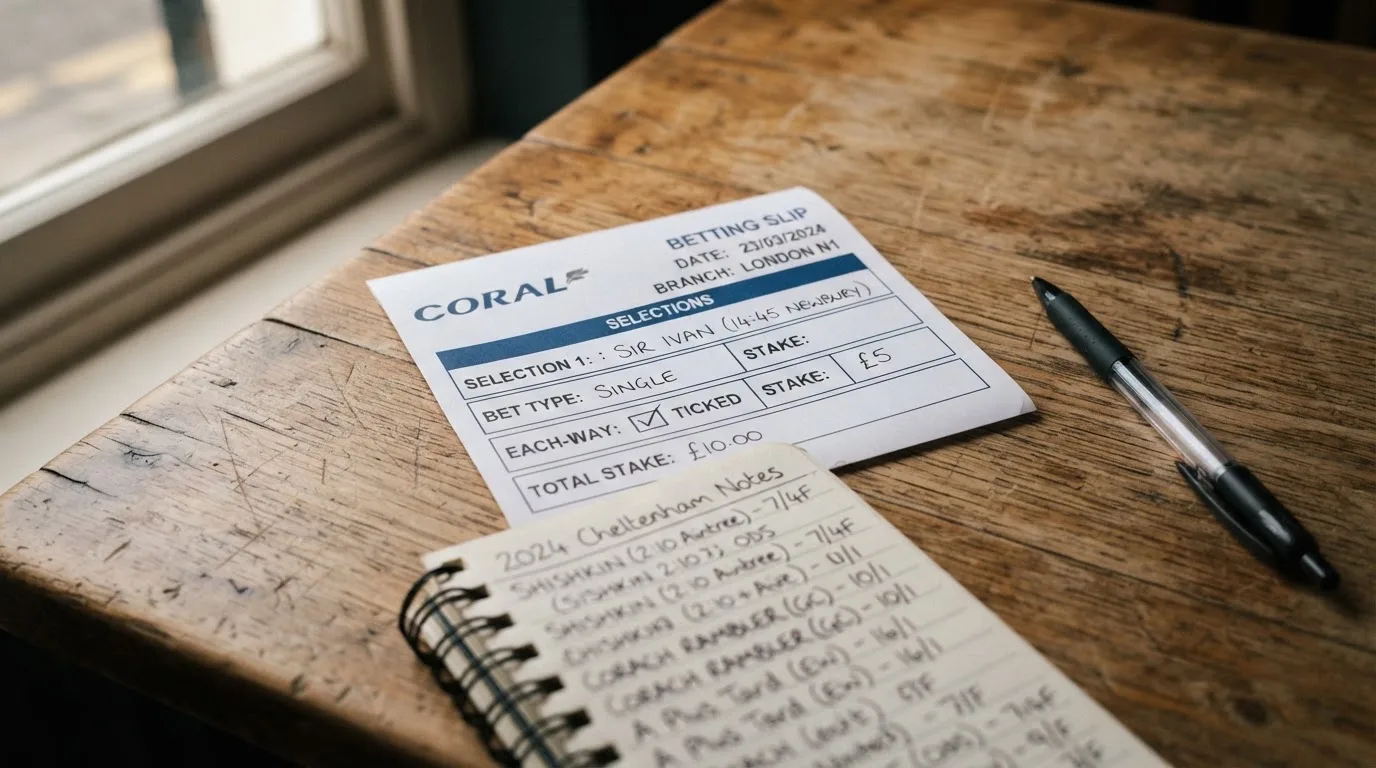
An each-way bet is two bets of equal stake: one for the win, one for the place. The stake doubles. A £5 each-way bet costs £10. The place part pays a fraction of the win odds, and the fraction varies by race type and field size.
UK each-way place terms run to a published schedule. Handicaps with more than 15 runners pay 1/4 odds for 4 places. 12-to-15-runner handicaps pay 1/4 for 3 places. Other races with more than 7 runners pay 1/5 for 3 places. 5-to-7-runner races pay 1/4 for 2 places. Fewer than 5 runners offers win only — the place part is returned if the horse wins, dead-heats or the race is void, but no separate place dividend exists.
The worked example that maps the schedule to a payout: a £10 each-way bet on a 10/1 horse at 1/4 place terms (3 places) costs £20 in stake. If the horse wins, the win leg pays £100 profit plus the £10 stake back, and the place leg pays £25 profit (10/1 at 1/4 = 5/2, so £10 × 2.5 = £25) plus £10 stake back. Total return is £145 on a £20 outlay. If the horse places only, the win leg loses, the place leg pays £25 + £10 = £35 return, and the £10 win stake is forfeit. Net cost of the trial is £5 — the £10 lost on the win leg minus the £5 profit on the place leg.
Each-way pays where the win odds are long. A 3/1 shot at 1/4 place terms returns 13/8 if it places (3/1 × 1/4 = 3/4, plus the unit, so 7/4 — corrected: 3/1 at 1/4 is 3/4 place odds, returning a 175% stake-on-place profit or £17.50 on a £10 place). Short-priced favourites pay little each-way and reward the place leg poorly. The structure rewards the punter who prices a horse as a long-shot winner rather than a short-priced place.
Where the each-way math catches the unwary
A common error is double-counting. The bet costs twice the displayed unit stake, so a punter who has £100 to wager and wants £5 each-way bets across twenty horses is laying £200 of stake, not £100. Bankroll management treats each-way as costing the unit stake per runner for book purposes.
A second quirk: place terms vary by operator on the same race. The high-street bookmaker paying 1/4 for four places in a sixteen-runner handicap (a generous 1/4 4-place line) versus the online bookmaker paying 1/5 for three places (standard) makes a £10 each-way difference of £20 to £10 on the winning horse. Worth checking before staking.
Other bet types the racing book carries
Singles, doubles, trebles, accumulators. A single is one selection. A double is two. A treble three. An accumulator (shortened to acca in racing language) is four or more. Multiples multiply the decimal odds of each leg into one price, so a four-fold acca at 2.00, 3.00, 4.00 and 5.00 prices out at 120.00 — a winning £5 returns £600. The catch is that each leg must win on its own, and the more legs the more the bookmaker’s compounded margin erodes the implied probability.
Full-cover bets package multiples into a fixed structure. A Trixie is three doubles and a treble, four bets from three selections. A Patent is three singles, three doubles and a treble, seven bets from three. A Yankee is six doubles, four trebles and a four-fold acca, eleven bets. A Lucky 15 is four singles, six doubles, four trebles and a four-fold, fifteen bets. A Heinz is fifty-seven. A Goliath is two hundred and forty-seven. The unit stake multiplies across the structure, so a £1 Lucky 15 on three horses costs £15 in total stake.
Ante-post. Bets placed before the final declarations are confirmed. The price is longer than the day-of-the-race price, because the field can change. The catch is the non-runner rule: if the horse is declared a non-runner after the bet is struck (and the bookmaker’s rule is the standard British Horseracing Authority rule), the stake is refunded — but only if the bet was placed with a BOG-eligible bookmaker that honours the refund. Some ante-post books forfeit the stake on a non-runner. Read the small print.
Spread betting. A different beast entirely. Spread betting is not a price on a horse at all; it is a quote on a number — the winner’s winning distance, the number of finishers, the winning margin at the line — and the punter’s profit or loss is multiplied by how far the result is from the quoted spread. Spreadex, regulated by the Financial Conduct Authority for its spread products and by the Gambling Commission for fixed-odds sports, carries an explicit warning that losses can exceed the deposit. Spread betting is licensed separately from fixed-odds betting and carries its own duty rate.
Betting exchanges. Lay the horse rather than back it. A backer’s £10 at 5/1 is matched against a layer who thinks the horse should be shorter, and the layer’s liability is the backer’s potential winnings. Exchanges run on a betting intermediary licence — a separate Gambling Commission category from the standard remote general betting licence.
Promotions, free bets and the £100 turnover ceiling
The page has a paragraph on offers because every racing punter meets them, and a rule that governs most of them. Wagering requirements on bonuses are capped at 10x at every GB-licensed bookmaker. A £10 bonus needs £100 of qualifying bets before the bonus converts to withdrawable cash. Heavier terms — 30x, 50x — are not legal in Great Britain on a standard betting bonus. Mixed-product promotions (an offer tying a sports bet to a casino spin or a bingo ticket to unlock a sports free bet) are banned.
The cap does not reach every offer. Free bets whose stake is not paid back with the win are usually treated differently: many bookmakers pay no wagering requirement on free-bet winnings, only a minimum-odds threshold and a deadline. The 10x cap applies to deposit-match bonuses and stake-back offers that return bonus funds. Free-bet credits that convert straight to withdrawable cash on settlement are outside it.
The deadline governs every offer type. Seven days is the industry standard for free-bet expiry from the moment the credit lands in the account. A punter who doesn’t get the free bet on in time loses it; the offer is forfeit, the qualifying stake still counted. Minimum odds usually sit around 1/2 (1.50 decimal) on the qualifying bet, sometimes 4/6 (1.67 decimal) on the free-bet placement itself.
The marketing words deserve a clinical reading. “Risk-free” typically means a refund as a free bet, not a refund in cash — the original stake is lost, the refund is a free-bet credit with its own expiry. “Free bet” is exactly what it says, with the caveat on stake-not-returned. “Best odds guaranteed” is the offer that pays the difference between the morning price and SP, and is the racing punter’s only free hedge against late market drift. “Enhanced odds” is a one-off price boost on a chosen runner, and the extra winnings are usually paid as free bets or capped at a stated maximum. The word that is always worth checking is “guaranteed” — it tends to come with conditions.
In-play, cash out, and the stream question
In-play, or in-running, betting lets a punter strike a bet after the race has started. Every modern GB bookmaker carries an in-play racing book on the major meetings, with prices updating through the race as the running unfolds. LiveScore Bet carries an in-play section; the larger firms run it as standard.
Cash out closes the bet before settlement. The bookmaker offers a real-time price on the current position — lock in a profit if the horse is travelling well, cut a loss if it isn’t. Cash out is a tool, not a guarantee: the offered price is the bookmaker’s price, with its own margin, and a punter who cashes out at break-even has paid the bookmaker for the privilege.
Live streaming of horse racing in Great Britain is partly a bookmaker product and partly a Racing UK / Sky Sports Racing product. Most GB bookmakers offer live video feeds of UK and Irish racing from a handful of courses — the bigger meetings on Channel 4 Racing’s successor feeds, the smaller meetings as live streams from the tracks. Quality varies by operator and by the meeting: a £10 monthly free-bet stake from a high-street firm may not unlock Cheltenham streaming, while a monthly turnover threshold at the same firm will. Tote customers typically receive racing streams through Tote’s dedicated service.
The question of where to watch depends more on the meeting than the bookmaker. The Grand National and Cheltenham Festival streams freely through bookmaker free-bet-funded products during the meeting; smaller weekday meetings may be stream-only for funded accounts. Racing UK’s subscription product carries most British racing year-round for viewers outside the bookmaker ecosystem.
The legality frame for Great Britain
The Gambling Commission, a non-departmental public body sponsored by the Department for Culture, Media and Sport, regulates commercial gambling in Great Britain under the Gambling Act 2005. Northern Ireland sits outside the Act under older legislation; this page reads as a GB page and says so throughout.
The 2005 Act, as amended by the Gambling (Licensing and Advertising) Act 2014, requires an operator whose remote facilities are used in Great Britain to hold a Commission licence wherever it is based. A Curaçao, Maltese or Gibraltar corporate licence is not enough on its own. The Commission’s public register, searchable by business name, trading name, domain or account number, is the whole test: it is the GB licence record, and the licence number on it is the operator’s licence number. A licence verified this week is verified as at this week — the register is the date of access, not the date of issue.
Categories on the register matter for the kind of betting offered. Remote general betting standard (real events) is the category every sports bookmaker on this list holds. Remote general betting standard (virtual events) is a separate category for computer-simulated fixtures. Remote pool betting covers off-course pool betting on horse and dog racing. Betting intermediary is the exchange category. A bookmaker offering fixed-odds racing prices needs the standard real-events licence; a tote operator needs pool betting; an exchange needs intermediary; a brand offering all three holds all three.
There is no statutory list of permitted sports or markets. There is no statutory cap on stakes in sports betting. There is no state monopoly. The book’s content is the operator’s licence conditions and its own house rules, within the framework the Act and the Commission’s Licence Conditions and Codes of Practice (LCCP) impose.
What may be bet on is wide. In-play sports betting, virtual events, esports, politics, TV shows and novelty markets are all available at licensed GB bookmakers. The control is the operator’s licence conditions and customer-protection duties, not a statutory prohibition list. Pool betting on horse racing carries its own separate duty.
Advertising runs through a parallel framework. The Committee of Advertising Practice (CAP Code, non-broadcast) and the Broadcast Committee of Advertising Practice (BCAP Code, broadcast) handle ad content; the Advertising Standards Authority enforces. The LCCP marketing conditions sit alongside. Section 16 of the CAP Code requires that marketing is socially responsible, must not appeal strongly to under-18s, and must not feature someone who is or appears to be under 25 in a significant role (with an exception for marketing placed at the point of bet placement). The rule concerns who appears in advertisements, not who may place bets.
Bonuses, deposits, credit cards
GB bookmakers cannot accept credit-card deposits for gambling — the rule took effect on 14 April 2020 under LCCP condition 6.1.2, and covers credit-card-funded e-wallet deposits too. Debit cards and bank-based payments are not covered. The minimum age is 18. Name, address and date of birth are verified before the first deposit or bet — including with a free bet or bonus — under rules in force since 7 May 2019.
Tax
The player pays no tax on betting winnings in Great Britain, although a professional gambler should ask HMRC or an adviser. General Betting Duty is the operator’s tax on gross profits, currently 15%; from 1 April 2027 a new remote betting rate of 25% applies within it, with remote bets on UK horse racing, self-service betting terminal bets, pool betting and in-person betting staying at 15%. Until that date, the remote rate is 15% across the board. Spread betting carries separate rates of 3% on financial and 10% on other. The Commission’s statutory levy sits separately.
The offshore frame
A GB licence is compulsory at the point of consumption: an operator whose facilities are used in Great Britain needs the licence, wherever it is based. A punter using an unlicensed site loses the GB protections — no GAMSTOP coverage, no Commission complaints route, no approved alternative dispute resolution, no British consumer redress if funds are withheld, not bound by the 10x bonus cap or the £150 vulnerability check. The Commission pursues enforcement against operators, not customers: cease-and-desist notices, search-engine referral changes, registrar and host liaison, payment-provider work, and court-order DNS blocking powers the Commission is gaining or about to gain. ISP blocking is not in operation at the time of writing, and no offence aimed at a customer who bets on an unlicensed site was found in the framework.
The honest framing: licensed equals the checks, limits, GAMSTOP, bonus cap; unlicensed equals none of those and possible loss of funds. Neither is “the safe choice” by default. The choice is which trade-off fits the situation.
Responsible gambling: the framework that protects the punter
GAMSTOP is the national multi-operator online self-exclusion scheme and a mandatory licence condition for online operators since 31 March 2020. Periods run to six months, one year, five years, or five years with auto-renewal. After the minimum period the exclusion stays in place for a further seven years unless the customer asks GAMSTOP to remove it. GAMSTOP covers online sites and apps; betting shops use a separate self-exclusion service. Every GB-licensed online operator on this page is a GAMSTOP member; the unlicensed operators are not.
Financial vulnerability checks apply at licensed remote betting operators (LCCP condition 3.4.4, in force since 30 August 2024) when a customer’s deposits minus withdrawals exceed £150 in a rolling 30 days. The check is a public-record check — bankruptcy, county court judgments, similar registers — not an income check or a credit reference check. Financial risk assessments — the affordability checks of the press coverage — have been announced by the Commission in a staged plan published in 2026, with no start date as at this writing; write that as “announced, staged, no start date”, not “in force”.
Deposit limits sit at the operator level: every GB-licensed bookmaker offers a gross deposit limit on a fixed time frame, with the first changes in force since 31 October 2025 and a second phase postponed to 30 September 2026. Whether the second phase has come in is not established. There is no state-set deposit or loss ceiling for betting; limits are the customer’s choice until the customer asks for a higher cap and the operator agrees.
Help is available without depending on the operator. GamCare runs the National Gambling Helpline (24 hours, free, confidential). GambleAware funds research, education and treatment. Gamblers Anonymous runs peer-support meetings across the country. The NHS gambling clinics offer specialist treatment; local NHS talking-therapies (IAPT in England) can refer onwards. Most operators carry links to all four on their safer-gambling pages.
Operators licensed outside the Great Britain regime represent a different licensing category; they do not describe a category of punter, a category of bet, or an evasion of the registration process. A customer who has registered with GAMSTOP cannot open an account at any GB-licensed bookmaker during the exclusion period; opening one at a non-GB operator does not register on GAMSTOP and does not enforce the exclusion the customer has set themselves. The choice to bet offshore during a self-excluded period defeats the exclusion the customer asked for.
Cryptocurrency at the racing book
No British named-account rule, no state list of permitted payment methods, and no rule for or against cryptocurrency deposits at licensed operators was established. The general frame is that licensed operators verify identity before the first deposit — name, address, date of birth — so anonymous play at a GB-licensed site is not available whatever the funding source. A punt funding an account with a crypto-asset on a GB-licensed book goes through the verification flow as any other customer.
Operators licensed outside the Great Britain regime that accept crypto deposits are not on this page’s comparison list. The Commission’s public register remains the test of GB licensing; a brand on that register and accepting a crypto deposit runs the standard verification and stake-limit regime. A brand not on the register is treated as unlicensed for the purposes of this page.
Mobile and apps: how the racing book travels
The racing book on mobile is, in practice, the racing book full stop. The GB app market is dominated by three or four brands on the App Store charts; the rest of the licensed set runs mobile-first sites with full sportsbooks.
A betting app should run quickly on the day of racing, with in-play markets updating as the field approaches the start, fast market navigation between meetings, and a bet slip that handles an each-way bet without splitting it into two fingers on the slip. Live streaming of racing in the same app is the standard expectation. Push notifications on price boosts and BOG updates are the small difference between brands. Touch ID login and instant withdrawals to debit are table stakes.
The punt that doesn’t come off on mobile is a slow odds movement after a non-runner. A horse scratched at the start leaves a market repricing, and a slow app shows the old prices for longer than a fast one. Off the line, horse racing odds move in 0.02-decimal increments over a couple of seconds; the speed the app updates at is the speed the punter beats the next customer to the new price. The GB App Store rankings for the racing-relevant weeks are the read-by-eyeball test for which brands have built the slicker mobile experience.
How to bet on horse racing, in five mechanical steps
The arithmetic of a horse racing bet is straightforward once each step is clear.
Step 1 — pick the race and the horse. A racing card lists the runners, the form, the going, the distance and the trainer-jockey combination. A short-list of three horses from a twelve-runner field is the typical racing analyst’s output.
Step 2 — set the stake. Bankroll management runs on units, usually 1% of the betting bank per selection. A punter with a £1,000 bank wagers £10 units on a single bet, scaling the unit if the value stands out.
Step 3 — choose the bet type. Single, each-way, double, treble, acca, or one of the full-cover structures. The bet type changes the cost (each-way doubles, full-cover multiplies) and the risk profile (more legs, more variance).
Step 4 — place the bet. Confirm the price at the time of the bet. The price visible on the screen at the moment of placing is the price the bet is struck at, not the price at the start.
Step 5 — settle. If the horse wins, the win leg pays; if it places within the place terms, the place leg pays; if it neither wins nor places, the stake is lost. BOG tops up the win payout to SP if SP is bigger, on UK and Irish racing from 8 AM on the day. Settled bets appear in the account within minutes of the weighing-in announcement.
The ten licensed bookmakers in this comparison
The ten brands below all hold a Gambling Commission remote licence for real-event betting as at the date of the comparison. Several are siblings under one corporate parent and run racing books of different shapes; the comparison treats them as distinct reviews because each runs its own app, its own price feed and its own promotional calendar in Great Britain. The reviews end with a verdict, not a description.
| Brand | Licence number | Licence holder | What the operator’s own racing terms state |
|---|---|---|---|
| Tote | 054779-R-331321-008 | TDCO Limited | Pool betting specialist operating the Tote; offers Tote bets alongside fixed-odds markets on UK and Irish racing |
| BetGoodwin | 002927-R-327985-008 | Goodwin Racing Limited | Racing-focused sportsbook; covers UK, Irish and international meetings |
| Geoff Banks | 054095-R-330366-010 | GB Sports Advisors Limited | Racing-led bookmaker offering live in-play and ante-post markets |
| VBet | 044662-R-324273-022 | SCGO Limited | Multi-product sportsbook with racing coverage alongside football, tennis and the wider book |
| Sporting Index | 027343-R-308898-011 | Sporting Index Limited | Spread betting specialist with fixed-odds sport; FCA-regulated spread product, GC-regulated fixed-odds |
| Kalooki Sportsbook | 057730-R-333396-005 | Kalooki Sportsbook Limited | Sportsbook covering racing and football; GAMSTOP member |
| LiveScore Bet | 056859-R-332720-005 | LiveScore Betting and Gaming (Gibraltar) Limited | Multi-sport sportsbook with a Bet Builder covering match result, both teams to score, corners, goals and player markets |
| Dabble | 065677-R-340363-005 | Dabble Sports UK Ltd | Social-betting sportsbook with horse racing among the covered sports |
| 10bet | 043173-R-322899-023 | Blue Star Planet Limited | Sportsbook covering football, tennis and racing with cash out, bet builder and live streaming |
| Betfred | 039544-R-319290-010 | Petfre (Gibraltar) Limited | Established high-street brand running a full sportsbook with 21 sports plus casino |
Tote
Tote holds the pool-betting end of the racing book that other bookmakers don’t. The Tote’s offer on a major festival is a tote dividend set by the pool, paid on the win, place, exacta and tricast bets. On a quiet Tuesday at Wolverhampton, the same brand runs fixed-odds markets alongside the pool, with each-way terms set by the standard industry schedule. Tote’s value to the racing punter is the dividend product on the big days — the Tote Ten to Follow, the placepot, the Scoop6 on the bigger festivals — which fixed-odds books do not replicate.
The verdict: Tote suits a punter who follows the racing calendar into its festival windows and wants the pool dividend on the headline meetings. The fixed-odds book is competent rather than headline-grabbing; the value sits in the pool.
BetGoodwin
Goodwin Racing’s online sportsbook carries the racing focus of the parent firm’s high-street brand. Pricing on the morning of a meeting tends to track the early industry line, with the BOG top-up to SP on UK and Irish racing. The each-way terms follow the industry-standard 1/4 3-place or 1/5 3-place lines rather than the more generous 1/4 4-place lines on the larger fields. The welcome offer is structured as three free-bet credits (sports, acca, sub-cover) rather than a single bonus block.
The verdict: BetGoodwin suits a UK and Irish racing-only punter who is happy to take a competitive but mainstream price and values the racing focus of the brand over a full multi-sport book. The three-part welcome offer reads as a sportsbook aimed at the racing customer who places a daily treble.
Geoff Banks
Geoff Banks runs the racing-led bookmaker the GB Sports Advisors parent built for the racing-only punt. The app carries live in-play prices, ante-post markets on the bigger festivals and the smaller meetings, and a tighter price feed than the multi-sport brands. The racing terms read like a high-street racing firm’s terms; the multi-sport coverage is thin and a punter looking for a Premier League bet builder should look elsewhere.
The verdict: Geoff Banks is the choice for the racing-only punter who doesn’t want a multi-sport book. Ante-post pricing on the Cheltenham Festival and the Grand National is the brand’s strength.
VBet
VBet runs a multi-product sportsbook with a racing section among the football, tennis and US sports lines. The welcome offer is a single free bet (qualifying bet loses, free bet credited) rather than a deposit-match structure — a stake-back pattern rather than a matched-bonus pattern. The product is broad: casino, slots and live dealer sit alongside the sportsbook in the same account, although horse racing is its own licence category within the broader offering.
The verdict: VBet is the choice for a punter who wants racing alongside a multi-sport book and accepts a flat stake-back welcome pattern over a free-bet bundle. The racing book is competent; the brand’s edge is breadth.
Sporting Index
Sporting Index runs the spread-betting product under FCA regulation and the fixed-odds sportsbook under GC regulation. The crossover is a sportsbook with both fixed-odds and spread quotes on bigger racing events. The fixed-odds terms are industry-standard; the spread product is what the brand exists for, and a spread bet on the day’s winning distances carries the FCA-licensed spread betting disclaimer that losses can exceed the deposit.
The verdict: Sporting Index is for the punter who wants spread quotes on a meeting and accepts that the spread book on race-day is the brand’s actual product. The fixed-odds racing book is a competent second string rather than the headline.
Kalooki Sportsbook
Kalooki Sportsbook runs a newer sportsbook line under a younger GC licence. The product covers horse racing, football and the bigger US sports. The verification flow follows the standard GB pattern and the brand is a GAMSTOP member. Each-way terms follow industry standard; BOG on UK and Irish racing from 8 AM.
Kalooki offers a newer sportsbook with a clean product, suited to punters who accept that a shorter track record may mean less depth in the everyday racing markets compared to established high-street names.
LiveScore Bet
LiveScore Bet’s racing section sits inside a multi-sport sportsbook with a Bet Builder that combines markets from one event or from same-day racing into combined bets. The Bet Builder covers match result, both teams to score, corners, total goals, player scoring and card markets — the multi-market structure racing punters use for the Saturday afternoon multi-meeting cards. The book also covers tennis, basketball, American football and the wider book.
LiveScore Bet targets the punter who prioritises a strong bet-builder tool across the wider sports book, though the racing feed remains multi-sport rather than racing-first.
Dabble
Dabble runs a social-betting sportsbook built around following other punters and copying their bets, with horse racing among the sports covered. The welcome offer is a single free bet on first deposit at minimum odds, with a seven-day expiry and the stake not returned with the win. The product is more mobile-first than desktop-first; the social-betting feed is the brand’s distinguishing feature.
Dabble differentiates itself with a social copy-bet layer, making it an option for punters who enjoy following others’ racing picks rather than those seeking the deepest price feed.
10bet
10bet’s UK sportsbook covers football, tennis and horse racing with cash out, bet builder and live streaming among the listed features. The product is multi-sport first; the racing section is competent without leading on price. The welcome offer runs as a matched bonus with a turnover ceiling bounded by the 10x cap.
The verdict: 10bet is for a punter who places football and tennis bets alongside racing and wants the cash-out and live-streaming features the brand lists. The price feed is mainstream rather than aggressive on racing.
Betfred
Betfred is the established high-street bookmaker whose online book carries 21 sports and a casino. The racing book is a multi-decade operation: BOG on UK and Irish racing from 8 AM, the standard each-way terms, and a tote-tote product alongside the fixed-odds book. The high-street heritage reads as a more conservative price feed than the racing-only online brands but with the multi-sport book that catches punters whose betting is wider than racing.
The verdict: Betfred is the choice for a punter who bets across the major sports and accepts a price feed that tracks the industry line rather than leading on price. The multi-sport book and the racing heritage compensate for the price-feed conservatism.
How to read the comparison
The ten brands above are not a ranking. They are ten licensed real-events bookmakers; each carries a different mix of racing focus, multi-sport breadth, spread product, bet builder and welcome pattern. The right one depends on what the punter actually bets on.
A punter whose week is 80% racing and 20% football would look at BetGoodwin, Geoff Banks, Tote or Betfred as the racing-led end of the market. A punter whose week is 20% racing and 80% football-and-tennis would look at LiveScore Bet, 10bet, VBet or Dabble as the multi-sport end. Sporting Index sits apart for anyone interested in spread quotes on the bigger meetings. Kalooki is a newer sportsbook with a clean product.
The wagering cap binds every welcome offer at this register: a 10x ceiling on bonus turnover, an outright ban on mixed-product promotions, and an expiry deadline on free-bet credit. BetGoodwin’s three-part welcome, VBet’s stake-back free bet, Dabble’s single-credit welcome, 10bet’s matched bonus, Betfred’s book — each reads against the same regulatory floor. The marketing language varies; the financial terms converge.
Picking the live-streaming option
Live streaming of British and Irish racing is now a standard feature at every GB bookmaker, with differences in the size of the meeting streamed and the stake-funded threshold for access. A punter wanting every Festival race streamed is looking at any of the ten brands; a punter wanting the smaller weekday meetings streamed as well is looking at the brand whose stream catalogue covers the fields the punter follows. The stream access question is more about the meeting list than the brand list.
Picking the in-play option
In-play racing is similarly standard; every GB bookmaker above carries live in-play markets on the major meetings. The differentiation is in the speed of price updates after a non-runner, the depth of the in-play book on smaller meetings, and the cash-out availability on suspended markets. A punter who cashes out regularly should look at a brand whose cash-out covers the racing markets the punter follows.
The bookmaker margin, in one sentence
The margin sits inside every price, in every market, at every GB bookmaker. It is the cut the bookmaker wins regardless of which horse passes the post first. A punter who reads the margin and matches bet type to bet type ends up paying less of the day’s bankroll to the bookmaker’s fee, even when the betting record stays at break-even.
What a winning horse racing bet pays back
A winning single at decimal odds 3.50 (5/2 fractional) on a £10 stake returns £35.00 — the £25 profit plus the £10 stake. A winning each-way bet at the same price on a place-terms race returns the win leg (£35) plus the place leg (£35 × 1/4 = £8.75 profit + £10 stake = £18.75) for a total of £53.75 on a £20 stake. A winning four-fold acca at 2.00, 3.00, 4.00 and 5.00 on a £5 stake returns £5 × 120.00 = £600. The compounding is real, and so is the increased chance that one of the four legs lets the bet down.
The arithmetic is the easy part. The harder part is choosing prices the bookmaker will let a punter strike at, and pricing the field accurately enough that the long-term payout exceeds the long-term stake. The margin does the rest of the work in either direction.
FAQ
How does horse racing betting work?
A punter stakes money on a horse to win a race, or to place within a set number of positions depending on the race’s field size. The bookmaker offers a price on each runner; the price is the ratio of profit to stake if the horse wins (fractional) or the multiple of stake that returns if it wins (decimal). A winning bet pays the stake plus the profit at the price struck. BOG tops up the price to SP if SP is bigger.
How do you work out the return on a horse racing bet?
Multiply the stake by the decimal odds. For a £10 single at 3.50, the return is £35 — the £10 stake plus £25 profit. Fractional odds 5/2 mean £5 profit per £2 staked; £10 at 5/2 returns £35. Each-way doubles the stake and adds a place leg paid at a fraction of the win odds.
How can a punter check a bookmaker holds a Gambling Commission licence?
The Commission’s public register is searchable by business name, trading name, domain or account number. A brand whose registered name, account number and domain all appear on the register against an operating licence holds the licence. The register carries the licence number, the licence categories and the date the licence took effect. The check should be redone at the date the punter intends to open the account, because licences can be revoked or surrendered.
What is a bookmaker’s margin and how does it appear in the odds?
The margin is the cut the bookmaker keeps from a market, present in every price offered. For a two-way market at 1.90 / 1.90, the implied probabilities sum to more than 100% — 1 ÷ 1.90 = 52.63% on each side, summing to 105.26% — and the extra 5.26 points is the margin. For a twelve-runner handicap at industry-standard overround, the implied probabilities sum to around 110%, giving a margin of around 10%. The margin is what a punter pays in the long run for the bookmaker’s service.
Why does the best odds guaranteed offer matter?
BOG guarantees the punter the better of the morning price and the SP. If a horse is 5/1 in the morning and 7/2 by the off — a 50% drift — a punter who struck the bet earlier in the day gets paid at the SP rather than the morning price. The opposite (a horse that shortens during the day) means the punter keeps the longer price struck earlier. Either way, BOG erases a piece of the punter’s price risk between the morning and the off. The cap is the day of the race on UK and Irish racing; ante-post, tote and pari-mutuel bets are excluded.
Horse racing & greyhounds – Best betting
Content created by the «Best betting» team
