
Chess betting odds in the UK: markets, margin and where the prices sit
 Available in US
Chess betting odds in the UK sit in a small corner of the sportsbook, somewhere between the
politics novelty tab and the esports lobby. Few British bookmakers carry chess at all, fewer still
publish a price before the tournament starts, and almost none of them stream the board. That
sparseness is the topic of this page. A punter weighing where to back Gukesh, where to back a
Candidates hopeful, or where to lay a 2700-rated grandmaster needs to know which operators price
chess, how those prices are built, and what the margin on a chess market really costs.
Data current as of 27 October 2026, checked against the Gambling Commission’s public register.

The angle through it is choice. The board has several routes to a bet: ante-post on a title
tournament, match outrights on a single game, in-running prices when the position turns, and a
handful of prop markets on the moves themselves. Each route suits a different kind of punter, and
each one prices differently. What follows goes through those routes, the markets that sit on them,
the margin that lives inside the price, and the licensed UK bookmakers that carry chess on the
slip.
Staying in control: safer gambling on chess bets
Chess markets test the punter’s discipline in a particular way. A game can run four hours, the
odds move on each engine assessment, and the temptation to add a leg to an accumulator or chase a
losing position with a stake-sized “recovery” bet is the same one that costs any punter on any
sport — except chess has longer sessions, more dead time, and fewer in-play cues than football or
tennis.
GAMSTOP is the multi-operator online exclusion scheme in Great Britain. Every bookmaker routed into
this comparison is a GAMSTOP member by licence condition, and the self-exclusion covers six months,
one year, five years, or five years with auto-renewal. Once a punter signs up with one operator the
exclusion applies across every GB-licensed site and app. After the chosen minimum period the
exclusion stays in force for a further seven years unless the punter asks GAMSTOP to remove it.
Betting shops use a separate scheme; the online exclusion does not stretch to the high street.
A financial vulnerability check is now part of licensed remote betting. When a punter’s deposits
minus withdrawals exceed £150 in any rolling 30 days the operator runs a public-record check —
bankruptcy, county court judgments, similar markers — against the customer’s name. That is not an
affordability check, not a credit reference search, and not an income verification. A separate
plan for fuller financial risk assessments has been announced by the Commission and staged in
phases; no start date is on the page for that second layer, so it is “announced, staged, no start
date” — not “in force”.
Deposit limits are the punter’s own setting. Operators must offer a gross deposit limit on a fixed
time frame, and changes since 31 October 2025 cover the first phase; whether the second phase is
live at the moment of reading is not established from a single register entry. Either way, the
operator’s own ceiling on a deposit is the punter’s to set, lower the cap by choice, and GAMSTOP
covers the cross-operator side of the same discipline.
Help is one tap away. GamCare runs the National Gambling Helpline; GambleAware funds treatment and
the public-facing information; NHS gambling clinics operate in several regions; Gamblers Anonymous
runs meetings. None of these is a substitute for self-exclusion when self-exclusion is the right
step, but each is a starting point when a punter feels the betting starting to crowd out
something else.
The identity check sits before the first deposit. Since 7 May 2019 a licensed operator verifies name,
address and date of birth before the customer can deposit or gamble, including on a free bet or
bonus. There is no anonymous play on a GB-licensed chess market, and that fact belongs on the
punter’s side of the ledger too: the verification that keeps a minor out is the same one that
means a self-excluded adult cannot quietly reopen elsewhere.
On the handset: chess markets in a UK betting app
Chess is a small sport on the British sportsbook and the app experience is shaped by that fact. A
punter opening a GB-licensed app for chess will not find the sport on the front page. Football
leads, horse racing follows, and chess sits a few taps deeper in the A–Z list — present, but rarely
promoted.

Touchscreen betting works well for chess at the match-outright level. A punter taps the player,
confirms the stake, the slip holds the selection until the game starts, and the price is locked in
at the moment of placement. That is enough for the typical chess bet, which is an outright on a
single match or tournament before the round begins.
The browser route is the same in shape. The UK-licensed operators route their sportsbooks through
the same domain whether the punter arrives on a phone or a laptop, and the pricing is the same in
both. Live streaming is rare on chess: one operator here covers live in-play, and that coverage is
limited to selected events rather than every round of every tournament.
Notifications are a quiet strength of the app. A punter with a bet on the next Candidates round
gets a price alert when the operator pushes a boost, a settlement push the moment the result lands,
and a Cash out prompt if the operator offers in-running prices. Each of those is a small thing;
together they make the app the more practical route when chess is one of several sports on the
punter’s slip.
A handful of operators extend the app to a casino, lottery, or scratchcard product beside the
sportsbook, and the same deposit, identity check and self-exclusion cover all of those products on
the same licence. For a punter who plays only chess, the sportsbook is the relevant surface; for
the punter who likes a casino game between rounds, those extras matter too.
Live chess betting and cash out
Live chess betting is a narrow product on the British market. Chess is unusual among sports in
that the position itself tells most of the story: a pawn on the seventh rank, a knight fork, a
bishop on a long diagonal — the price of the game moves on shape rather than on time, and most
operators price live chess only at round boundaries or after a significant capture. A handful of
operators here price in-play at all, and the prices move slowly.
Cash out sits on top of the live market. Where the operator offers in-play, Cash out lets the
punter settle a pre-match bet before the game finishes, at a price the book sets on its own
feed. Cash out is the operator’s price, not the market’s; it is usually worse than the equivalent
price on a betting exchange, and the operator’s terms say so. The trade for the punter is
certainty against expected value: take the smaller certain return, or hold the position and let
the game run.
Live streaming of chess is rare on UK-licensed books. Football, tennis, and horse racing lead the
operator’s streaming product; chess sits in the long tail of the catalogue, where the operator holds
the rights to a feed of the game but does not always have the broadcast infrastructure to carry
it. A punter looking to watch the board will more often follow the game on the tournament’s own
broadcast — the FIDE YouTube channel, the organisers’ Twitch — and use the betting app for the
slip.
Bet Builder products on chess are not widespread. Football and tennis dominate the bet builder
catalogues on the operators here, and chess markets on the same-game multi tool are scarce. A
punter looking to combine markets from a single chess match may have to build the combination as
a manual accumulator instead, which means a margin applied to every leg and a multiplication of
those margins into one overall price — a topic the next section returns to.
In-play on chess is also a discipline test. A four-hour game has long quiet stretches between
moves, and the punter with a Cash out prompt open during the whole game is a punter watching the
operator’s price more than the board. The punter who places a chess bet pre-match and lets it run
to settlement avoids the in-play layer altogether.
Predictions and strategy: reading a chess betting line
Chess betting tips and chess betting strategies live in a strange place. The signals that move a
chess line are not form, not fitness, not weather — they are preparation, opening repertoire,
recent results between the two players, and the engine assessment of the position. Each of those
is the punter’s job, not the bookmaker’s. The book prices what the market thinks; the punter who
reads the board better than the market is the punter who finds value.
Bankroll discipline is the strategy that pays regardless of sport. A punter staking a fixed
percentage of bank per bet survives losing runs; a punter staking a fixed sum per bet does not.
The figure is small either way on chess, where the markets are thin and the value edge is narrow;
a punter looking for a quick doubling of bank on a chess acca is the punter the house takes.
Analytic work helps when it grounds on specifics. A recent head-to-head between the two players,
the colour allocation in a two-game match, the rest pattern between rounds, the engine’s live
assessment of the position — each of these moves a line by a fraction. A punter who has done the
work and finds a price that disagrees with the model by enough to overcome the margin has a bet.
A punter who has not done the work has a punt.
The bookmaker’s margin is the single number a punter should never lose sight of. A chess line at
1.80 / 1.80 on a two-way match sits on roughly an 11% margin; a line at 1.90 / 1.90 sits on roughly
5%. That difference is the difference between the operator keeping 11p of every pound bet and
keeping 5p. A punter who has done the work to find a 3% edge over the line has a real edge on the
5% margin and no edge at all on the 11% margin. The margin is the ceiling on what a sharp chess
bet can pay.
Bet types and odds: how a chess price is built
Chess betting odds are the prices that sit on the three outcomes a chess game can have: White
wins, Black wins, or the game is drawn. Most chess markets on the British sportsbook are
two-way (no draw), some are three-way (with the draw), and a few are special — match score, total
games, method of victory. Each format prices differently.
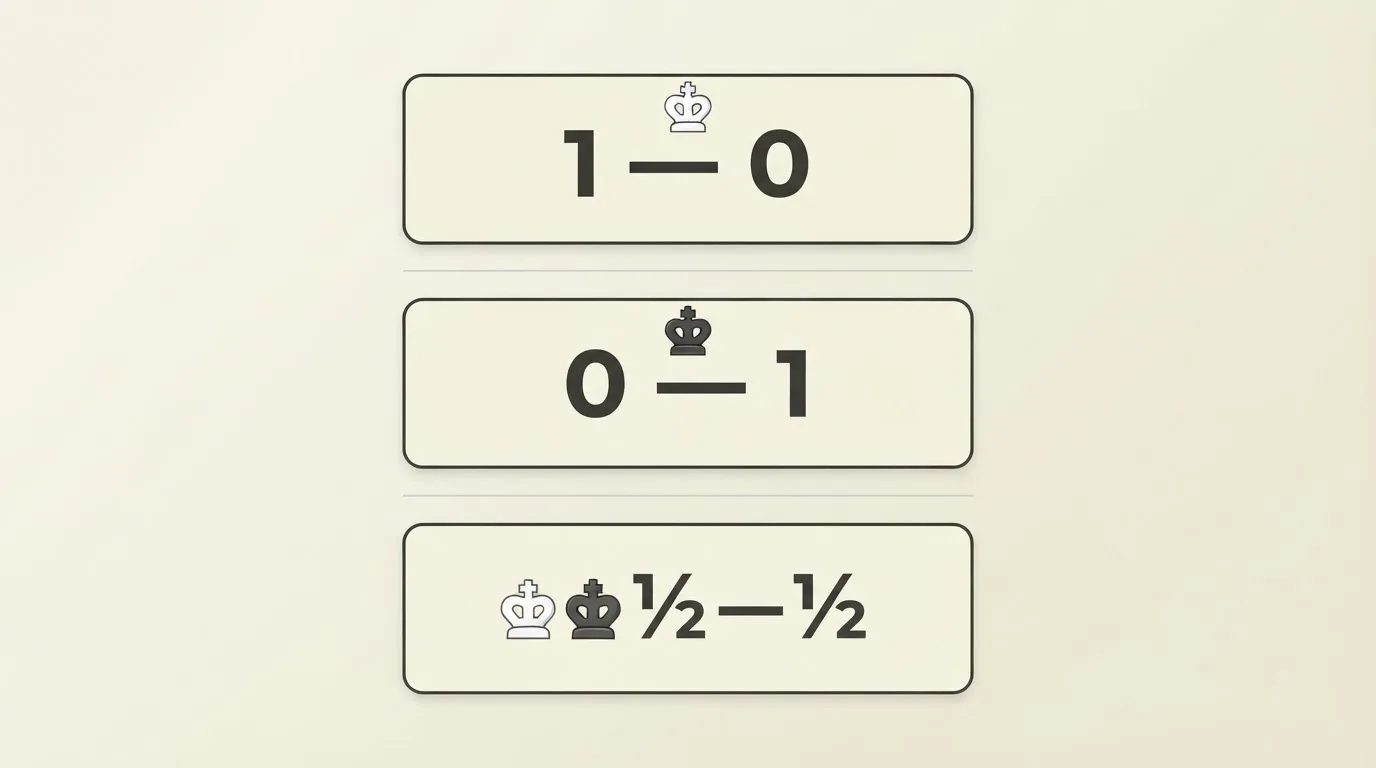
A chess game can only end in three results: 1–0 for White, 0–1 for Black, and ½–½ for the draw.
Those three results are how the governing body of the sport records every game, and they are the
outcomes the bookmaker must price. On a classical game between two grandmasters of similar
rating the draw is the most common single outcome, and a three-way market reflects that — the
draw sits at the shortest price of the three, with each player around 2.50 or longer. On an
uneven matchup, with one player rated 200 points above the other, the favourite’s price shortens
and the outsider lengthens; the draw price is broadly insensitive to the rating gap because both
sides can still force a draw from a wide range of positions.
Two-way markets drop the draw. The bookmaker prices only White or Black, and the price reflects
the match as if a draw were impossible — which it is not. The punter’s stake on the favourite
loses to a draw; the stake on the outsider loses to a draw; the operator keeps the losing stake
either way. Two-way markets on chess are a worse deal for the punter than three-way markets at
the same level of price accuracy, and a punter who has the choice should prefer the three-way
line where it is offered.
The bookmaker’s margin is the slice of every pound staked that the operator keeps, on average,
across the full market. The arithmetic for a two-way market at decimal odds of 1.90 / 1.90 — the
illustrative price used here, not a quoted price — runs as follows. The implied probability of each
side at 1.90 is 1 ÷ 1.90, or about 52.63%. The two probabilities sum to 105.26%; the surplus over
100% is the operator’s margin, here roughly 5.26%. That margin is the operator’s edge on the
market, before any punter skill enters the picture.
The same arithmetic on a tighter two-way line at 1.85 / 1.85 gives an overround around 8.1% (a margin of 7.5%); on a
looser line at 1.95 / 1.95 the overround drops to roughly 2.6% (a margin of 2.5%). Three-way chess markets carry a
wider margin than two-way markets at the same level of accuracy — typically 7–10% versus 5% — and
that spread is the cost of pricing the draw correctly.
Combination bets multiply the margin of every leg into the overall price. A two-leg accumulator
at 1.90 / 1.90 × 1.90 / 1.90 pays 1.90 × 1.90 ≈ 3.61, but the per-leg margin of 5.26% compounds
into an overall margin of around 10.2% on the combined bet. Three legs take it higher; four legs
higher still. A punter building a chess acca pays a margin that grows with every leg, and a
genuine edge of 3% on each individual leg turns negative on a four-fold combination.
Each-way bets work on chess the same way they work on horse racing: two equal stakes, one on the
outright win and one on the place. The place terms depend on the field; in a chess tournament the
“place” is usually the final, sometimes the semi-final, and each operator sets its own place
terms. The stake on an each-way bet is twice the unit stake, and the return on a place-only
finish is paid at a fraction of the win price — a third or a quarter, depending on the operator
and the field size.
Free bets work on chess the same way they work anywhere else in the sportsbook. The free-bet
stake is not paid back with a win — only the profit returns to the punter’s balance — and the
value of the free bet depends on the price the punter takes it at. A £10 free bet at 2.00 is worth
roughly £5 in expected value at a 5% margin; at 5.00 it is worth closer to £8. The same rule
applies whether the free bet is on a chess match or on a football game; the sport does not change
the arithmetic.
Sports and tournaments: what a UK bookmaker covers on chess
Chess is one of the smaller sports on the British sportsbook, and the tournament calendar shapes
what a UK operator prices. The cycle runs roughly as follows.
The World Chess Championship sits at the top. Gukesh Dommaraju won the title in 2024 and
defended it across 2025; the next match is the one the markets price in 2026, and the operator
lists the outright winner, the match score, the total games, and sometimes a method-of-victory
market (which side wins, in regulation or in rapid tie-breaks). Wilhelm Steinitz was the first
universally recognised World Champion in 1886; the lineage from Steinitz to Gukesh runs through
140 years of matches and forms the historical backdrop to the modern cycle.
The Candidates Tournament decides the challenger. Eight players qualify through a series of
paths — the FIDE Circuit, the Grand Prix series, two qualifier spots — and the winner plays the
Champion in the title match. The Candidates carries the same market set as the Championship,
plus an each-way place market on the tournament winner: top four, top two, and so on.
The Grand Prix series and the FIDE Circuit feed into the Candidates. The Grand Prix is a series
of four-player knockout events across the calendar; the Circuit aggregates tournament results
over a season. Each carries match-outright markets on the four-player fields and tournament
outrights on the field.
National leagues sit beneath the international circuit. The German Bundesliga, the Russian
League, the Spanish Liga, the PRO Chess League in North America — each runs a team format with
board-order markets and match-outrights. UK bookmakers price the Bundesliga more often than the
other leagues; the rest sit in the long tail of the catalogue.
Online speed events and the Champions Chess Tour round out the year. The Champions Chess Tour is
a series of online rapid and blitz events with a season finale, and the operators here price the
stage outrights and the season outright. The format is short, the field is wide, and the margin
on these events tends to be tighter than on classical chess because the volume of bets is higher.
Esports chess is a separate product on the operator’s slip. Some operators carry it under the
esports tab, not the chess tab, and the rules differ (the time control, the engine, the platform
each event runs on). A punter checking the chess tab for an esports event should check the
esports tab too — same game, different product.
The rules under which these games are played sit with FIDE. The world governing body of chess
publishes the rules in its Handbook, and the relevant articles for betting purposes are the
ending rules. A chess game is drawn by stalemate, by agreement between the players, or by a
claim of threefold repetition or the fifty-move rule. Since 2014, fivefold repetition or a
seventy-five-move rule end the game automatically without a claim. A punter whose bet depends on
a decisive result should know what the rules say about draws, because a forced draw is a settled
draw — the punter’s stake on the outright loses either way.
The ten UK bookmakers for chess betting
The comparison below ranks the ten operators licensed by the Gambling Commission for remote
general betting on real events that carry chess or stand ready to price it on request. Each is a
holder of a current GB remote licence; each is on the Commission’s public register; each takes
part in GAMSTOP. The ranking reflects the criteria the punter applies when the sport sits this
far down the A–Z list — coverage of chess, depth of the in-play product, and the strength of the
operator’s general pricing.
| Brand | Gambling Commission licence | Chess-relevant stance |
|---|---|---|
| Betfred | 039544-R-319290-010 (39544), held by Petfre (Gibraltar) Limited | Broad sportsbook across 21 sports and over 2,000 casino-style games on the app; chess sits in the long tail |
| BetMGM | 039198-R-319450-029 (39198), held by LeoVegas Gaming PLC | Sports welcome terms state four £10 free bets split between football accumulators and sports multiples for new UK customers who deposit £10 or more and place a sports bet within 7 days |
| Bet600 | 044731-R-323941-016 (44731), held by Tyche Tech Limited | Best Odds Guaranteed on horse racing: the SP replaces the early price when the SP is bigger |
| 10bet | 043173-R-322899-023 (43173), held by Blue Star Planet Limited | Sportsbook covering football, tennis and horse racing with Cash out, Bet Builder and Live Streaming |
| DragonBet | 064908-R-339041-003 (64908), held by DragonBet Ltd | App focuses on Welsh football and rugby, racing, American football, in-play and bet builder markets |
| Fitzwilliam Sports | 048760-R-335434-009 (48760), held by SBKI Limited | Dublin-based bookmaker with capped membership, a “High Stakes Welcome” subject to compliance criteria, and the usual safer-gambling links |
| Bar One Racing | 056516-R-332750-007 (56516), held by Bar-One Racing Limited | Irish independent bookmaker with shops across Ireland and horse racing sponsorships at Dundalk, Fairyhouse, Navan, The Curragh, Curraheen Park and Cork |
| Midnite | 101839-R-342850-001 (101839), held by Midnite Limited | Site shows in-play events, acca builder, popular accas and price boosts with maximum-stake limits |
| Paddy Power | 039439-R-319330-013 (39439), held by PPB Counterparty Services Limited | App covers football, horse racing, boxing, rugby, tennis, golf, darts, snooker and F1 |
| NetBet | 039170-R-319343-032 (39170), held by Netbet Enterprises Limited | Daily Boosts, Profit Boosts and free bet offers, Bet Builder with instant dynamic odds, and stats for major leagues |
The spread is the story. Several of these operators carry chess as one line among dozens; a few
treat it as a tournament outright on the World Championship and the Candidates only; one — Midnite —
runs the kind of in-play product a chess punter looks for, with price boosts and an acca builder.
A punter looking to back the next Candidates round should check the outright tab on each
operator’s chess page; a punter looking to back a single Bundesliga match should expect thinner
coverage and may have to ask the operator to price the event.
Betfred
Betfred is one of the larger British high-street names, with the gambling licence held by Petfre
(Gibraltar) Limited under account 39544. The sportsbook covers 21 sports on the app, alongside
over 2,000 casino-style games, and chess sits on the slip as part of the long tail. The breadth
is the strength: a punter who bets on football, horse racing and chess finds all three on one
account, with one deposit, one verification and one self-exclusion.
The trade-off is depth. Chess on Betfred is a tournament-outright product — the World
Championship, the Candidates, the Grand Prix stages — rather than a per-match product. A punter
looking for the price on a single Bundesliga round will not find it on the slip; a punter looking
for the outright on the next World Championship match will. That kind of selection is the right
fit for the chess punter who bets on the headline events and skips the rest.
BetMGM
BetMGM’s UK licence sits with LeoVegas Gaming PLC under account 39198, and the sports welcome
terms state that new UK customers who deposit £10 or more and place a sports bet within 7 days
receive four £10 free bets — two football accumulators with four or more selections and two
sports multiples with two or more — valid for 7 days, with a minimum-odds requirement and an
opt-in. That structure reflects a 10x wagering cap on bonuses that has been in force since
19 January 2026; the operator cannot legally require more turnover than the cap allows, and the
structure shows the cap at work.
Chess on BetMGM sits on the slip the same way it sits on Betfred: tournament outrights on the
headline events, in the long tail of the A–Z. The welcome package is a sports welcome, not a
chess welcome, and the punter betting only on chess gets the same four free bets and the same
minimum-odds floor on every leg as the football punter. The welcome is the operator’s marketing;
the trade for the punter is the 10x cap on the wagering and the seven-day validity on the free bets.
Bet600
Bet600’s licence is held by Tyche Tech Limited under account 44731, and the standout product is
Best Odds Guaranteed on horse racing: when the starting price is bigger than the early or show
price taken, the bet is paid at the SP. That product is a horse-racing product, not a chess
product, and a punter looking for it on a chess bet will not find it.
Chess on Bet600 is a smaller piece of the slip than on the headline operators, and the depth of
the in-play product is limited. The trade-off is the BOG on racing: a punter who backs both
horses and chess gets the racing side benefit and pays for it in the thinner chess catalogue.
That is the right fit for the punter whose chess betting is a side interest and whose main
spending is on racing.
10bet
10bet’s licence is held by Blue Star Planet Limited under account 43173, and the sportsbook
covers football, tennis and horse racing with Cash out, Bet Builder and Live Streaming. The
breadth of the betting-tools catalogue is the headline: a punter who uses Cash out to settle a
position, the Bet Builder to combine markets, and Live Streaming to follow the event finds all
three on one app.
Chess on 10bet sits in the same long tail it sits in on the other operators. The product is a
tournament-outright on the headline events, and the in-play and Cash out coverage of chess is
limited. The trade-off is the breadth of the betting tools on the rest of the slip: a punter who
uses the operator for football and tennis gets the full toolkit, and the chess bet is the
incidental. A punter betting on chess as the main sport should look at the operators with deeper
chess coverage first.
DragonBet
DragonBet is operated by DragonBet Ltd under account 64908, and the app focuses on Welsh football
and rugby, racing, American football, in-play and bet builder markets. The product is Welsh in
identity and broad in coverage, with the racing and American football lines added for the
non-Welsh punter. Chess sits on the slip as a tournament-outright, and the depth of the
in-running product on chess is limited.
The fit is the punter with a Welsh or a UK racing interest, for whom chess is a side product on
the same account. The trade-off is the inverse of the breadth: a punter whose primary interest is
chess will not find a deeper catalogue here than on the headline operators.
Fitzwilliam Sports
Fitzwilliam Sports is a Dublin bookmaker with capped membership, held under account 48760 by SBKI
Limited, and the welcome is a “High Stakes Welcome” subject to compliance criteria. The
operator’s own page states that instant deposits, fast withdrawals, timeouts and deposit limits
are available, with links to GambleAware, GamStop and Gamblers Anonymous. The capped-membership
shape is the differentiator: the operator is smaller than the headline brands, and the welcome
is structured for the larger-stake punter who has passed the operator’s checks.
Chess on Fitzwilliam Sports is a smaller piece of the catalogue than on the headline operators,
and the in-play coverage of chess is limited. The fit is the punter whose main interest is
horse racing on a smaller, capped-membership book, with chess as a side product. The trade-off is
the inverse: a punter who prioritises chess will find a more limited selection here.
Bar One Racing
Bar One Racing operates as BAR 1 Betting, an Irish independent bookmaker with shops across
Ireland and horse racing sponsorships at Dundalk, Fairyhouse, Navan, The Curragh, Curraheen Park
and Cork. The licence sits with Bar-One Racing Limited under account 56516, and the product is a
mix of racing and sports. Chess sits on the slip as part of the long tail.
The fit is the punter with an Irish racing interest, for whom chess is a side product on the
same account. The trade-off is the same as on DragonBet: a punter whose main interest is chess
will not find a deeper catalogue here than on the headline operators, and the racing product is
the headline.
Midnite
Midnite is the standout on this list for the chess punter who wants the betting tools. The site
cites Gambling Commission account 101839, held by Midnite Limited, and shows in-play events, an
acca builder, popular accas and price boosts with maximum-stake limits. The combination of the
acca builder and the in-play product is what a chess punter who bets on tournament outrights
looks for, and the price-boost product sits on top.
The chess welcome is the operator’s sports welcome: new customers who bet £5 or more on pre-match
odds of EVS (2.0) or greater within 14 days of sign-up receive £25 in free bets and 50 free
spins, valid for 7 days. The minimum-odds floor of EVS is the threshold a chess punter clears
with ease on the favourite in most outright markets; the cost is the seven-day validity and the
free-bet structure, where the stake is not paid back with a win. The fit is the chess punter who
wants the in-play and the acca builder, and is willing to take the free-bet terms.
Paddy Power
Paddy Power’s licence sits with PPB Counterparty Services Limited under account 39439, and the
app covers football, horse racing, boxing, rugby, tennis, golf, darts, snooker and F1. The breadth
is the headline: Paddy Power is one of the headline British operators, and the sportsbook covers
the major sports plus several that sit further down the A–Z. Chess is on the slip as part of the
long tail.
The fit is the punter who uses Paddy Power for football and racing, with chess as a side product.
The trade-off is the inverse: a punter who prioritises chess will find a more limited selection here than on Midnite, and the breadth is the strength on the rest of the slip.
NetBet
NetBet’s licence is held by Netbet Enterprises Limited under account 39170, and the sportsbook
carries Daily Boosts, Profit Boosts and free bet offers, a Bet Builder with instant dynamic
odds, and stats for major leagues. The combination of the boosts and the Bet Builder is the
differentiator, and the stats product sits on top for the punter who uses form data to price a
bet.
Chess on NetBet is a tournament-outright product on the headline events, and the in-play coverage
of chess is limited. The fit is the punter who uses the Bet Builder on football and tennis, with
chess as a side product. The trade-off is the same as on 10bet: a punter whose main interest is
chess will find a more limited selection here than on Midnite.
The margin on a chess match, by the numbers
A chess bookmaker’s margin is the slice of every pound staked that the operator keeps on average
across a market. The arithmetic for a two-way market at the illustrative price of 1.90 / 1.90
runs as follows. Each side at decimal odds 1.90 implies a chance of 1 ÷ 1.90, or about 52.63%.
The two probabilities sum to 105.26%, and the surplus over 100% — 5.26% — is the operator’s
margin. The punter’s payout share on this market is roughly 94.74% of every pound staked across
both sides, before any specific bet wins or loses.
That margin is a band, not a single figure. A two-way chess market at 1.90 / 1.90 carries roughly
5.26% margin; at 1.85 / 1.85 the margin rises to around 8.1%; at 1.95 / 1.95 it falls to roughly
2.6%. Three-way chess markets sit higher — typically 7–10% — because pricing the draw correctly
takes a wider slice of the market. Combination bets compound the per-leg margin into a larger
overall margin on the combined bet, and a punter building a chess acca pays that compounding on
every leg added.
The consequence is what a sharp chess punter already knows. A punter with a 3% edge over the
operator’s line on a 5% margin has a real edge; the same 3% edge on an 11% margin disappears.
The margin is the ceiling on what a skill edge can pay, and a chess punter who bets the headline
markets where the lines are sharper will keep more of that edge than one who bets the long-tail
events where the operator’s price is the only price.
Legal frame: the Gambling Commission and the GB-licensed bookmaker
The Gambling Commission licenses the British commercial market under the Gambling Act 2005, which
covers Great Britain — England, Scotland and Wales. A bookmaker whose remote facilities are used
in Great Britain needs a Commission licence wherever it is based; a Curaçao, Maltese or Gibraltar
licence is not a substitute. Since the Gambling (Licensing and Advertising) Act 2014 this has been
the law, and the relevant sections of the 2005 Act (sections 33 and 36, as amended) are where the
offence sits.
There is no statutory list of permitted sports or markets. A bookmaker holds a licence for a
category — remote general betting standard (real events), remote general betting standard (virtual
events), remote general betting limited, remote pool betting, or remote betting intermediary (the
licence for betting exchanges) — and offers markets under its own rules and the Licence
Conditions and Codes of Practice (LCCP). Chess falls under remote general betting standard (real
events), the same category as football, tennis and racing.
The Commission’s public register is the whole test of whether a brand holds a licence. The
register can be searched by business name, trading name, domain or account number, and a match on
any one of those confirms a licence. Every operator routed into this comparison is on the
register against a current account; every licence is in force at the moment of writing.
Identity verification sits before the first deposit. Since 7 May 2019 the operator verifies name,
address and date of birth before the customer can deposit or gamble, including on a free bet or
bonus. A punter who wants anonymous play cannot have it on a GB-licensed site; a punter who
wants a regulated site accepts that check.
In-play betting is offered by GB bookmakers under the operator’s licence conditions and
customer-protection duties; the legal frame for in-play on chess is the same as the frame for
in-play on football. The controls sit with the operator, not the statute, and a punter
considering an in-running bet reads the operator’s own terms for the specifics.
Betting exchanges run under a betting intermediary licence, and the rates and rules specific to
exchanges — back and lay, the commission on net winnings — are stated only from each exchange’s
own terms. A punter comparing a sportsbook price to an exchange price should check the exchange
commission before assuming the exchange is the cheaper side.
Credit cards are banned for gambling in Great Britain since 14 April 2020, including
credit-card-funded payments through an e-wallet. Debit cards and bank-based payments are not
covered. Cryptocurrency deposits at licensed operators are not established either way; payments
are described qualitatively and from each operator’s terms.
The player pays no tax on betting winnings in Great Britain; that is general information, not tax
advice, and a professional gambler should ask HMRC or an adviser. General Betting Duty is the
operator’s tax on gross profits at 15%; from 1 April 2027 a new remote betting rate of 25% applies
within it, with remote bets on UK horse racing, self-service betting terminal bets, pool betting
and in-person betting staying at 15%. Until 1 April 2027 the remote rate stays at 15%, and
whether operators pass duty on through odds is not established. Never write that the player is
charged duty.
Offshore is the alternative a GB punter should understand. A GB licence is compulsory at the point
of consumption; providing gambling facilities in Great Britain without the licence the Act
requires is an offence under section 33, with a summary conviction of up to 51 weeks’
imprisonment, a fine up to level 5, or both (six months in Scotland). The offence sits with the
operator. The punter who bets on an unlicensed site loses GAMSTOP coverage, the Commission
complaints route, an approved dispute-resolution body, and British consumer redress if funds are
withheld. The operator is not bound by the 10x bonus cap or the £150 vulnerability check. Neither
licensed nor unlicensed is “the safe choice” by default; the trade-off is the trade-off a punter
makes knowingly.
Reading the slip: a chess betting slip in practice
The mechanics of placing a chess bet on a GB-licensed sportsbook follow the same flow as a bet on
any other sport. The punter opens the chess tab on the A–Z, picks the event — the World
Championship match, the Candidates round, the Grand Prix stage, the Champions Chess Tour event —
and selects the market. On a match outright the punter taps White, Black, or (where offered) the
draw; on a tournament outright the punter taps the player; on a total-games market the punter
taps the line.
The stake is the punter’s input. A £10 stake on a player at 3.00 returns £30 if the player wins
the tournament — the £10 stake plus £20 of profit. The same £10 on a player at 1.50 returns £15 —
the £10 stake plus £5 of profit. The price locks at the moment of placement; a movement in the
price afterwards does not change the bet.
The settlement is the moment the result is known. On a tournament outright the bet settles when
the tournament finishes and the winner is confirmed; on a match outright it settles at the end
of the game (or, in the case of rapid tie-breaks, at the end of the play-off). The settlement
push arrives on the app, the winning stake returns to the balance plus the profit, and the
losing stake is gone.
Cash out sits between placement and settlement where the operator offers in-running prices. A
punter with a £10 bet on White at 1.80 takes a Cash out prompt at £8 when the position favours
Black; the £8 is settled onto the balance, the bet closes, and the result of the game no longer
matters for that stake. Cash out is the operator’s price, not the market’s; a punter taking the
Cash out takes a smaller certain return in place of a larger uncertain one.
Free bets work the same way. The punter has a £10 free bet from the welcome offer; the free bet
is placed on a player at 2.00; the player wins; the £10 free-bet stake is not returned, and the
£10 of profit lands on the balance. The free bet is worth roughly £5 in expected value at this
price, and the punter who uses the free bet at a longer price gets more of that expected value.
Chess as a betting market: how it compares to the headline sports
Chess is a thin market on the British sportsbook, and the thinness is the trade-off for the
shape of the sport. Football runs hundreds of markets on every Premier League fixture; chess
runs three or four on every World Championship match. A punter who wants the depth of football
should bet on football; a punter who wants the pricing on a narrow set of markets should look at
chess where it sits.
The pricing is sharper on the headline events. The World Championship match and the Candidates
attract enough volume for the operator to run a thin margin; the long-tail events — the
Bundesliga round, the online speed event, the FIDE Circuit stage — carry wider margins because
the volume is lower. A punter who bets the headline events pays a smaller margin per pound
staked than a punter who bets the long tail.
The in-play product is thinner than on football. A punter looking for a Cash out prompt every
two minutes for ninety minutes will not find it on chess; the operator updates the price at
round boundaries or after significant captures, and the punter’s prompt sits open through long
quiet stretches. The discipline test on chess in-play is the discipline test of patience.
The bet builder product is rare on chess. Football and tennis dominate the bet builder
catalogues on the operators here, and chess on the same-game multi tool is scarce. A punter
looking to combine markets from a single chess match builds the combination as a manual
accumulator instead, and pays the compounding margin that an accumulator carries.
The promotional product is the same as on the rest of the slip. The free bets, the price boosts,
the acca insurance — each carries the same terms on chess as on football, with the same 10x cap
on the wagering, the same minimum-odds floor on the qualifying bet, and the same validity
window. The punter who bets only on chess gets the same promotional shape as the punter who
bets only on football; the sport does not change the offer.
Frequently asked questions
Where can a UK punter bet on chess?
Chess sits on the slip of several GB-licensed bookmakers, including Betfred, BetMGM, Midnite,
Paddy Power, 10bet, DragonBet, NetBet, Fitzwilliam Sports, Bar One Racing and Bet600. Coverage
is tournament-outright on the World Championship, the Candidates, the Grand Prix and the
Champions Chess Tour, with a smaller set of markets on the Bundesliga and other national leagues.
The Commission’s public register is the test of every licence cited.
Can you bet on chess in the UK?
Yes, at any bookmaker licensed by the Gambling Commission for remote general betting on real
events. There is no statutory list of permitted sports, and chess is covered by the same
licence category as football, tennis and racing. A punter betting on chess on an unlicensed site
loses GAMSTOP, the Commission’s complaints route, and any British redress if funds are
withheld.
How does a chess bet work?
A punter picks an event — a match, a tournament, a tour stage — selects a market (outright,
total games, method of victory, each-way place), and stakes a chosen amount at the displayed
decimal odds. The stake returns to the balance plus the profit if the selection wins; the stake
is lost if the selection does not. Three-way markets on chess include the draw at its own
price; two-way markets drop the draw and price only White and Black.
How can a punter check a bookmaker’s Gambling Commission licence?
The Commission’s public register at gamblingcommission.gov.uk can be searched by business name,
trading name, domain or account number. A match on any one of those fields confirms the licence
and shows the licence holder, the licence categories and the licence status. The licence number
on the operator’s own site should match the register entry.
How is a chess return worked out from stake and odds?
The return on a winning selection is the stake multiplied by the decimal odds. A £10 stake at
decimal odds 2.50 returns £25 — the £10 stake plus £15 of profit. A losing selection returns
nothing. The same arithmetic applies to combination bets, where the odds of the legs multiply
into one price and the stake returns at that combined price on a win.
What is a bookmaker’s margin on a chess market?
The margin is the slice of every pound staked that the operator keeps, on average, across the
market. It is the surplus over 100% when the implied probabilities of all outcomes are added
together. A two-way chess market at the illustrative price of 1.90 / 1.90 carries a margin of
roughly 5.26%; a three-way market on White / Black / Draw typically sits between 7% and 10%.
The margin is the ceiling on what a skill edge can pay, and a punter reads the prices with that
ceiling in mind.
Tennis, darts & cue sports – Best betting
Content created by the «Best betting» team
