
Booking points betting: how the cards and points work, and where to place them
 Available in US
A booking-points market treats the cards shown during a football match the way a goalscorer market treats goals. Instead of asking who will score or how many goals will be played, the market asks how many booking points the referee will hand out across the ninety minutes and stoppage time. The points follow a card: a yellow card counts as ten, a red card as twenty-five, and a second yellow that becomes a red is twenty-five rather than thirty-five. These are the conventions used by the operators that publish the market in Great Britain, and they have held for years — the points have changed less than the surrounding football.
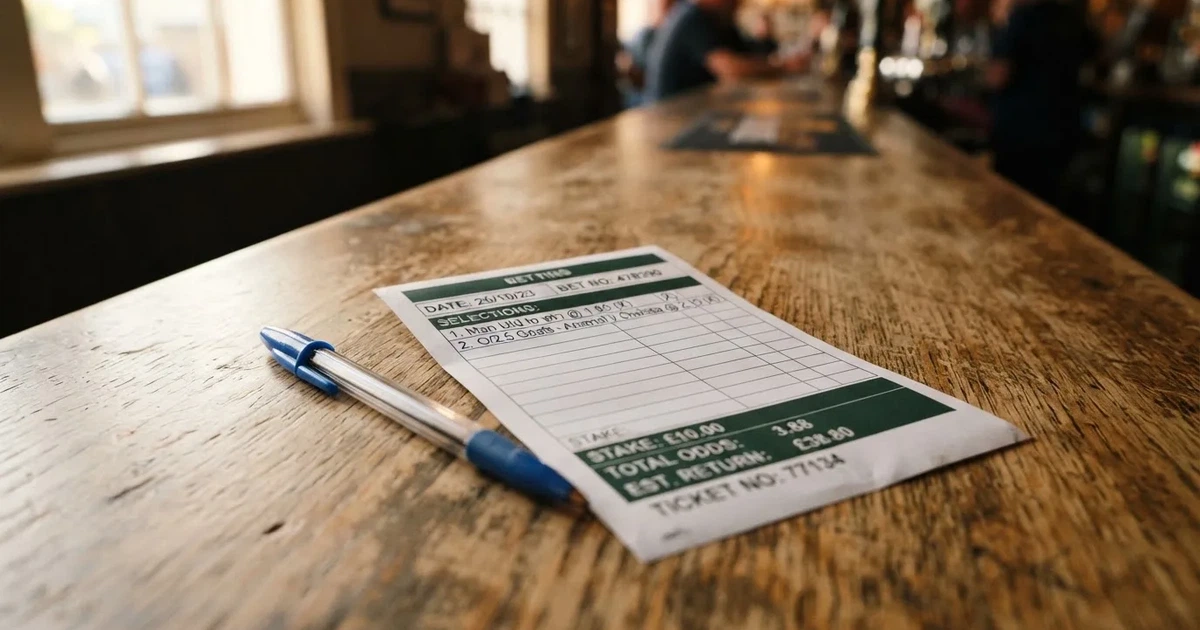
That the market is offered at all depends on the operator’s licence, not on a statute. Great Britain has no government list of permitted bet types. An operator holds a Gambling Commission licence for a category — most sports books hold a remote general betting standard (real events) licence — and publishes markets under its own rules and the Licence Conditions and Codes of Practice. The Commission’s public register is the test of who holds a licence, and it does not list the markets each operator chooses to publish.
What follows is built around that fact. The first sections set out how a booking-points market is constructed and priced, with worked examples drawn from the kind of lines operators publish. The middle of the page walks through the ten bookmakers reviewed for booking-points betting in this guide, ordered by what they bring to the market rather than by a house score. The latter sections deal with the rules a reader should know about — verification before the first bet, GAMSTOP, the bonus cap, and the difference between a Great Britain licensed site and one running offshore. The calculation underneath the odds sits in plain prose, with no shortcuts and no shortcut terms.
Data current as of 27 October 2026; reviewed against the Gambling Commission’s public register and each operator’s published terms.
How a booking-points market is built and settled
A booking-points market is a totals-style line on a single match. The bookmaker publishes a number — usually expressed as an exact threshold such as “over 30.5 points” or as a small band such as “20–30 points” — and the bettor chooses a side. Settlement uses the same points scale everywhere it is offered in Great Britain: ten for a yellow, twenty-five for a straight red, twenty-five for a second yellow that becomes a red, and zero for everything else. Cards shown after the final whistle, cards to substitutes on the bench, and cards shown to non-playing staff do not count.

The threshold the operator chooses defines the shape of the market. Around thirty booking points is a frequent mid-line for a Premier League or Championship fixture, but the exact figure shifts with the referee assigned and the disciplinary record of each team. Some operators publish multiple lines for the same match — under, exact band, and over — so a bettor who wants a narrow line and a bettor who wants a wider one are both accommodated. The exact threshold is not the same across bookmakers for the same fixture, and the points scale is not always disclosed on the bet slip itself; the operator’s rules page is where the scale sits.
Settlement happens after the match official’s record is closed. Disputed cards are settled on the official league data, not on the broadcast feed, and a card shown on the pitch and later overturned by the FA’s disciplinary process still settles on what happened on the pitch. The result is final once the operator publishes it, and the Commission does not second-guess individual market settlements the way it polices terms and conditions in general.
The market sits inside a wider cards market family. A “total cards” market is a count of cards, not points; a “first card” market is a name-the-team-or-name-the-player line; a “player to be carded” market is a player-specific line that pays out only on that single player being shown. Booking-points is the points-aggregated cousin of these. A reader who has played one of them already knows the language the operator uses.
How odds and the bookmaker’s margin work on a booking-points market
A booking-points market is priced like any other two-way line. The operator publishes two prices — one for “over”, one for “under” — at decimal odds that reflect both the likelihood of each outcome and the margin the operator keeps. British bookmakers publish fractional odds by default and decimal odds by request or in the bet slip; this guide uses decimal odds throughout, since the conversion from fractional to decimal is straightforward (a/b becomes a ÷ b + 1, so 9/10 is 1.90).

The margin is the proportion of every pound staked that the operator keeps across all outcomes of a single market. It is the same number seen from two sides: as a margin (the house take) and as a payout share (the proportion returned to bettors on average). On a two-way market with both sides at 1.90, the implied probability sum is one divided by 1.90 plus one divided by 1.90, which is approximately 105.3%; the margin is 5.3% and the payout share is approximately 94.7%. The arithmetic holds for any market the operator publishes — booking-points, match result, both teams to score — and a margin in the 4–7% band is ordinary for an English top-flight fixture, while a tighter market such as match result on a Champions League knockout may come in lower.
Stated as a range rather than a single figure: on a typical two-way booking-points line published in the British football market, the margin lands between roughly 4% and 8%, with most pre-match lines closer to the middle of that band. Lines further from kick-off tend to carry a wider margin because the operator has less information about the named referee and the starting elevens. In-play lines move in real time and the margin on any one tick of the price is harder to read from outside; the market is the bookmaker’s, and the price the bettor sees is the price that includes the operator’s edge.
Two practical consequences. The first is that the return on a winning bet is straightforward arithmetic — stake multiplied by the decimal odds is the return that comes back to the bettor, and the profit is the return minus the stake. A £10 stake at 1.90 returns £19, of which £9 is profit. The second is that the margin is paid on every bet, win or lose, because the operator builds it into both sides of the line. A bettor who beats the odds on a single match still pays the margin on that match, and a bettor who backs the favourite on a succession of matches pays the margin on each one.
What “value” means on a booking-points market
A booking-points market is hard to price from outside, because the public information on referee tendencies and on team discipline is patchier than the information on goals. A reader who has tracked the assigned referee for ten matches will have a better sense of the line than one who has only watched the team. That asymmetry is what “value” rests on: a price that pays more than the bettor’s own estimate of the true probability.
The bookmaker’s margin sits underneath any such calculation. A bettor who thinks the line should be at 50/50 will only ever see prices close to that probability at less than evens, because the operator keeps a margin on both sides. The arithmetic of value is therefore “estimate of true probability” against “implied probability of the price”, and the difference is the bettor’s edge before the margin is paid. On a market where the operator’s margin is 5%, a bettor needs a genuine 5% edge over the operator’s true line to come out ahead over time.
Two corollaries follow for booking points in particular. First, the markets for the most-disciplined leagues (the Premier League’s better-behaved referees, certain La Liga officials) tend to carry the same margin as the more volatile markets, because the operator prices uncertainty, not the type of market. Second, the smallest-stake bettors are usually the most disadvantaged on a market like this, because the edge they can build against a sharp line is small and the per-bet take is the same proportion. The reader who bets £2 on a booking-points line pays a 5% margin the same way the reader who bets £200 does.
What the legal frame actually controls
The legal frame controls the operator, not the market. The Gambling Act 2005 covers Great Britain — England, Scotland and Wales — and the Gambling Commission licences commercial betting under it. The Commission’s public register is the test of whether a brand holds a licence: a reader can search by business name, trading name, domain or account number, and the result is what counts. A bookmaker using a Curaçao, Maltese or Gibraltar licence is not licensed for Great Britain, even where those licences are real in their own jurisdictions.
Three consequences follow. First, since the Gambling (Licensing and Advertising) Act 2014 came into effect, an operator whose remote facilities are used in Great Britain needs a Commission licence wherever it is based; sections 33 and 36 of the 2005 Act set the offence. Second, there is no statutory cap on the number of licences — the Commission has licensed the entire online market on this footing, and the register is long. Third, providing gambling facilities in Great Britain without the licence the Act requires is an offence aimed at the operator, with a sentence on summary conviction of up to fifty-one weeks’ imprisonment, a fine up to level 5, or both (six months in Scotland).
Northern Ireland is outside the 2005 Act and runs under older legislation. The phrases “Great Britain licensed” and “GB-licensed” are the right ones; a GB licence does not regulate Northern Ireland. The Commission’s register lists every GB-licensed brand, and the brand’s own site lists the same number back. Where the two do not match, the register is the source of truth.
Identity verification is the rule a reader meets first. Since 7 May 2019, licensed remote operators must verify name, address and date of birth before a customer can deposit or gamble — and that includes gambling with a free bet or bonus, not only with deposited funds. The check is at the licensed operator, and it happens before the first bet, not at withdrawal. It is the licence condition that rules out anonymous play at any brand on this page.
What the responsible-gambling framework puts on the operator
GAMSTOP is the national multi-operator online self-exclusion scheme and a mandatory licence condition for online operators since 31 March 2020. A reader who registers with GAMSTOP is blocked at every GB-licensed online operator that runs the scheme. Self-exclusion periods are six months, one year, five years, or five years with auto-renewal, and after the minimum period the exclusion stays in place for a further seven years unless the customer asks GAMSTOP to remove it. GAMSTOP covers online sites and apps; betting shops use a separate service.
Beyond GAMSTOP, the operator runs three further checks. A financial vulnerability check (LCCP condition 3.4.4, in force since 30 August 2024) applies when a customer’s deposits minus withdrawals exceed £150 in a rolling 30 days — since 28 February 2025 — and it is a public-record check (bankruptcy, county court judgments), not an income check and not a credit reference check. Financial risk assessments (the “affordability checks” of the press) are announced in a staged plan, with no start date. The Commission’s article of 7 July 2026 sets out the stages, and readers should treat them as announced, staged, and not yet in force. Deposit limits (RTS 12) require operators to offer a gross deposit limit on a fixed time frame; the first changes have applied since 31 October 2025, and a second phase has been postponed to 30 September 2026. The Commission does not set the deposit or loss ceiling itself: limits are set by the customer.
Two adjacent rules. Credit cards are banned for gambling in Great Britain since 14 April 2020 (LCCP condition 6.1.2), and that ban covers credit-card-funded payments through an e-wallet. Debit cards and bank-based payments are not covered by the ban. The minimum age for any gambling product at a licensed operator is 18, and the operator verifies the date of birth before the first bet.
Help exists outside the operator’s own site. GamCare runs the National Gambling Helpline. GambleAware funds treatment and education. NHS gambling clinics provide specialist treatment in several regions. Gamblers Anonymous runs peer-support meetings across the country. None of these is a substitute for the operator’s safer-gambling tools, but each is a route a reader in difficulty can use without going through the bookmaker.
What the bonus rules actually do
Promotion rules in force since 19 January 2026 cap wagering requirements on bonuses at 10x (a £10 bonus at 50x needs £500 of bets; under the cap no more than £100). Mixed-product promotions — an offer that requires gambling on two or more product types such as betting, casino, bingo and lottery — are banned. Whether the cap applies to free bets with no wagering condition, and any cap on the money value of a bonus, are not established, and a reader who is uncertain about a specific offer should read its terms before claiming.
The practical shape of the cap is straightforward. A bonus is money the operator credits to a customer’s account on a condition; the wagering requirement is the number of times that money must be staked before it can be withdrawn. Under the new rule, the multiple is no more than ten. A £30 bonus now needs £300 of qualifying bets at the operator’s minimum price before it can be withdrawn; before the rule, some operators ran wagering multiples of five times that figure. The cap closes that gap.
A free bet is a different shape. A free bet is a token that pays the winnings but not the stake — a £10 free bet at 1.90 returns £19 (£9 of winnings plus the £10 stake is not returned). A “risk-free” bet refunded as a free bet is not a refund in money; it is the same token, paid only on a loss. The marketing words “free”, “risk-free” and “matched” describe the structure of the offer, not the value of it, and the value of a free bet is its expected return at the price the bettor takes, less the margin the operator keeps on the market.
No promo code is printed on this page. The offers described below are stated from each operator’s own terms as those terms were published; readers should check the live terms before claiming, because offers change, and the version that matters is the one on the operator’s site at the time of claim.
How the ten licensed bookmakers in this guide were chosen
The ten brands reviewed on this page are the brands the Gambling Commission’s public register lists against a remote betting licence for Great Britain, drawn from across the price-aggregator listings that publish booking-points markets and from the app-store descriptions of major and smaller UK books. The register is the source of truth on the licence; the operator’s own terms are the source of truth on what the operator does.
Each review heading names the operator and the angle the operator brings to the booking-points market — the specific feature, market coverage or pricing approach that sets the brand apart on this kind of bet. The same headings appear in the order set out in this guide. The angle is not a ranking and not a recommendation: ten licensed operators sit on this list, and the reader’s pick will depend on the market the reader wants to play, the size of the stake and the operator’s terms on bonuses, in-play settlement and the verification flow.
Three caveats that apply to every review. First, the licence number on the register and the licence number on the operator’s site are the same number, and the register is the test. Second, several brands run under the same parent — for example Ladbrokes and Coral, Paddy Power and Betfair — and the reviews treat them as the operator the parent company runs them as. Third, every GB-licensed online operator takes part in GAMSTOP, and the same safer-gambling tools appear across the list, with differences in interface and tone that the reader will see in practice.
Booking points at Bet Ahoy
Bet Ahoy offers booking-points markets on the English football fixtures published on its sportsbook. The brand is operated by Bet Ahoy Ltd under Gambling Commission account 100094 for remote general betting standard (real events), the same licence category most sportsbooks hold. Its welcome offer, as the App Store description lists it, is a sports-bet-and-acca pairing of two £5 tokens for a £10 qualifying bet, with the standard terms on minimum odds and expiry that apply across the market. The token structure is what the marketing calls “free bets” but is paid out as bet credits, and the stake is not returned with the win.
What the brand is built for is the small-stake football bettor. The interface is mobile-first, the markets on a typical Premier League weekend include match result, both teams to score, total goals and the booking-points and total-cards markets that sit beside them, and the in-play book runs across most English league fixtures. The price the operator publishes is a touch above the sharpest books on routine fixtures, which is a fair price for the convenience of a clean mobile interface and the bet-builder options on offer.
The verdict: for the bettor who wants a tidy mobile book on the Premier League and Championship and is comfortable paying a small premium for the convenience, Bet Ahoy does the job. The £10 qualifying bet is well within the £150 vulnerability-check threshold for most accounts, and the bonus cap that came in during 2026 leaves the offer’s wagering at a multiple the reader can clear without staking more than the token is worth.
Booking points at DragonBet
DragonBet is the Welsh bookmaker that markets itself on Welsh football and rugby, with racing, American football, in-play betting and bet-builder markets on the rest of the schedule. It is operated by DragonBet Ltd under Gambling Commission account 64908 for remote general betting standard (real events). The Welsh focus is not a narrow one: the same bookmaker publishes a full English league schedule, the European cups and a deep racing card, and the booking-points market is published on football at all of these levels.
The brand is built for the bettor who wants a regional book with national coverage. The Welsh football and rugby markets are deeper than the big four offer, and the price on the English leagues is competitive at the operator’s typical margin. The bet-builder markets are an aggregator of match result, goalscorers, total goals and cards, with a structure that takes in the booking-points lines as one element of a same-game accumulator. The in-play book runs across most English football and the major European leagues.
The verdict: for the bettor who likes a regional brand with a national book, DragonBet is the right shape. The Welsh football focus gives the reader a market the bigger books thin out, and the English-league prices are sharp enough that booking-points at the standard thresholds settle without an obvious margin premium.
Booking points at BetTom
BetTom’s sports welcome offer is the half-back structure that has become common across the GB market: 50% back as a free bet up to £50, with a matching casino half on the same qualifying bet. The brand is operated by Bet Tom Limited under Gambling Commission account 64959 for remote general betting standard (real events). The casino pairing is the part that trips the new mixed-product promotion rule — a £50 free-bet welcome with a casino half is the kind of offer that the rule prohibits, and readers should check the live terms on this page as the rule settles in across the market.
The book itself runs a standard English-league schedule with a clean in-play book on the Premier League, Championship and the major European leagues. Booking-points markets appear on football at the standard thresholds, and the bet-builder markets run alongside them. The token structure is the standard sportsbook shape, and the verification flow is the standard licensed-operator flow: name, address and date of birth at the first deposit, with no anonymous play.
The verdict: for the bettor who is comfortable with the standard book and reads the welcome offer carefully, BetTom is a fair mid-market choice. The bonus cap that came in during 2026 is the rule that makes the welcome offer worth the half-back structure; the same offer at the same half-back multiple would have been uneconomic for the operator under the old cap, and the new cap is what the operator can now offer.
Booking points at Smarkets
Smarkets is the betting exchange on this list. The platform runs under Gambling Commission account 39173 in the betting intermediary category — the licence that the Commission issues to exchanges — and the brand’s Malta parent operates the matching engine. The standard commission on eligible exchange bets is 2%, and new customers have been offered a 0% commission for 60 days on a minimum first deposit of £10. The exchange mechanic is different from a sportsbook: customers bet against each other rather than against the operator, with back and lay bets and the option to request a better price.
Booking-points markets on an exchange are published when there is two-way liquidity at the threshold. Liquidity at the deepest English-league fixtures is real and the line is sharp; liquidity at smaller fixtures is thin and the line is wider. The price on the line is the market-clearing price among customers, and the operator’s margin is the 2% commission on net winnings. The arithmetic of value is the same as on a sportsbook — estimate of probability against implied probability of the price — but the implied probability of an exchange price does not carry the operator’s margin built in, which is why exchange prices look longer than sportsbook prices for the same outcome.
The verdict: for the bettor who wants the sharpest available price on a booking-points line and is comfortable with the back-and-lay mechanic, Smarkets is the right venue. The 2% commission is the cost of the price, the 60-day 0% period is a real saving for a new account, and the GAMSTOP coverage and the licensed-operator verification flow apply as on every other brand on this list.
Booking points at Paddy Power
Paddy Power’s app offers Bet Builder+, Super Sub, expanded Win More markets and the player and acca statistics that sit beside them. The brand is operated by PPB Counterparty Services Limited under Gambling Commission account 39439 for remote general betting standard (real events), in the same Paddy Power / Betfair group that also runs Betfair Sportsbook and Betfair Exchange. The bet builder is the feature the brand publishes on, and booking-points lines are available both as a standalone market and as one leg of a same-game accumulator.
What Paddy Power brings to a booking-points market is the in-play product. Super Sub is the rule that a bet rolls over to the substitute if the selected player is replaced before the bet settles — a useful feature on a player-card market rather than on a totals market, but a structural commitment to flexible settlement that the operator extends across its markets. The in-play book runs across the Premier League, Championship and the major European leagues, and the price is competitive at the operator’s typical margin.
The verdict: for the bettor who plays the bet builder and the in-play product and is comfortable with a major-brand sportsbook, Paddy Power is the natural choice. The Irish heritage gives the racing product a particular depth, and the English football book is wide enough that booking-points at every threshold the operator publishes is on the schedule.
Booking points at Bar One Racing
Bar One Racing has rebranded as BAR 1 Betting, an Irish independent bookmaker with shops across Ireland and horse racing sponsorships at Dundalk, Fairyhouse, Navan, The Curragh, Curraheen Park and Cork. The remote operation runs under Gambling Commission account 56516 for remote general betting standard (real events), held by Bar-One Racing Limited. The racing focus is the brand’s centre of gravity: the racing book is deep, and the Irish racing sponsorship gives the operator a card the bigger books do not match.
The football book runs the English league schedule with a clean in-play product on the Premier League and Championship. Booking-points markets appear on football at the standard thresholds, and the bet-builder markets run alongside them. The brand’s heritage is racing, not football, and the football book is the secondary product rather than the primary.
The verdict: for the bettor who plays Irish and UK racing as the main book and treats football as a side market, BAR 1 Betting is a fair mid-market choice. The football book is good enough on the standard fixtures; it is not as deep as the racing book, and the bettor who lives on football markets will find a wider book elsewhere on this list.
Booking points at Fitzwilliam Sports
Fitzwilliam Sports bases its prices on Oddschecker’s average price for each selection, with Apple and Google mobile apps. The brand is operated by SBKI Limited under Gambling Commission account 48760 for remote general betting standard (real events). The pricing approach is the headline: an operator that prices to an aggregator’s average is not trying to be sharp on every line, and the price the bettor sees is closer to the average of the market than the best line in it.
Booking-points markets at Fitzwilliam Sports are priced in line with the operator’s approach. The margin on the line sits close to the market average rather than at the tight end of the market, and the bettor who takes the price gets an average-priced bet rather than a sharp one. The bet-builder and in-play product is the standard licensed-operator book at the operator’s typical margin, as do the standard verification and GAMSTOP requirements.
The verdict: for the bettor who wants an average-priced book with a clean interface, Fitzwilliam Sports is a fair choice. The pricing approach gives the reader a transparent price without an obvious premium on the standard fixtures, and the mobile apps are the form factor the operator publishes on.
Booking points at Betmaster
Betmaster is operated by BM Solutions GB Ltd, registered in Malta, and the brand’s own site states it holds Gambling Commission account number 65699 in the remote general betting standard (real events) category. The Malta registration of the operating company is a common shape across the GB-licensed online market — an operator may run from Malta and hold a GB licence, or vice versa, and what matters is the licence the operator holds for the customer.
The football book at Betmaster runs the standard English league schedule with a clean in-play product. Booking-points markets appear on football at the standard thresholds, and the bet-builder markets run alongside them. The casino product is part of the same account, and the mixed-product promotion rules that came in during 2026 apply across the operator’s own welcome offers.
The verdict: for the bettor who wants a standard mid-market book with a casino product on the same account, Betmaster is a fair choice. The Malta-registered operating company and the GB licence are the standard shape, and the bonus cap that came in during 2026 is the rule the reader checks the welcome offer against.
Booking points at Lottoland
Lottoland is the lottery, casino and sports betting platform that publishes its GB licence for customers in Great Britain. The brand is operated by EU Lotto Limited under Gambling Commission account 38991 for remote general betting standard (real events), and the app combines casino, lottery betting, sports betting and scratchcards. The lottery focus is the brand’s centre of gravity; the sports book is the secondary product.
The football book runs the English league schedule with a standard in-play product. The lottery betting product is the part of the brand that sets it apart on this list, and the sports book at a routine Premier League weekend is competitive but not the sharpest in the market.
The verdict: for the bettor who plays the lottery as the main product and treats sports betting as a side market, Lottoland is a fair choice. The GB licence covers the sports book in the same way it covers the lottery, as do the standard verification and GAMSTOP requirements.
Booking points at 888sport
888sport offers pre-match and in-play betting, Cash Out, Bet Builder, racing streams, BetFinder form tools, a live bet feed and daily boosted odds. The brand is operated by 888 UK Limited under Gambling Commission account 39028 for remote general betting standard (real events), in the same group as the casino and poker brands that share the 888 name. The racing streams are the feature the brand publishes on, alongside the cash-out product on the standard book.
Booking-points markets at 888sport are published at the standard thresholds on football at the English leagues and the major European competitions. The in-play book runs across the same fixtures, and the bet-builder markets include the booking-points line as one element of a same-game accumulator. The price is competitive at the operator’s typical margin, as do the standard verification and GAMSTOP requirements.
The verdict: for the bettor who plays the standard book and uses the racing streams and the cash-out product as part of the routine, 888sport is a fair choice. The price is competitive without being the sharpest in the market, and the racing streams add a layer the standard book does not match.
Comparison of the ten licensed bookmakers on booking-points markets
The table that follows is built around the matters that matter for a bettor playing a booking-points market. The columns are the licence number and the licence holder, which the reader cross-checks against the Commission’s register, and what the operator’s own terms state on the market the reader is asking about. The price on a specific fixture moves daily and is not in the table; the table is a structural comparison rather than a price comparison.
| Brand | Gambling Commission remote licence | Licence holder | Booking-points markets and related terms |
|---|---|---|---|
| Bet Ahoy | 100094 | Bet Ahoy Ltd | Mobile-first English football schedule with booking-points and total-cards markets; bet-builder markets across the standard fixtures; standard sportsbook verification flow |
| DragonBet | 64908 | DragonBet Ltd | Welsh football and rugby focus with the full English league schedule; bet-builder markets including booking-points lines as one leg |
| BetTom | 64959 | Bet Tom Limited | Standard English league schedule with in-play and bet-builder; bonus cap and mixed-product promotion rules apply to the welcome offer |
| Smarkets | 39173 (betting intermediary) | Smarkets (Malta) Limited | Exchange mechanic with back and lay bets; 2% commission on net winnings; 60-day 0% commission for new customers on a £10 minimum deposit |
| Paddy Power | 39439 | PPB Counterparty Services Limited | Bet Builder+, Super Sub, Win More markets; booking-points available as a standalone market and as one leg of a same-game accumulator |
| BAR 1 Betting | 56516 | Bar-One Racing Limited | Racing-focused book with English league football schedule; booking-points markets on the standard football fixtures |
| Fitzwilliam Sports | 48760 | SBKI Limited | Prices set to Oddschecker average per selection; mobile apps on Apple and Google; booking-points markets at the market-average price |
| Betmaster | 65699 | BM Solutions GB Ltd | Standard English league schedule with in-play and bet-builder; Malta-registered operating company with a GB licence |
| Lottoland | 38991 | EU Lotto Limited | Lottery, casino and sports betting on one account; standard English league schedule with booking-points markets |
| 888sport | 39028 | 888 UK Limited | Pre-match and in-play betting, Cash Out, Bet Builder, racing streams, daily boosted odds; booking-points markets on football at the standard fixtures |
The table is a structural comparison. The reader’s pick will turn on the price the operator publishes on the specific fixture, the deadline on any welcome offer, and the terms on bonuses, in-play settlement and the verification flow — each of which the reader checks against the operator’s own terms at the time of the bet.
What the offshore alternative looks like
A reader who reaches a non-GB-licensed bookmaker is outside the protections the Commission’s licence provides. The site is reachable from a British IP address; the licence it holds is a Curaçao, Malta or Gibraltar one, and that licence does not authorise the operator to take bets from customers in Great Britain. The 2005 Act makes the provision of facilities the offence, not the placing of the bet — there is no offence aimed at a customer who bets on an unlicensed site — but the loss of protection is real.
The protections a GB-licensed site provides are GAMSTOP coverage, the Commission’s complaints route, an approved dispute-resolution body, British consumer redress if funds are withheld, the 10x bonus cap that came in during 2026, and the £150 vulnerability check that came in in 2025. An offshore site provides none of these. Verification is lighter or absent, source-of-funds checks are rare, and the consumer redress route runs through the offshore regulator and the operator’s own terms rather than through the Commission. The Commission’s enforcement is disruption rather than blocking — cease-and-desist notices, search-engine referrals, work with registrars, hosts and payment providers, and court-order DNS blocking powers that have been granted or are about to be granted. ISP blocking is not in operation as a general rule.
The honest framing is that licensed equals checks, limits, GAMSTOP and the bonus cap, but also verification before the first bet, and that unlicensed equals none of those protections and the possibility of lost funds if the operator withholds a withdrawal. Neither is “the safe choice” by default, and the reader who chooses an offshore site does so on a calculation that balances convenience and price against the loss of those protections.
What the next step looks like for a reader
The next step for a reader who wants to play a booking-points market on a GB-licensed site is the verification flow. Name, address and date of birth are verified before the first deposit or bet, with a free bet or bonus counting for that requirement. The flow takes a few minutes on most operators and includes a soft credit check that does not affect the reader’s credit file but does confirm the date of birth and the residential address.
A reader who has gambled before will already have an account at one of the major brands; the relevant comparison is the operator’s booking-points schedule, the price on the specific fixture and the operator’s terms on bonuses and the bet builder. A reader who is new to the market should pick a bookmaker from this list, complete the verification flow, and place a single bet at the smallest stake on the standard market to read the operator’s terms in practice. The first bet is the one that reveals the operator’s verification flow, the deposit window, and the in-play product; everything else is in the marketing.
A reader who has a £10 stake and a single booking-points market in mind has a fair picture of what the market costs and what the operator keeps. The arithmetic of value is the same arithmetic it would be on a £200 stake, and the operator’s margin is the same proportion either way. The reader who decides to play at a smaller stake plays with the same edge — or the same absence of edge — that the bettor at a larger stake does.
Frequently asked questions about booking points betting
What are booking points in betting?
Booking points are a totals-style market on the cards shown during a football match. A yellow card counts as ten, a straight red as twenty-five, and a second yellow that becomes a red as twenty-five rather than thirty-five, on the convention used across British operators. The bettor chooses a side on the threshold the operator publishes (over a number, under a number, or in a band), and settlement uses the points scale the operator states in its rules. The market is one of a wider cards family that includes total cards and player-to-be-carded lines, and it sits inside the Commission’s licensing framework rather than a statutory list of permitted markets.
What is the bookmaker’s margin and how does it sit inside the odds?
The margin is the proportion of every pound staked that the operator keeps across all outcomes of a single market. It is the same number seen from two sides — as a margin (the house take) and as a payout share (the proportion returned to bettors on average). On a two-way market at 1.90 / 1.90 the implied probability sum is roughly 105.3%, so the payout share (Quotenschlüssel) is 95.0% and the margin is 5.0%. The arithmetic holds for any market the operator publishes, and the margin is paid on every bet, win or lose, because the operator builds it into both sides of the line.
How can it be checked that a bookmaker holds a Gambling Commission licence?
The Commission’s public register is the test. A reader can search by business name, trading name, domain or account number; the result is what counts, and the licence number on the register and the licence number on the operator’s site should match. A Curaçao, Maltese or Gibraltar licence is not a substitute for a Commission licence for Great Britain, even where those licences are real in their own jurisdictions, since the Gambling (Licensing and Advertising) Act 2014 made a Commission licence compulsory at the point of consumption.
How is the return on a bet worked out from the stake and the odds?
The return on a winning single bet is stake multiplied by decimal odds, and the profit is the return minus the stake. A £10 stake at 1.90 returns £19, of which £9 is profit. For a combination bet the odds of the legs multiply into one price, so a double at 1.90 and 2.50 settles at 4.75 if both legs win. The fractional form is also published — 9/10 in this case — and conversion is a divided by b plus 1, so 9/10 is 1.90 in decimal.
What does it cost to clear a sportsbook bonus in 2026?
Promotion rules in force since 19 January 2026 cap wagering requirements on bonuses at 10x, and mixed-product promotions — offers that require gambling on two or more product types — are banned. A £30 bonus now needs £300 of qualifying bets at the operator’s minimum price before it can be withdrawn, where older offers ran wagering multiples of five times that figure. A free bet is paid out as winnings only, with the stake not returned, and the value of a free bet is its expected return at the price the bettor takes, less the margin the operator keeps on the market.
Bet types & in-play – Best betting
Content created by the «Best betting» team
