
Where the handicap line meets the British market
 Available in US
27 October 2026 · licences checked against the Gambling Commission’s public register
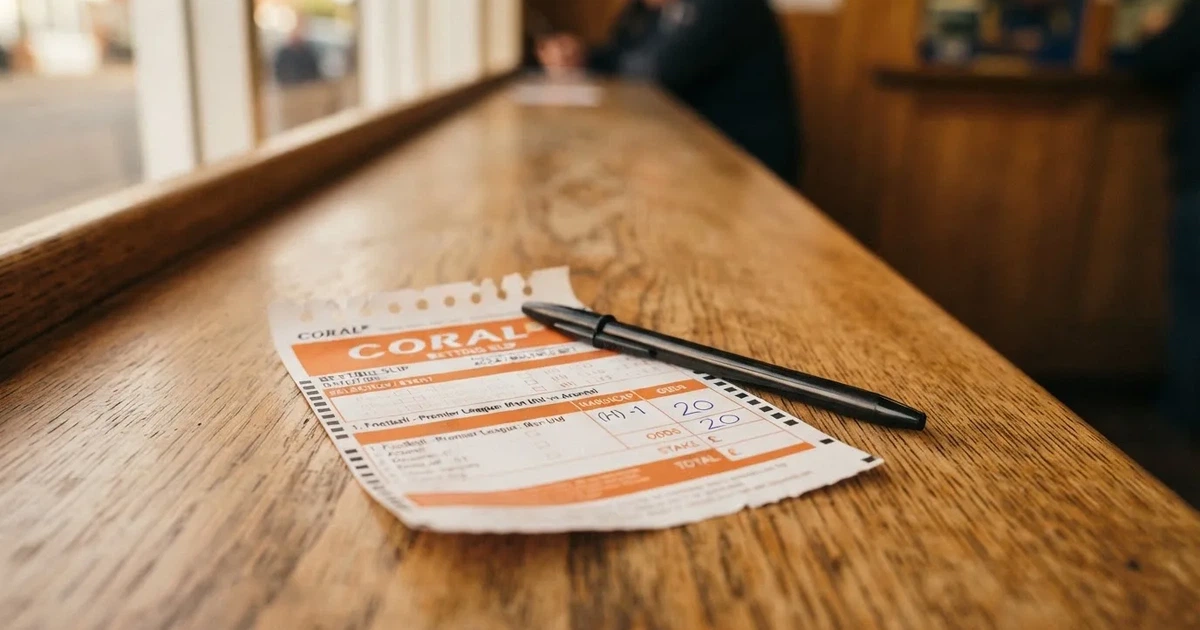
How to read an Asian handicap line
Asian handicap is a football betting method in which teams are handicapped according to their form, so a stronger side must win by more goals for a bet on it to win; the draw is removed from the outcome, leaving two selections per match rather than three. The handicap is expressed as a goal number applied to one side, and the line you choose decides both how the bet settles and what counts as a winner. Several distinct shapes of line exist, and the difference between them is not cosmetic — it changes whether your stake returns, partially wins or loses outright.
The simplest line is a whole number, such as -1 or +1. A result that ends level after the handicap is applied is a push and all original stakes are returned. A £10 stake at -1 on a home side that wins by exactly one goal pays you back the £10 with no profit added, because the applied handicap takes that one-goal margin away. The bet never wins; it never loses either. It survives.

A half-goal line, such as -0.5 or +1.5, removes the push entirely because nobody can score half a goal. The bet is a straight two-way affair: either the selection is a winner after the handicap, or it is a loser. A -0.5 handicap turns a home favourite into a straight win bet at the price quoted, useful when you think the side will win but fear a goalless draw; a +1.5 handicap on the underdog pays out as long as the favourite does not win by two or more. These are the workhorse lines.
A quarter line, such as -1.75, splits the stake across two adjacent lines (-1.5 and -2.0), so a 1.75 line is roughly a bet at 1.5 and a bet at 2.0. The two halves settle independently. One can win, one can push, one can lose; the final return is the sum of what each half does. Quarter lines are the basis of most professional handicap trading because they let a bettor fine-tune how much they win if their team lands “near the line”. The trade-off is that the ticket is more complicated to read at a glance.
The worked-up example that always gets quoted: a £100 stake at 2.29 on Everton -1.75, Everton winning 2-0, refunds £50 on the -2.0 half (a push) and wins on the -1.5 half (£50 × 2.29 = £114.50), a total return of £164.50. The push is the part casual punters miss: the stake is partially returned at the same time as a portion wins at full price, and the arithmetic at the end of the ticket is the sum of both halves, not a single calculation against one price.
Why bookmakers quote these lines at all
The draw is gone — and that is the whole point. A traditional 1X2 market (home / draw / away) carries three outcomes and the bookmaker builds an overround across all three; an Asian handicap cuts out the draw and gives the firm a two-way market to quote, which usually translates into a lower margin on each line. The bettor’s edge, where they have one, comes from spotting matches where the handicap line disagrees with the actual goal expectation.

The bookmaker’s margin sits inside every price, and on this market it sits inside both sides of the two-way line. A handicap quoted at 1.90 / 1.90 carries margin from both ends: a 100-unit stake split between the two sides returns 100 × (1 ÷ (1/1.90 + 1/1.90)) = 100 × 0.95 = 95 units on a perfectly balanced book, and the remaining 5 units is what the firm keeps of every unit bet on this market. Push that margin up to 1.85 / 1.85 and the same stake returns about 92.5 units; the spread between these bands is the difference between a sharp line and a soft one, and on long enough sample sizes, the lower-margin bookmaker charges the bettor less for the same bet. A 1.90 quote is a band, not a single point: the line you actually see depends on the match, the side and the live action around it, but as a guide to what good looks like, anything close to 1.90 / 1.90 on a major league handicap is a tight price by UK standards.
Selection and settlement in plain language
Selection on a handicap market means picking a side after the line is applied; you do not pick the match outcome itself. The handicap has been taken out of the event before you bet, in a sense — what you are betting on is whether the handicapped version of the side beats the opponent. Settlement is by the result on the pitch plus the handicap number: a -1.5 handicap treated as the betting side, and the goals added or subtracted accordingly. Whole-number handicap lines are the only ones where the stake can come back unchanged; every other line either wins or loses.
For each bookmaker below, the question is not whether they quote Asian handicap — most licensed UK brands do — but how clean their price is on a known fixture, whether they list the half and quarter lines alongside the standard ones, and whether their in-play product keeps the market live once the whistle has gone.
Predictions and strategy
The strategists selling Asian handicap tips tend to pitch a single observation: pick a side whose actual goal expectation is several goals different from the bookmaker’s line, and stake accordingly. That’s the book, and it works the same way other forms of value betting work — find a price that is higher than your fair estimate of the outcome’s probability, and let mathematics do the rest over hundreds of bets.
Most “asian handicap betting system” pages you find online are dressed-up versions of one of three approaches, and they all come with the same caveat: the price is set by professionals, the line is set by professionals, and you, the bettor, are competing against the firm’s model and against every sharp account feeding liquidity into the exchange layer. The handicap line is one of the more efficient markets on the British bookmaker’s site precisely because it is popular with sharp bettors. There is no hidden edge.
The most common analytical approach is the form-based read: which side has been winning by how many, and where is that trend going? A home side who has won four out of five and covered -1 in three of them is on a strong run, but a -1 line the bookmaker is offering at 1.85 is pricing in roughly half the time they will cover by two-plus goals. The closing line — the last price before kick-off — is generally the sharpest number available, because the most information has gone into it. Backing sides earlier in the week costs more than backing them on Saturday morning, and that cost is the bookmaker’s margin on a less-informed line.
The second approach is the totals-derived handicap. If you think a game will have 2.6 goals but the over/under line is 2.5, you might also think a -0.5 home handicap is a value play for similar reasons. The handicap and the totals are different framings of the same underlying goal expectation, and sharp accounts use both. Most licensied UK bookmakers will show both side-by-side in their football match view, and reading them together is the simplest sanity check on a price.
The third approach is the in-play handicap, where the line moves as the match progresses. A 0-0 at half-time on a -0.5 home side is half the matchup gone and no goals scored yet; whether the line you would have wanted at kick-off is still available depends on the in-play product. More on that below.
There is no asian handicap betting strategy that survives in isolation. Bankroll management is where most tipsters beat most tipsters-tippers: a single -1.75 bet at 2.29 that lands wins £129.50 profit on a £100 stake, but stake sizing and the willingness to leave a -1 push alone is what makes the practice sustainable. The goal-expectation model the handicap line is built on is unforgiving to bettors who chase losses with bigger stakes on the next fixture.
The limitation of all the analytic angle: the asian handicap tipsters who publish daily picks are not advertising their strike rate honestly. A “best football betting tips today asian handicap” page is either selling a subscription or sending you to one. The picks themselves are no better than any informed observer’s, and the price the bookmaker is offering is the only honest signal of how that observer’s view differs from the firm’s.
The deeper question of bankroll management in handicap markets — flat staking versus Kelly staking versus percentage staking — applies across every market, not just handicap. Flat staking preserves capital but caps upside; percentage staking survives losing runs better but compounds more slowly; Kelly staking is theoretically optimal and practically ruinous for almost every bettor who tries it without a calibrated edge. Whatever system you pick, the cost is in the bookmaker’s margin: 5% of every stake across an even-money line, taken off the top before the bet is even placed.
Bet types, odds and how they connect to Asian handicap
What handicap sits next to
Asian handicap is one of the ways a football match can be priced by a British bookmaker. The other standard ones are the 1X2 (home / draw / away), both teams to score (BTTS), over/under totals, and draw no bet (where the draw returns the stake and the two-way market reduces to two outcomes). Handicap is the natural extension of the latter to non-goal lines: instead of removing the draw only, you move the line off the draw by half a goal and on, all the way out to ±3.5 on most major matches. Asian handicap, draw no bet and double chance are the “reduced-vig” football markets, because they cut out at least one outcome and the book’s margin tends to be tighter.
The handicap line is a more expressive tool than the 1X2. A side you think has a 65% chance of winning has, roughly, a 35% chance of either drawing or losing; on the 1X2, you’re betting on the 65% outcome at whatever price the firm has set, and you’ll often be asked to take an odds-on price. On the -0.5 handicap, that same 65% expectation becomes a line you can take closer to evens, with the same one-bet exposure. For punters who have a strong view on the winner but a weak view on the margin, the handicap compresses the 1X2 and the margin into one price.
The connection to accumulators: handicap legs compound in price the way any other legs would, because the odds multiply. A four-fold of 1.85 / 1.90 / 1.85 / 1.95 handicap legs gives a combined price of about 12.7, and any push along the way returns only the legs that lost or won, not the whole ticket. A whole-number handicap line on one leg is, in accumulator terms, an effective “void” if it lands at exactly that margin — the rest of the accumulator stands. A quarter-line that pushes on one leg is similarly neutralised. The accumulator insurance products some UK bookmakers sell — usually named in terms of “money back if one leg lets you down” — are most often sold against exactly this risk on the handicap.
The shapes of line on a British site
A UK-licensed bookmaker’s football page will, on a major league match, list Asian handicap under one of three labels. “Asian Lines” or “Handicap” in the market list typically opens a ladder of lines from -3.5 to +3.5, in half-goal and quarter-goal steps. The full-goal lines (-1, -2, -3 and their positive counterparts) appear too, because they are the whole-goal pushes — the lines a casual punter finds easiest to read, the lines a sharps account uses least. The quarter lines (-0.25, -0.75, -1.25, -1.75 and so on) are the lines the price is actually set on, and a bookmaker who shows them at a tight margin is the bookmaker the more engaged punter wants.
The number of lines varies. On a Premier League match, top brands show the full ladder from -3.5 to +3.5 plus all the quarter splits, a dozen or more lines per side. On lower-league and non-league football, the ladder typically narrows to ±1.5 plus the quarter splits near zero, and on women’s football and youth football some brands don’t quote the handicap market at all. The breadth of the ladder — the number of lines, the spread on each — is itself an indicator of how serious the bookmaker is about the market, and the bettor comparing brands should check it on the fixtures they actually bet on, not the marquee fixtures the marketing material uses.
A side note on terminology: “Asian corner handicap”, “Asian goal handicap” and “Asian handicap” are usually the same market in football but refer to slightly different framings on the same site. “Asian total” or “Asian over/under” is a totals market expressed in quarter lines — a 2.25 total splits into under 2.0 and under 2.5 — and behaves mathematically the same way. “Asian handicap betting” as a phrase covers the goal handicap, the corner handicap and the totals version, all of them built on the same split-or-not mechanic.
How a bet on the handicap settles
A bet is placed at the price shown on the betting slip, against the stated line, with the stated stake. At full-time — defined by the bookmaker in their own rules, generally 90 minutes plus stoppage time — the result is determined, the handicap applied, and the bet settled as a winner, loser, push, or split result for quarter lines. The settlement shows in the account as stake returned, profit added, stake lost or a partial state for the quarter lines.
The match results that count for handicap purposes are the same ones that count for 1X2 — the 90-minute result, plus any stoppage time added on by the referee, but excluding extra time and penalties unless the bookmaker’s rules say otherwise. Some bookmakers include extra time on certain competitions; some don’t; the bettor who cares will read the market rules before staking, especially on knockout football where extra time is a feature of the round.
Late substitutions, VAR interventions and injury-time goals all settle the bet as they actually happened. There is no opportunity to “cash out” a handicap bet before the final whistle in a meaningful sense that overrides the result — once the bet is struck, the handicap has been applied to the final score.
The top 10 Asian handicap sites in Great Britain
The table below lists ten brands that hold a Gambling Commission remote licence for general betting on real events, quote Asian handicap lines on football fixtures, and were current at the comparison date. The licence number is the account number on the Commission’s public register, not the operating company number, and is the field to use when verifying against the register.
| Brand | Licence number (Gambling Commission) | Asian handicap coverage |
|---|---|---|
| Unibet | 45322 | Full ladder across major leagues, in-play line across the Premier League |
| Dabble | 65677 | Premier League and Championship handicap, social product built around picks |
| Matchbook | 39504 | Exchange-only handicap, deep liquidity on top leagues |
| Octobet | 62545 | Horse racing core, football handicap a smaller line |
| BetVictor | 39576 | Full Premier League ladder, with Best Odds Guaranteed on racing |
| Bet Ahoy | 100094 | Full ladder on top flights |
| bet365 | 55148 | The widest in-play handicap product on the British market |
| Betmaster | 65699 | Top-flight ladders, smaller line on lower leagues |
| Betfred | 39544 | Football handicap solid, acca insurance on multi-leg tickets |
| William Hill | 39225 | Premier League ladder with price boosts, racing BOG from 8 AM |
Each of these ten brands is licensed by the Gambling Commission for remote general betting standard (real events); every one of them takes part in GAMSTOP. None of them is the only licensed brand — the Commission’s register lists several hundred, and a single brand’s presence in a ten-row table reflects where the comparison’s authors chose to look, not a regulatory ranking. The brands that don’t appear may still offer Asian handicap, often competitively, but they fell outside the criteria this comparison used. A broader check of the Commission’s public register remains the most accurate way to identify every licensed operator.
Unibet — Platinum Gaming Limited, account 45322
Unibet’s UK site has been active since 1999 under Platinum Gaming Limited, and its football product carries Asian handicap from -3.5 to +3.5 plus all the quarter splits on major leagues. The site’s deep-fixture coverage means a Premier League line will be quoted through pre-match and into in-play; lower-league and non-UK football still carry a usable ladder, though the spread tightens at the edges.
Beyond the handicap itself, Unibet’s wide sport mix — the firm is a casino-floor as well as a sportsbook — makes it a useful single account for a punter who plays football and horse racing on the same wallet. Its sports welcome offer is a £40 free-bet package on a £20 qualifying bet at minimum odds of 2.0, with the free bets expiring within 7 days of issue and the stake not returned on winning free bets; the headline number sounds generous until the expiry and the qualifying minimum are set against it, which is typical for the format. The wagering-style multiplier, where one exists, sits under the 10x cap now in force on GB-licensed welcome offers.
Worth taking if you want a single account for both football handicap and a wider product. Less compelling if you only play Premier League — the difference between Unibet and the sharper brand below is mostly bookmaker margin on the marquee matches.
Dabble — Dabble Sports UK Ltd, account 65677
Dabble is a newer brand and runs with a social layer on top of the standard sportsbook: users can copy other punters’ bets and chat in-app. The sportsbook quotes Asian handicap on the Premier League and Championship, with the rest of the leagues narrower. The handicap product itself is solid; the differentiator is the social feed alongside it, which suits punters who like a community angle on the markets they bet on.
Dabble’s welcome offer is a £10 free bet for a £10 qualifying bet, with the standard 7-day free-bet expiry and the stake not returned. The qualifying minimum odds apply, and the headline masks the same basic shape every operator runs: a small qualifying bet, a free-bet equal to the qualifying stake, an expiry that requires the punter to use the free bet within a week, and a stake-not-returned clause that pulls the headline value back by 50% to 70% on the typical free-bet price. It’s competent and small.
The social product is the thing. If copying other punters’ selections is what you actually want from a betting app, Dabble is the most developed version of that in the GB market. If you don’t, the handicap product alone is something the more dedicated sportsbooks also do.
Matchbook — Triplebet Limited, account 39504
Matchbook is a betting exchange, not a traditional sportsbook. Customers back and lay against each other, with Matchbook taking a commission on net winnings. The Asian handicap market on Matchbook is exchange liquidity: prices reflect what other punters are willing to back and lay, and the overround on the most-traded football lines can be tighter than on a fixed-odds sportsbook. Liquidity depends on the match — a Premier League tie will have steady money on the handicap, a League One fixture will not.
As an exchange, Matchbook’s commission structure is its cost: commission on net winnings, applied by membership tier. Backers pay it from their returns, layers pay it on their winnings, and the headline price on the screen is gross of commission. The maths is similar to every exchange — a sharper price most of the time, a commission line item on the statement.
Worth taking if you shop prices between bookmakers and an exchange and the difference matters to your staking. Less worth it if you don’t lay bets — the commission is harder to justify on a one-way betting pattern.
Octobet — Octopus Game Limited, account 62545
Octobet’s strongest product is horse racing — Best Odds Guaranteed on UK and Irish racing, up to £150 per customer per race. The football side is smaller and the Asian handicap ladder on the Premier League and Championship is functional but not deep. Lower leagues show the standard lines only.
For a punter whose betting is split between football handicap and horse racing, Octobet is a credible single account. For a punter whose betting is heavily football, the racing BOG doesn’t offset the narrower handicap ladder against a competitor with the full -3.5 to +3.5 spread.
Worth taking if horse racing is doing more of the work than football. The football handicap product is competent, not a market leader.
BetVictor — BV Gaming Limited, account 39576
BetVictor’s sportsbook has long combined a serious horse racing product with a wide football book. The Asian handicap market covers the Premier League ladder in full, with the major European leagues following close behind. Best Odds Guaranteed on UK and Irish racing, enhanced live race streaming, a BetFinder feature and Smart Stats sit alongside the betting slip. BetVictor’s handicap pricing on top leagues tends to compete directly with the other sharp brands on this list.
The bookmaker has historically been one of the better shops on Premier League handicap, and the in-play product carries the lines across the full 90 minutes. Less differentiated on lower leagues, but no worse than the rest of this comparison.
Worth taking if you want a long-standing licensed bookmaker that handles both football handicap and racing on the same wallet, with the depth to hold its pricing on the top leagues.
Bet Ahoy — Bet Ahoy Ltd, account 100094
Bet Ahoy is the newer brand in the comparison and the smallest by marquee-league depth. The Asian handicap on the top flights is full; the deeper market on second-tier European football and lower English leagues narrows.
The welcome offer is a £10 free bet split between a £5 sports bet and a £5 acca, with the same 7-day expiry and stake-not-returned structure as every other name on this list. The split is unusual — the £5 acca token has to be placed on an accumulator — but the headline value is in line with the rest of the field.
Worth taking if you want to add a second bookmaker to a sharper primary and care less about the deeper leagues. The handicap product is solid for a customer whose betting is on Premier League and Championship.
bet365 — Hillside (UK Sports) ENC, account 55148
bet365 is the benchmark against which every other British sportsbook is measured for in-play football. The Asian handicap market on the Premier League ladder is fully quoted pre-match, kept live in-play with a typical 1-2% margin during play, and re-priced continuously through the 90 minutes. The Bet Builder+ product stacks handicap legs against other markets on the same match; Super Boosts and daily Boosts sit on top of the same product.
For a punter whose betting model is in-play football, bet365 is the strongest single account in the comparison. The breadth of the firm — casino, poker, bingo, gaming — is wider than the handicap buyer’s needs, but the depth of the football product justifies it.
Worth taking for the in-play handicap product alone. The drawback is the brand’s size: the welcome offer, the loyalty scheme and the operator’s scope all reflect a firm that approaches GB compliance at its own pace rather than at a customer-pleasing tempo.
Betmaster — BM Solutions GB Ltd, account 65699
Betmaster is operated by BM Solutions GB Ltd, registered in Malta, with a Gambling Commission licence for GB customers. The football product covers top-flight ladders and a narrower line on second-tier competitions. The product is a fairly typical mid-market sportsbook — fewer markets and lines than the biggest names, more margin on those it carries.
For a punter shopping price on Premier League handicap, Betmaster is unlikely to be the cheapest line on the fixture. The product is competent and the welcome offer follows the same small-stake, short-expiry shape as every other bookmaker on the list.
Worth taking if you’ve already exhausted the major books and need another licensed account to keep line-shopping. The handicap product is good; the price isn’t consistently sharp on the top leagues.
Betfred — Petfre (Gibraltar) Limited, account 39544
Betfred’s sportsbook has accumulated a long product list over its trading history: Bet Builder, Sub Switch on player markets, Racing Post data, Extra Places on racing, acca insurance. The football handicap market covers the Premier League and Championship fully, with European top flights close behind. The accent is on the multi-leg ticket — Bet Builder around the handicap — rather than the single-leg handicap line.
Worth taking if you bet the handicap within a bet builder product and want a single-licence bookmaker with a familiar product range. The price on standalone Premier League handicap doesn’t lead the market, but the supporting product makes it a credible second account.
William Hill — WHG (International) Limited, account 39225
William Hill’s price boosts and Super Boosts are a daily feature on its football markets, with handicap legs among the boosted selections. The Premier League ladder is fully quoted, the European top-five leagues are covered, lower leagues narrow. Best Odds Guaranteed on UK and Irish racing from 8 AM on the day of the race, on both single and multiple bets; the BOG does not apply to ante-post, tote or pari-mutuel bets.
Worth taking for a long-standing GB-licensed bookmaker with a wide product. The handicap pricing competes with the sharper books on Premier League, less so on the deeper leagues.
How this works under Gambling Commission licence
A bookmaker serving customers in Great Britain needs a Gambling Commission licence, and the Commission’s public register is the whole test of who holds one. The register can be searched by business name, trading name, domain or account number; every brand’s account number is the row in the table above, and a quick search by the number confirms the licensee, the licence category and the licensed trading names. Several brands can run under one licensee — for example, a single parent group will run a casino brand and a sportsbook brand on separate licences but under related holding entities. Look at the licence holder field, not just the trading name.
The Gambling Act 2005 covers Great Britain (England, Scotland and Wales). Northern Ireland is outside the Act and has its own older law, so a GB licence does not regulate customers in Northern Ireland. Since the Gambling (Licensing and Advertising) Act 2014, an operator whose remote facilities are used in Great Britain needs a Commission licence wherever it is based — a Curaçao, Maltese or Gibraltar licence is not a substitute.
There is no state monopoly on the British commercial gambling market and no statutory cap on the number of licences. The licence categories relevant to a sportsbook are remote general betting standard (real events) for fixed-odds and the variety of markets most sportsbooks offer; remote general betting standard (virtual events) covers virtual fixtures; remote general betting limited is the smaller category for operators with restricted product; remote pool betting covers pool-style betting on horse and dog racing; and remote betting intermediary is the licence a betting exchange holds. Every brand in the table above holds the first of these, and Matchbook additionally holds the exchange licence.
What may be bet on
No statutory list of permitted bets or markets exists in GB law. An operator holds a licence for a category and offers markets under its own rules and the Licence Conditions and Codes of Practice (LCCP). In-play betting is offered by GB bookmakers and the controls are the operator’s licence conditions and customer-protection duties — never written up as “unrestricted” as a legal conclusion. Esports are treated like any other event; virtual events are a separate licence category; bets on politics, TV shows and novelty markets are offered by GB bookmakers and no statutory prohibition was found. Spread betting on financial instruments is regulated by the Financial Conduct Authority, not the Commission.
Minimum age and identity verification
The minimum age is 18. Identity verification happens before a customer can deposit or gamble on a licensed British site, and the requirement covers name, address and date of birth verification. Where a free bet or bonus is offered, verification still applies — the no-deposit route to a GB-licensed sportsbook has been closed off. That means no anonymous play at a licensed site, and source-of-funds questions at higher spend are part of the money-laundering rules rather than a flag of trouble. The differentiator from an unlicensed site is exactly this: licensed = verified, limits in place, GAMSTOP coverage; unlicensed = none of those.
Player protection and the wider safety regime
GAMSTOP and self-exclusion
GAMSTOP is the national multi-operator online self-exclusion scheme, and it has been a mandatory licence condition for online operators since 31 March 2020. The exclusion periods are six months, one year, five years, or five years with auto-renewal; after the minimum period the exclusion stays in place for a further seven years unless the customer asks GAMSTOP to remove it. GAMSTOP covers online sites and apps; betting shops use a separate service. Every GB-licensed operator on the public register is required to be part of the scheme, which is the mechanism through which a self-excluded customer can be stopped at the deposit stage on a single sign-up attempt. The limitation is the exclusion only covers the brands participating in GAMSTOP, and the offshore bookmakers are not participants.
Financial vulnerability checks
A financial vulnerability check is triggered when a customer’s deposits minus withdrawals exceed £150 in a rolling 30 days. The check is a public-record check (bankruptcy or county court judgments, for example), not an income check and not a credit reference check. It applies to all licensed remote betting. The threshold of £150 has been in force since 28 February 2025. Broader financial risk assessments — “affordability checks” as they are often called in the press — were announced in a Commission article of 7 July 2026 in a staged plan with no start date. Until a start date is set and announced, no conclusion about further thresholds or timing should be drawn from this page.
Deposit limits and stake limits
Operators must offer a gross deposit limit on a fixed time frame under the Commission’s Remote Technical Standards. The first changes have applied since 31 October 2025; a second phase was postponed to 30 September 2026. There is no state-set deposit or loss ceiling for betting: limits are the customer’s choice, set in their account. Operators can also set their own maximum stakes and restrict individual customers — that is a private decision, not a regulatory one.
Help and support
GamCare operates the National Gambling Helpline. GambleAware funds treatment and education. NHS gambling clinics offer specialist support in some regions. Gamblers Anonymous runs peer-support meetings. Every GB-licensed bookmaker carries links to these services and is required by the social responsibility code to make them visible to anyone self-excluding.
Live betting and in-play Asian handicap
In-play Asian handicap is where the lines move most and where the house edge is hardest for the bettor to read. The handicap book opens at kick-off with a market on each side; the minute a goal goes in, the bookmaker re-prices the handicap to reflect the new state, usually by effectively shifting the line by one whole goal across every active market.
In-play handicap is mechanically a series of overlapping markets. A pre-match -0.5 home handicap on a 0-0 scoreline is, the moment the away side scores, roughly the same as a -1.5 home handicap at the original pre-match price: the firm has applied the goal to the line and re-quoted the market. The bettor who took the pre-match position is locked in at the original price — that’s the trade — but the next in-play price reflects the new state. bet365’s in-play product keeps the handicap ladder across the full 90 minutes; the other bookmakers listed above support a narrower live product on the lower leagues and a fuller one on the Premier League.
Cash out and what it does on handicap
Cash out is the bookmaker’s offer to settle a bet before the final event has been decided, at a price the firm sets on the state of the market at the moment of the offer. On a whole-goal handicap, the cash-out value will reflect whether the match is currently a winning, losing or pushing state; on a quarter-line, the cash-out value splits the bet’s value across the two halves. The price the firm offers is calculated by the firm, not derived from any exchange market, and the bettor takes whatever the firm offers or holds to settlement.
Cash out is a feature licensed bookmakers offer, but the value offered changes with the state of the market, and a bettor wanting to cash out a handicap leg early in the match is essentially asking the firm to mark the position to market. The offer is usually weaker than a sharp price; the convenience is that the position can be exited without a request to the firm in advance and without laying the bet off on the exchange.
Live streaming and concurrent viewing
Live streaming of football fixtures is offered by GB-licensed bookmakers as a feature adjacent to in-play betting, on a fixture-by-fixture basis. The in-play product on the handicap is the betting product; the stream is a way for the bettor to watch the match without switching apps. Streaming rights vary by competition — the Premier League restricts who can stream what, the lower English leagues have different arrangements, the European competitions vary by country — and a bookmaker’s live product is partly determined by which rights it has bought.
The bookmaker’s margin in numbers
The fixed odds versus decimal odds confusion, settled in plain English: UK bookmakers quote odds in fractional form (5/1) by default and convert to decimal (6.00) at the bettor’s request. The fractional “5/1” means a £1 stake returns £5 profit plus the £1 stake, total £6; the decimal 6.00 is the same value, every unit of stake returns 6 units total. Conversions are mechanical: a/b → a÷b+1. The two forms of the same number describe the same bet, and the only practical difference is how easy it is to read a combined price across legs of an accumulator — decimal multiplies, fractional does not.
What the margin looks like on the line
The margin is the share of every pound staked that the bookmaker keeps on a market, averaged over time. On a two-way handicap at decimal odds 1.90 / 1.90, the formula is simple: payout share = 1 ÷ (1/1.90 + 1/1.90) = 1 ÷ (0.5263 + 0.5263) = 1 ÷ 1.0526 = 0.95, and the margin is 1 − 0.95 = 0.05, or 5%. That is the share of every pound the firm keeps on average across a perfectly balanced book. On a 1.85 / 1.85 line, the same formula gives a payout share of 1 ÷ (2 × 0.5405) = 0.925, margin 7.5%. On 1.95 / 1.95, the payout share is 0.975 and the margin is 2.5%. The cleaner the line — the closer to 1.90 / 1.90 — the lower the margin and the more the bettor keeps of every winning bet.
The margin is not a fee charged on the bet. It is built into every side of every market, and on long enough sample sizes the firm collects it as a share of turnover. A bookmaker with a 5% margin on a football handicap keeps £5 of every £100 staked across that market, before paying out the winners. The losers pay the winners, and the margin is the firm’s cut. The bookmaker’s quoted odds are not their fair price — they are the firm’s price plus the margin — and the size of that margin is the difference between a sharp bookmaker and a soft one over many bets.
The bettor’s price after a free bet
A free bet whose stake is not returned is the most common free-bet structure on a GB-licensed sportsbook. The value of a £10 free bet at 2.00 (evens) is not £20 — it is the £10 stake plus £10 profit minus the implied margin on the bet, which on a 1.95 / 1.95 line gives roughly £9.50, or about 95% of the headline value. The headline cost of the offer is the £10 stake the punter has already paid in qualifying bets, and the headline benefit is the £9.50 free-bet value, with the rest eroded by the margin on the bet. The same maths on a 1.85 / 1.85 line gives a free-bet value of about £8.80, and on a 1.90 / 1.90 line about £9.30. The headline-to-value ratio is what determines whether a free bet is worth claiming, and the marketing word “free” obscures the fact that the bet is paid for in qualifying stake and in the margin on the free-bet itself.
Worked arithmetic on the comparison
A worked comparison: an illustrative two-way handicap market at decimal odds of 1.90 / 1.90.
Payout share, assuming a perfectly balanced book: payout share = 1 ÷ (1/1.90 + 1/1.90) = 0.95. Margin: 1 − 0.95 = 0.05, or about 5%.
The result is presented as a band — the 1.90 / 1.90 line is a tight quoted price, and the actual margin on the books you can bet on depends on the match, the side, the time before kick-off and the in-play product. On the major Premier League handicap ladders the effective margin is often in the 2.5% to 5% band at the close of pre-match; on a deeper league or a less well-supported fixture it can run to 7% or 8%. The 1.90 / 1.90 example is useful because it is the number where the market is at its tightest and the band of margin moves around what most readers will recognise as a competitive bookmaker line.
For a £10 stake at 2.00 (1/1) on a Premier League -0.5 home handicap, the return on a winning bet is £10 × 2.00 = £20 total, comprising the £10 stake returned plus £10 profit. The same stake at 1.85 returns £18.50 total on a win. The implied margin in both is what makes the firm’s expectation of profit across the market; the punter’s expectation of profit depends on whether their view of the probability is sharper than the firm’s.
Off the licence line: what an unlicensed site costs the punter
A bookmaker without a GB licence is illegal to operate for British customers under section 33 of the Gambling Act 2005, and the operator faces up to 51 weeks’ imprisonment or a level-5 fine or both on summary conviction (six months in Scotland). The customer, by contrast, is not the target of the criminal offence: the law is aimed at the operator. What the customer loses by betting with an unlicensed brand is protection, not liberty. No GAMSTOP coverage at the deposit stage. No Gambling Commission complaints route. No approved dispute-resolution body. No British consumer redress if funds are withheld. The 10x bonus cap and the £150 vulnerability check do not bind an unlicensed firm. That’s the cost on the customer side, and it compounds the more the customer’s account balance grows.
Enforcement is disruption, not blocking. The Commission issues cease-and-desist notices, refers unlicensed brands to search engines, and works with registrars, hosts and payment providers to take sites offline. Court-order DNS blocking powers have been given, or are about to be given, to the Commission; ISP blocking is not yet in operation. The honest framing: licensed = verification, limits, GAMSTOP, bonus cap, formal complaints, dispute resolution; unlicensed = none of those, plus the risk that an offshore firm simply doesn’t pay out. Neither is “the safe choice” by default — but the licensed side is the one that has the regulatory backstop when something goes wrong.
What the lines look like across the season
Asian handicap lines move with form and fixture congestion. A Premier League side on a four-game winning streak will see its handicap lines tighten — a -1 line that was 1.95 at the start of the run might be 1.80 by the fifth match. Conversely, a side that has lost three in a row will see the opposite: the -0.5 line on a home fixture that was 1.85 a fortnight ago is 2.05 by the weekend. The line moves to reflect the firm’s updated expectation, and a punter who has been watching the form from the start of the run has a sharper view of where the line should sit than the average customer joining the market at the close.
Tournament football tightens lines further. The Champions League knockout rounds are quoted with smaller margins than the group stage; the World Cup and the Euros are quoted with the tightest margins anywhere in the market, partly because the firms know the betting public is engaged and partly because the liquidity on the exchanges is at its peak. A bettor shopping prices on a Champions League final -0.5 line will see most of the licensed bookmakers within 0.02 of each other; on a League One mid-week fixture the same line can vary by 0.10. The depth of the firm and the size of the match determine the line’s liquidity.
A practical note on a long weekend of fixtures: Saturday at 3 PM is the busiest betting hour in Britain. Lines move fastest at 2:55 PM, slowest around lunchtime on a Tuesday. Lines react to team news an hour before kick-off. Lines go in-play at kick-off and the in-play product takes over from the price. The £10 bet on Saturday’s first match at 12:30 PM is a different animal from the same bet on Saturday’s fifteenth match at 5:30 PM — the early match is settled on a tighter line, the late match is settled on a price that has moved through team news and kick-off, and the difference in expected value reflects the difference in information that has gone into each line.
Frequently asked questions
What is Asian handicap in betting?
Asian handicap is a football betting method in which teams are handicapped according to their form, so a stronger side must win by more goals for a bet on it to win. The handicap removes the draw from the outcome, leaving two selections per match instead of three, and changes a £10 stake at 1.85 into a different price depending on whether the chosen side is the favourite or the underdog.
What is Asian handicap in soccer betting?
In soccer the handicap is applied as a goal number to one side, and the line you choose decides whether the bet settles as a win, a loss, or a push. Whole-number lines return the stake on a tied handicap result; half-goal lines are a straight two-way affair; quarter lines split the stake across two adjacent lines and settle each half independently. The draw is gone before the bet is struck.
What is an Asian handicap bet?
An Asian handicap bet is a single selection on a side after the line is applied. A bet of £10 at 1.95 on the home side at -0.5 wins £9.50 profit if the home side wins, loses the £10 if they fail to win, and never pushes because no draw is possible after a -0.5 handicap. Settlement is by the result on the pitch plus the handicap number, at full-time only.
How can it be checked that a bookmaker holds a Gambling Commission licence?
The Commission’s public register can be searched by business name, trading name, domain or account number, and every licensed brand’s account number is the row in the table above. A quick search by the number confirms the licensee, the licence category and the licensed trading names. Several brands can run under one licensee, so look at the licence holder field rather than the trading name on the register page.
How is the return on a bet worked out from the stake and the odds?
For a single bet at decimal odds, the total return on a winning bet is stake × odds, with the stake included. A £10 stake at 2.00 returns £20 total, comprising £10 stake returned plus £10 profit. The same bet at 1.85 returns £18.50 total on a win. For a combination bet the odds of the legs multiply into one price, so a four-fold of 1.85 / 1.90 / 1.85 / 1.95 has a combined price of about 12.7.
Bet types & in-play – Best betting
Content created by the «Best betting» team
