
Table tennis betting tips in 2026: a guide, not a tip sheet
 Available in US
27 October 2026 · verified against the Gambling Commission’s public register

Table tennis sits in a strange place on a UK betting slip. The matches are short, sometimes over in under twenty-five minutes; the season barely stops because the ITTF calendar and the Russian, Chinese and European leagues play through most weeks. For a bettor, that density is the attraction: more fixtures, more in-play moments, more chances to apply judgement. It is also the trap. The sport’s pace rewards impulse, and impulse rewards the bookmaker, because every price on the slip already carries the operator’s margin before a ball is struck.
This page is the working-up of “table tennis betting tips” rather than the tips themselves. It explains what a tip is — form, statistics, line-ups, the price the market offers — and what a tip is not: a forecast anyone can hand you before a match. It walks through what a value bet means in this sport, why no prediction is certain, how the return on a winning stake is worked out from the odds, and what the bookmaker’s margin looks like once it is taken out of a price. The angle throughout is choice: which paths exist for someone who wants to bet on table tennis from Great Britain, and who each one suits.
How table tennis fits inside a UK betting account
Table tennis is a thin, fast sport on UK bookmaker sites, and the way it sits inside an account is the first thing to clear up. Most operators list it under the winter sports menu rather than the headline sports, alongside darts, snooker and badminton, because the men’s and women’s professional circuits keep running while football, horse racing and tennis have a quieter period. The fixtures are small in number and high in turnover: a typical Tuesday carries the WTT Contender tour, the Russian Super League, the Czech Extraliga, the Bundesliga and a handful of TT Cup events run by live-scoring services, each with anywhere from a handful of matches up to thirty a night.
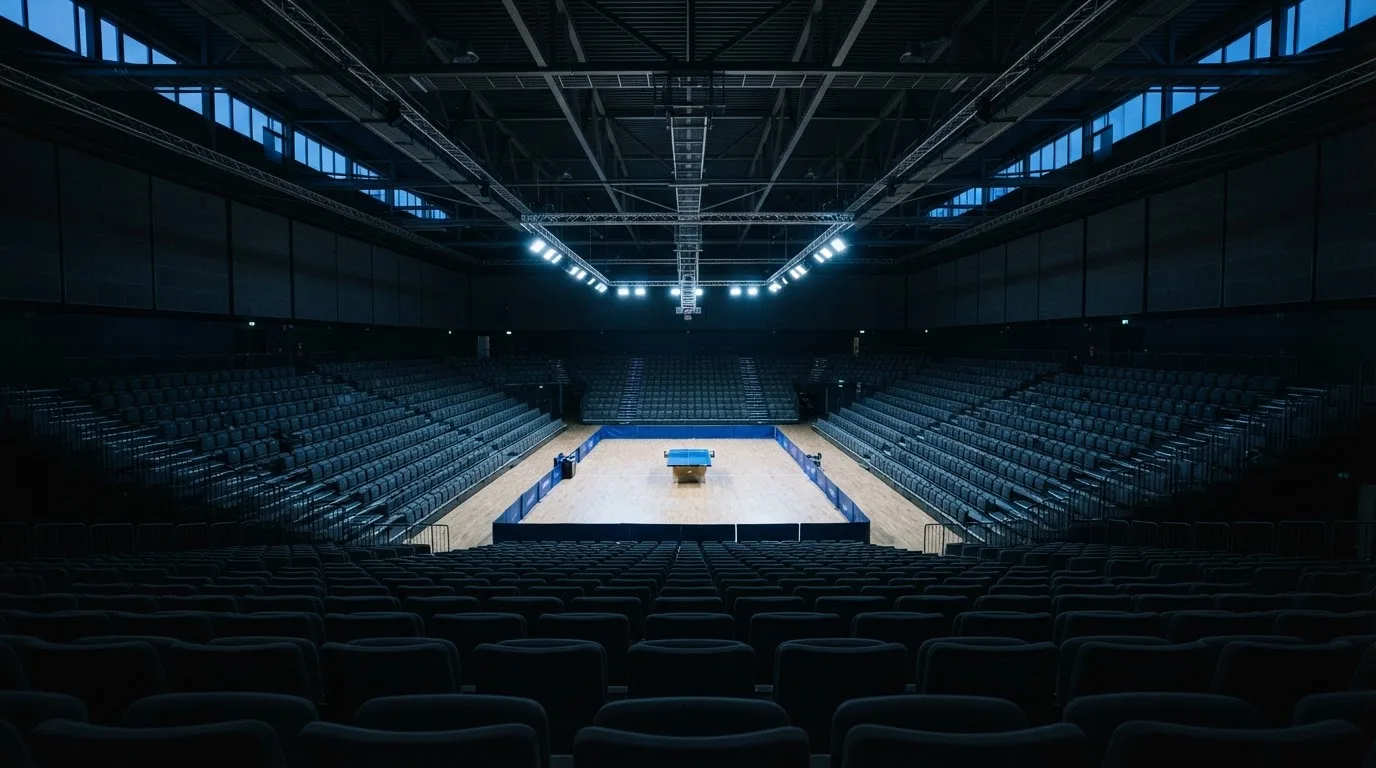
The match format is what shapes the markets. A table tennis game is won by the first player to reach 11 points, and if both players reach 10 the first to lead by 2 takes it. A match is the best of any odd number of games, typically best of five or seven for competition fixtures. That brevity is why in-play matters so much: a three-point swing inside a single game can reshape a price inside a handful of rallies, and the operator’s in-play margin is usually wider than the pre-match one because the model re-prices faster than the bettor can settle. Service alternates every two points, and once both players reach 10 each serves one point in turn — a small detail, but it matters in the closing stages of a tight game, where the next-server rule is one of the strongest predictors of who takes the next two points.
The physical setup is part of what makes table tennis such a stern fitness sport under the surface. The table is 2.74 m long, 1.525 m wide and 76 cm high, with a net 15.25 cm high; the ball is 40 mm in diameter and weighs 2.7 g. The ITTF was founded in 1926, and table tennis has been on the Olympic programme since 1988. None of those numbers decides a match, but each one shapes the conditions: the height of the net affects topspin-to-lop rallies, the 40 mm ball replaced the 38 mm one for slower play and longer rallies, the Olympic status means competition scheduling bunches around July.
Who can offer this market, and who actually does
A bookmaker taking bets from customers in Great Britain needs a Gambling Commission licence, regardless of where the operator itself is based. The Commission was set up under the Gambling Act 2005 and has been the regulator of the whole commercial market since then; since the Gambling (Licensing and Advertising) Act 2014, an operator whose remote facilities are used in Great Britain needs a Commission licence wherever it is incorporated. A Curaçao, Maltese or Gibraltar licence is not a substitute for the Commission’s remote general betting standard (real events) licence that covers a UK-facing sportsbook. Betting and casino are separate permits with separate rules: a casino-only licence does not cover a sportsbook, and an exchange licence covers only the betting intermediary function.

The Commission’s public register is the whole test of who holds a licence. It can be searched by business name, trading name, domain or account number, and it lists the licence holder, the licence categories it covers and the remote operating licences that flow from the operating licence. Several brands run under one licensee — Paddy Power and Betfair under PPB Counterparty Services Limited, for instance — so the licence check is not the same as a brand check. The featured set the rest of this page works through is one set of ten operators and covers a fraction of what the register holds; nothing on the page makes a brand “the only licensed one”, because the register lists more licensed operators than any single article can name.
Every GB-licensed operator is also a GAMSTOP member, the national multi-operator online self-exclusion scheme that has been a mandatory licence condition since 31 March 2020. The brand pages later in this guide are checked against the Commission’s public register; readers should do the same for any operator they are considering.
Responsible play and the safety tools already switched on
A licensed operator runs inside a tighter safety frame than an unlicensed one, and the frame is the same on every brand in the featured set. The minimum age is 18; name, address and date of birth are verified before the customer can deposit or gamble, including with a free bet or bonus. From 7 May 2019 those checks have to land before the first stake, not after a withdrawal request; the effect is that there is no anonymous play on a GB-licensed site, and a bettor cannot move money through an account that has not been identified.
GAMSTOP, the national scheme, covers every GB-licensed online operator; betting shops use a separate scheme. Self-exclusion periods are six months, one year, five years, or five years with auto-renewal; after the minimum period, an exclusion stays in place for a further seven years unless the customer asks GAMSTOP to remove it. A GAMSTOP registration blocks the customer from opening new accounts and is checked at sign-up, so it is a sharper tool than a self-imposed deposit limit on a single brand.
A separate layer of controls has come in since 2024. A financial vulnerability check (LCCP condition 3.4.4, in force from 30 August 2024) applies to licensed remote betting when a customer’s deposits minus withdrawals exceed £150 in a rolling 30 days; the trigger date of 28 February 2025 is when operators started running the check. It is a public-record check (bankruptcy, county court judgments and similar) rather than an income check or a credit-reference check, and what it does is catch the kind of financial state where a deposit limit alone is not the right safeguard. A financial risk assessment (the affordability check that has been talked about in the press) has been announced in a staged Commission plan; as of mid-2026 there is no start date, so on a licensed account the rule in force remains the vulnerability check rather than a wider affordability one.
Deposit limits under RTS 12 are operator-set, and the law sets the structure rather than a number. Operators must offer a gross deposit limit on a fixed time frame; the first changes applied in October 2025, a second phase was postponed to 30 September 2026, and whether that second phase is in force at the point of reading is not established through research. There is no state-set deposit or loss ceiling for betting: any ceiling is one the customer sets themselves.
Help is reachable independently of any operator. GamCare runs the National Gambling Helpline; GambleAware funds treatment and education; the NHS runs gambling clinics in several regions; Gamblers Anonymous runs group meetings. The featured operators also run product-level controls — deposit limits, time-outs, product restrictions, self-exclusion from that brand alone — but GAMSTOP and the help-line services stay the route for anyone who wants to step back further than a single brand can take them.
Crypto, anonymity and the offshore question
Search around the subject of table tennis betting and a strand turns up quickly: “table tennis betting with bitcoin”, “blockchain table tennis betting”, “table tennis betting with crypto”. It is a strand the GB-licensed market does not cover. No licensed UK operator is documented as accepting cryptocurrency, and a licensed bookmaker cannot accept anonymous play while the name-and-address check sits ahead of the first deposit. The two constraints meet: anonymity and the GB licence do not coexist.
An offshore operator sits outside the GB frame. A Curaçao or Curaçao-equivalent licence does not bring a Commission licence with it, and the consequence is not a fine word like “less safe”; it is a concrete list of protections that do not apply. There is no GAMSTOP coverage on an offshore site, so a self-exclusion the customer set on a GB-licensed brand does not extend to it. There is no Commission complaints route and no approved dispute-resolution body; if the operator withholds funds, the customer’s recourse is the offshore licence holder and any arbitration route the operator’s terms describe, which is rarely quick and is rarely British. The 10x bonus cap that licensed operators are bound by does not bind an offshore brand, so an offer can read more generously on the page; the offers section later in this guide is the right place to see what generosity tends to cost the bettor once rollover is added.
The honest framing is not “safe vs unsafe” but “rules vs no rules”. A GB-licensed operator runs inside a regime that checks identity, caps bonuses, blocks credit cards, runs the vulnerability check above £150 net and requires GAMSTOP membership. An offshore operator runs on its own house rules, and a player who signs up there is reading those rules alone. Neither is “the safe choice” by default; the licensed choice is a known set of consumer protections and a smaller list of approved payment methods; the unlicensed one is fewer rules and a longer list of risks on funds.
The credit-card ban (since 14 April 2020) covers any credit-card-funded payment at a GB-licensed operator, including credit-card-funded e-wallet top-ups. Debit cards and bank-based payments are not within that ban. Crypto deposited through an exchange card can sometimes slip past a payments page, because the underlying rail is not the card — but licensed operators are required to know who is paying them, so the test that fails is the customer-due-diligence one rather than the payment-method one. The practical result is the same: no anonymous crypto play at a licensed UK bookmaker.
Bonuses and free bets at table tennis odds
The “free bet” word is the one worth deflating first because it carries the most mis-selling potential on a table tennis slip. A free bet at a licensed UK operator is a credit, not a payout: the stake is usually not returned with a win, only the winnings, and the value of that credit is best understood as the expected winnings the credit will produce across the average use of it. A bookmaker can call £30 in free bets a “£30 free bet” because the winnings are paid back; the stake is not. A £10 free bet taken at decimal odds of 3.00 returns £20 if it wins — the £10 stake is gone, and the bettor has paid for it with the qualification step.
Bonus offers stack on top of free bets and add turnover. The promotion rules in force since 19 January 2026 cap wagering requirements on bonuses at 10x: a £10 bonus at 50x wagering needed £500 of qualifying bets before the bonus was paid out; under the cap no more than £100 of wagering is required. Mixed-product promotions — an offer that asks for betting plus casino, bingo or lottery — are banned. The 10x cap does not cover every promotion: the rules apply to bonuses with a wagering condition, and whether a free bet without a wagering step falls inside them, and any cap on the cash value of a bonus, are not established through research.
The maths behind a free bet has two faces. The face the marketing shows is the headline credit: “£30 in free bets”. The face the arithmetic shows is what the credit is worth on average across the bets the credit will fund. For a free bet whose stake is not paid back, the value is roughly the free-bet amount times (odds − 1) divided by the odds of the bet selected, scaled by the payout share of the market being played. Take a £10 free bet at decimal odds 2.00 on a market with a 95 % payout share: the calculation gives £10 × (2.00 − 1) ÷ 2.00 × 0.95, which is £4.75 of expected value. The same £10 free bet on a market with a 90 % payout share gives £4.50. The headline figure on a slip is always the credit, and the figure that actually matters is the one driven by the market the credit is being spent on.
Read the small print before claiming. Look for: the wagering factor and what it is applied to (the bonus, or bonus plus deposit); the minimum odds each qualifying bet must be taken at; the deadline for using the free bets or completing the rollover; the cap on free-bet winnings; whether the bonus is paid as cash, free bets or a mix; the markets that count toward rollover (some promotions exclude table tennis in favour of football, racing or outright bets). A bonus is not “free” if the terms erase what it paid in qualifying stakes to clear; the audit below is the right way to read it.
The bonus rules on this market do not make table tennis a special target for offers. Operators tend to count table tennis bets toward football or sportsbook rollovers, but the markets carrying the bulk of the rollover are the ones with the heaviest volume: pre-match football, horse racing, in-play tennis. A bettor who wants to clear bonus turnover on table tennis only should check the offer terms for the eligible-markets list before placing the first qualifying bet.
Live betting and cash out at a table tennis match
Table tennis is one of the purest in-play sports a UK bettor can stake on. The matches are short, the points come in clusters, and the prices move with every game won and lost. A three-game swing inside a best-of-five match is a single momentum flip, and the operator’s in-play model re-prices faster than the bettor can refresh — which is also why in-play margin is usually wider than the pre-match margin on the same selections.
Live betting at a licensed operator runs on the operator’s own licence and customer-protection duties. There is no statutory cap on in-play stake sizes; the operator decides, and where the in-play market has a sharper liability profile (a heavily favoured favourite, a match where one player is dominant) the operator’s maximum stake will shrink through the contest. Cash out is the operator’s offer to settle a bet before the event has finished, and the cash-out price is set by the operator’s own model: the bet is settled at a price the operator quotes, and the bettor can take it or leave it. The price moves as the match moves, and there is no second-best market to compare it against.
The Bet Builder or “same-game multi” feature layers markets inside one event: a table tennis match where the bettor backs player A to win 4-1 and the match total games over 4.5 is a single bet built out of two selections. The Bet Builder margin is the operator’s margin on the combined product rather than the sum of the margins on the legs, and the combined margin is wider than each leg’s margin on its own. The mechanism is not hidden — it is the same overround idea applied to a multi — but the headline figure on a Bet Builder slip is the price, not the margin, and it is the margin that quietly strips the value.
The trade-off in in-play is speed. A bookmaker’s algorithm is watching the same feeds the bettor is watching, and it prices within a second of a key point. The bettor’s edge is one a casual reader cannot often find at the pace in-play demands: a known injury, a server who has lost three service points in a row, a leg injury that does not yet have an in-game annotation. Where the bettor’s read is faster than the operator’s, the in-play price is mispriced and the value bet is real. Where the operator’s read is faster, the in-play market is a tax on the bettor’s reflexes. The numbers in this paragraph are qualitative; what is documented is the in-play feature at several featured operators, not the speed of their pricing models.
Predictions, strategy and why no tip is certain
The honest answer to “how to win table tennis betting” is that nobody can promise a win. The useful answer is that a tip is a hypothesis about probabilities, and the bettor’s job is to find one whose probability the price under-prices. A prediction made before the match is a probability the tipster has assigned, deliberately or otherwise; whether it lands depends on whether the probability was right and whether the price on the slip was the right reflection of it. No published tipster carries a public record of every prediction they have ever made at a given price on a given sport, and the absence of that record is the absence of proof.
A prediction in this sport usually rests on form, statistics and line-ups. Form is recent results and the quality of the opposition those results came against. Statistics are serve percentages, return-point win rates, games-to-deuce rate, head-to-head record at the venue, games played in the last seven days. Line-ups are the most fragile — a player withdrawing from a warm-up event or being substituted at the last minute can move a price by tens of percent. A published tip that lists all three and gives the implied probability the price sits at is a more useful document than one that names a winner; the first is a thesis, the second is a guess that wears the same clothes.
A value bet is what a prediction is really worth. The idea is mechanical: if a player’s true probability of winning is 60 % and the bookmaker’s price implies 50 %, the bet is value. The bookmaker’s price is what the bettor pays; the true probability is what the bettor thinks the chance is. The margin is what the bookmaker keeps on every unit bet, and it sits inside the price before the bettor weighs in, which means the bettor’s value calculation has to be made against the price minus margin rather than against the price itself.
Bankroll discipline is what turns a value bet into a winning strategy over months. A stake sized as a percentage of the bank, not a flat amount, smooths the variance and lets the bettor survive losing runs that any 60 %-edge strategy will run into. Flat-stake betting at fixed pounds per bet drifts after a losing run because the bank has shrunk and the stake has not, which is the classic ruin path. The other side of bankroll discipline is on the bonus: a deposit limit does not stop a bettor placing more bets; it stops a bettor making a single deposit bigger than it should be. The two settings are complementary.
The line a tipster should be read against is published form across hundreds of bets, not a single winning pick. Look for the closing-line value (whether the tipster’s price tends to beat the closing price, which is the sharpest number the market produces), the units won or lost over a sample of at least 1,000 bets and the sports the sample covers. A table-tennis-only tipster with a 6 % return on turnover at closing-line value across 2,000 bets is the kind of document a reader can act on; a single Saturday pick is not.
Bet types, odds and how a return is worked out
Table tennis markets at a UK bookmaker run from the headline 1X2 (match winner, often with the draw priced because best-of-five and best-of-seven matches can finish level in games but not in matches) to totals (over/under total games), handicaps (game handicap, where player A must win by a margin in games to cover the spread), set betting, race to a point total and a handful of player props. Each market carries its own margin, and the headline odds on each market are not the same odds.
A single bet returns the stake plus winnings at the decimal odds printed. The return on a £10 stake at decimal odds 2.50 is £10 × 2.50 = £25; the profit is the return minus the stake, £15. A bet at fractional odds 5/2 is the same: profit per unit stake is 5/2, total return is 5/2 + 1 = 3.50 in decimal form, so a £10 stake returns £35 (the conversion is a ÷ b + 1, so 5 ÷ 2 + 1 = 3.50). The two forms describe the same bet, and the price the bookmaker quotes is the same price either way.
An accumulator multiplies the odds leg-by-leg into one price. A four-fold at legs 2.00, 2.00, 2.00 and 2.00 carries a combined odds of 16.00; a £10 stake returns £160 if all four legs win, profit £150. The combined margin is the sum of the legs’ margins compounded, and the wider the combined margin the faster the bettor loses money for any combined probability the bettor thinks is correct. Acca insurance (a refund as a free bet if one leg loses) brings the combined price back up partway; the free bet has the value calc above, and the insurance’s cost has to be priced against the consolation.
A handicap bet shifts the line so that one player starts the match with a game handicap. A −1.5 games handicap on player A means player A must win by two games or more for the bet to land (best-of-five, so 3-1 or 3-0). The price reflects the handicap and carries its own margin. Spread betting is a different product: the bet is on whether the spread between two outcomes (the total number of points, the game margin) lands above or below the spread the bookmaker quotes; this is the FCA-regulated activity Spreadex holds alongside its Commission licence, and the page in that operator’s section states that losses can exceed the deposit.
Cash out, Bet Builder and the acca insurance each carry a margin that is wider than the underlying. The bettor sees the price the operator is willing to settle at, and the operator’s edge is in how that price moves rather than in how it is initially shown. A rule that the bettor can hold onto: a market’s headline odds describe a margin from the bookmaker’s side, and the bettor’s edge has to cover that margin before the bettor’s tip is a value bet at all.
Where to find the fixtures
The fixtures on a UK bookmaker’s table tennis page in mid-2026 are dominated by the ITTF World Tour (WTT events), the national leagues of Russia, China, the Czech Republic, Germany and France, the TT Cup and Setka Cup series run by live-scoring services, and the Olympic and World Championship cycles for the women’s and men’s sides. The ITTF was founded in 1926 and the Olympics have hosted table tennis since 1988 — those are the headline events, and the World Championships are the highest-profile non-Olympic competition each year.
The market’s own structure is what shapes which fixtures a bettor has access to. Best-of-five matches are typical of men’s and women’s professional play outside the Olympic final and the World Championship final; best-of-seven matches are reserved for the later rounds of the Olympic and World Championship events. Best-of-three is the practice frame in amateur and lower-tier competition, and the best of those matches is what makes “over/under total games” a workable market. The TT Cup and Setka Cup series run best-of-five with short turnaround between matches, and they are the highest-volume sub-market on the schedule: the operator’s liquidity follows the volume.
The bettor’s choice of fixtures is shaped by what the operator offers. Pre-match tables show anywhere from a handful of matches to thirty per night; in-play tables open the menu further because the operator can list the live score and price every game. The brand section that follows lists which operators are documented to carry in-play and Bet Builder features, and the rule of thumb is that the wider the operator’s sportsbook, the more table tennis fixtures are priced into the menu.
The top ten UK table tennis bookmakers at a glance
The table below names the ten operators the rest of this guide covers, the Gambling Commission licence behind each, the operator licence holder and what each operator’s own terms state about table tennis (or, where research does not carry a specific table-tennis line, the most relevant feature for this reader — in-play, Bet Builder, acca insurance, BOG on racing or a comparable). The featured set is one cluster of GB-licensed operators; it is not a list of every GB-licensed sportsbook, and the register is the source readers should check for any operator not named here.
| Brand | Gambling Commission remote licence | Licence holder | What the operator’s own terms state |
|---|---|---|---|
| Copybet | 53774 | Copybet UK Limited | Best Odds Guaranteed all day on UK and Irish racing; FPTP payout on horse racing |
| Bet600 | 44731 | Tyche Tech Limited | Best Odds Guaranteed on horse racing (SP upgrade) |
| Betfair | 39439 | PPB Counterparty Services Limited | In-play, Bet Builder, free live streaming, 90 Minute Payout |
| London Bet | 66162 | Thistle Bet Limited | Sportsbook (football, tennis, racing, greyhounds, darts, golf, cricket, NFL, NBA, MLB, snooker) with Pragmatic Play casino, in-play |
| 888sport | 39028 | 888 UK Limited | Pre-match and in-play, Cash Out, Bet Builder, racing streams, BetFinder, daily boosted odds |
| Bet Ahoy | 100094 | Bet Ahoy Ltd | 10 % Acca Bonus up to £1,000, Sub-Cover, BOG on UK/Irish racing up to £100, Double Result on UK/Irish racing |
| Fitzdares | 400 | Fitzdares Limited | Cash out, accumulators, Lucky 15s, specials and antepost on horse racing, football, tennis, rugby, cricket, golf, American football; in-play |
| BetVictor | 39576 | BV Gaming Limited | BOG on UK and Irish horse racing, enhanced live race streaming, BetFinder, Smart Stats |
| NetBet | 39170 | Netbet Enterprises Limited | Daily Boosts, Profit Boosts, free bet offers, Bet Builder with instant dynamic odds, sports stats |
| Spreadex | 8835 | Spreadex Limited | £60 in free bets for a £10 fixed-odds bet; free bets usable across fixed odds and spread betting; FCA-regulated for spread betting |
Ten operators are not the GB licensed market; the Commission’s register lists more, and the page is one reader’s slice across a wider field. Names above should be checked against the register before any account is opened; a brand’s appearance on the register is the licence test, and a brands-only comparison does not replace it.
The featured operators in detail
Copybet
Copybet runs under Gambling Commission account 53774, with Copybet UK Limited as the licence holder. The brand’s racing offer is the headline feature for what research documents: Best Odds Guaranteed runs all day, every day on UK and Irish racing, and a horse-racing winner who is later disqualified is still paid first past the post. The combination of full-day BOG and the FPTP concession makes Copybet’s racing terms more generous than the racing-only brands in the comparison; whether it transfers to table tennis is not documented beyond the general sportsbook the operator runs. The BOG rule applies to racing, and a table tennis bettor on the operator is on the standard sportsbook terms, including the 10x bonus cap that applies at GB-licensed brands.
For a reader whose sportsbook is split 80/20 between racing and table tennis on the winter calendar, Copybet’s value lies in the racing side. A reader whose primary interest is in-play table tennis with a Bet Builder should look elsewhere, because the table-tennis feature set is not documented at the level some of the comparison operators run.
Bet600
Bet600 runs under Commission account 44731, with Tyche Tech Limited as the licence holder. The brand is documented for its Best Odds Guaranteed on horse racing, where a bet taken at an early or show price is paid at the SP if the SP is bigger. The BOG rule is the headline racing concession; the table tennis offer sits inside the standard sportsbook terms. A reader who runs both a racing and a table tennis book at the same brand should check the BOG terms carefully — racing is what the concession applies to, and a table tennis bet does not come with the upgrade.
The operator’s account-opening offer and the rest of the sportsbook terms are not documented in detail through research. A reader interested in Bet600 should check the operator’s own terms for the welcome offer, the eligible markets for any bonus and the in-play feature on table tennis matches.
Betfair
Betfair runs under Commission account 39439, with PPB Counterparty Services Limited as the licence holder — a share of the Betfair–Paddy Power combined operation. The brand documents in-play betting, a Bet Builder feature, free in-app live streaming of UK and Irish horse racing and football, and a 90 Minute Payout market. The combination of in-play and Bet Builder on a regulated sportsbook, alongside the live streaming, makes Betfair one of the more rounded choices for table tennis matches where in-play pricing is the point.
The 90 Minute Payout market is football-only — it settles the match result on the 90-minute score regardless of extra time, which is useful for cup matches but does not move a table tennis bet. A reader whose winter schedule is heavy on in-play table tennis should compare Betfair’s in-play depth on the sport against other comparison operators.
London Bet
London Bet runs under Commission account 66162, with Thistle Bet Limited as the licence holder. The brand offers sports betting on football, tennis, horse racing, greyhounds, darts, golf, cricket, NFL, NBA, MLB and snooker, alongside Pragmatic Play casino slots and live in-play. The mixed sportsbook-and-casino product is one of the comparison’s narrower shapes, and the included sports are weighted toward the British betting menu rather than the international one.
Table tennis sits inside the tennis listing rather than as its own category in research; a reader who bets on table tennis specifically should check the operator’s own Wettprogramm rather than rely on the headline list. The 17+ App Store age rating on the brand’s app and the publish-by Thistle Bet Limited line confirm the brand’s GB reach. The mix of in-play tennis and casino on a single operator is one of the structure choices a reader with a single-account book might want, but it is not the strongest table tennis depth in the comparison.
888sport
888sport runs under Commission account 39028, with 888 UK Limited as the licence holder. The brand documents pre-match and in-play betting, Cash Out, Bet Builder, racing streams, BetFinder form tools, a live bet feed and daily boosted odds. The combination is the widest feature menu in the comparison: pre-match and in-play on the same operator, a Bet Builder that the table tennis bettor can use on a single event, and a live feed that updates faster than the standard market page.
The boosted odds feature deserves the deflation the bonus section gave. A “boosted” price is a one-off enhanced odds token on a named selection; the stake is paid back as a free bet or a capped win depending on the brand, and the cash-out rule typically does not apply to the boosted token. A reader who treats boosted odds as a discount is misreading them. The right read is the same as a bonus: what does it cost in qualification or where is the cap.
Bet Ahoy
Bet Ahoy runs under Commission account 100094, with Bet Ahoy Ltd as the licence holder. The brand documents a 10 % Acca Bonus up to £1,000, Sub-Cover for player substitutions, Best Odds Guaranteed on UK and Irish horse and greyhound racing up to £100, and Double Result payout on UK and Irish racing. The acca bonus is the headline feature for what most readers chase: a 10 % boost on a winning accumulator’s return, capped at £1,000.
The double-result concession on UK and Irish racing settles the bet on the runner’s finishing position regardless of later stewards’ inquiries; a similar rule on table tennis would settle the bet on the player who reached the winning point rather than the result of any later walkover. No table-tennis-specific rule of that kind is documented. A reader whose accumulator book includes table tennis legs will be paid 10 % on top of the standard return if the four-or-more-fold acca wins, capped at £1,000.
Fitzdares
Fitzdares runs under Commission account 400, with Fitzdares Limited as the licence holder. The brand documents cash out, accumulators, Lucky 15s, specials and antepost markets on horse racing, football, tennis, rugby, cricket, golf and American football, with in-play live odds. The feature shape is the deepest acca-and-perms selection in the comparison: Lucky 15s, doubles, trebles and the higher-multiple perms are all supported, and the antepost markets cover the British racing menu alongside the headline sports.
Table tennis is in the sports list through tennis and through “specials” — the rule that decides which markets are priced in-play usually lives in the specials list rather than the main tennis page. The Lucky 15 structure (fifteen bets across four selections: four singles, six doubles, four trebles and one four-fold, with unit stake multiplied by fifteen) suits a reader with a four-name-per-night table tennis portfolio; the structure is for spread betting, not for finding edges.
BetVictor
BetVictor runs under Commission account 39576, with BV Gaming Limited as the licence holder. The brand documents Best Odds Guaranteed on UK and Irish horse racing, enhanced live race streaming and a BetFinder feature for finding racing bets, alongside Smart Stats. The “Smart Stats” feature is the closest thing the comparison has to a built-in form tool; the brand exposes historical statistics on the sportsbook page, and a reader with an analytical approach to pre-match table tennis lines can use it.
BOG on racing and the build quality of the racing product are the headline features. A table-tennis bettor on BetVictor uses the standard sportsbook terms, and the in-play feature on table tennis matches is documented through the brand’s general live odds stream rather than a named table-tennis product.
NetBet
NetBet runs under Commission account 39170, with Netbet Enterprises Limited as the licence holder. The brand documents Daily Boosts, Profit Boosts and free bet offers, a Bet Builder with instant dynamic odds, and sports stats for major leagues. The Profit Boost feature has the same deflation the boosted-odds line at 888sport ran: a one-off enhancement on a named selection with the usual cap and the usual no-cash-out rule.
The Bet Builder with “instant dynamic odds” is the table-tennis-relevant feature: a table tennis acca built out of game-handicap, total games and race-to-points selections on a single match, priced by the operator’s combined-margin model rather than the sum of legs. The headline is the speed of the dynamic pricing; the cost is the wider combined margin.
Spreadex
Spreadex runs under Commission account 8835, with Spreadex Limited as the licence holder, and a separate FCA authorisation for the spread-betting side of the business. The brand documents a new-customer offer of £60 in free bets for a £10 fixed-odds bet, with the free bets usable across fixed odds and spread betting; the qualifying bet must be placed within 28 days of opening the account. The financial-spread-betting side is regulated by the FCA, and the brand’s own page states that losses can exceed the deposit, which is the standard regulated-line on a spread product.
The dual product (fixed odds and spread betting) under one account is the differentiator. A table tennis bettor who has read the spread-betting rule carefully can switch between fixed odds on the match-winner market and spread-betting on the total-points market from the same account. The 28-day qualification window on the welcome offer is the kind of detail a reader checking terms will want to confirm before placing the £10 qualifying bet.
The bookmaker’s margin and why it matters
The margin is the difference between the bookmaker’s payout share and 100 %. On a two-way market with decimal odds 1.90 / 1.90 the payout share is 1 ÷ (1 ÷ 1.90 + 1 ÷ 1.90), which is 1 ÷ (0.5263 + 0.5263), and that comes to 1 ÷ 1.0526, or 0.95. The margin is 1 − 0.95, or 5 %. The 5 % is what the bookmaker keeps of every unit bet on the market, before any further vig, bonus cost or marketing cost; it is the floor under the bettor’s edge.
The 5 % is the figure to compare against, not the price itself. A market priced at 1.90 / 1.90 with a 5 % margin is a generous book on the pre-match table tennis menu; a market priced at 1.85 / 1.85 with a 6.7 % margin is a sharper book and costs the bettor more on every bet placed. The price looks cheaper at 1.85 than at 1.90; the cost is the opposite — a cheaper-looking price that pays back less than the more expensive-looking one, because the operator’s margin widens.
Different markets carry different margins. The match-winner 1X2 market tends to be the most generous because it is the most liquid; totals (over/under total games) typically run at 6-8 % margin on the better books; player props and race-to points markets can climb into double-digit margins because the liquidity is thinner. A bettor’s edge is not just the edge of a single bet but the edge after the market-specific margin has been subtracted; the same bettor at the same true probability of winning is on worse ground in a totals market than in the match-winner market on the same match.
The comparative work is brand-by-brand and market-by-market. A £10 bet on the same player at the same probability of winning returns more at the brand with the lower margin, all else equal. Where a brand’s market features (Bet Builder, acca insurance) carry a wider margin than the underlying legs, the rule is the same: the figure that matters is the one left after the margin has been taken out. The margin belongs to the bookmaker; the value belongs to whatever is left.
Where the licensing frame stops and the choice begins
A GB-licensed bookmaker is the only brand a UK-resident bettor can rely on for the protections the previous section ran through. The protections come with a cost that does not show in the price: an identity check, an affordability trigger at £150 net deposits, a credit-card ban, a GAMSTOP check at sign-up. The unlicensed choice skips those and gives the bettor the freedom to deposit from a credit card at an unregulated site, anonymity in account funding and a wider promotion menu. The trade is that the bettor has no recourse in Britain if the operator withholds funds, no GAMSTOP coverage and no Commission complaints route. This page’s featured set is one GB-licensed operator per row, and the comparison is between GB-licensed operators; an unlicensed operator is not the “more private” version of a licensed one; it is a different product.
The choice between GB-licensed operators is where the practical work sits. Different brands offer different combinations of in-play depth, Bet Builder, acca bonus and racing concessions; a reader with a split book across racing and table tennis has different priorities from one whose winter calendar is purely table tennis. The brand-by-brand summaries above are the place to start; the Commission’s public register is the place to confirm the licence.
The numbers behind a tip
A prediction is not a number; it is a probability assigned, deliberately or otherwise, to one of several outcomes. A line of 2.00 on player A and 1.80 on player B implies the operator thinks player A wins with probability 1 ÷ 2.00 = 50 % and player B wins with probability 1 ÷ 1.80 = 55.6 %. The two probabilities sum to more than 100 %, and the gap is the operator’s margin, here 1 − (50 % + 55.6 %) = −5.6 % — that is, an overround of 5.6 %. The operator’s “true” probabilities, before the margin, are about 47.4 % and 52.6 % to make the book “round”.
A tip that names a winner is a probability the tipster has assigned. A “value bet” claim is a tipster saying their probability is higher than the price’s implied probability once the operator’s margin is taken out. A 60 % tip on a player at odds that imply 50 % is value; the same 60 % tip on a player at odds that imply 65 % is not. The strength of a tipster’s track record is the difference between the implied probability of their picked price and the actual probability of that pick landing, measured over a sample large enough that the variance settles out — usually a thousand or more picks.
A bettor’s edge is not just a price-versus-probability calculation; it is the ability to make that calculation more accurately than the operator does in pricing the line. On table tennis, that advantage is rare in the headline markets because the operator’s data on server-side performance is as good as anyone else’s, and the bettor’s advantage is more often in line-up information that has not been priced in (a player withdrawing from a warm-up event, a switch to a less-favoured glove, a venue that does not suit a player’s preferred rubber). The advantage is fragile and small; the operator’s margin is steady and certain.
Where the responsible frame and the choice meet
The frame and the choice meet at the deposit limit. The legal cap on turnover within a bonus is one ceiling; the customer-set deposit ceiling is another. The bettor who wants a controlled book sets a deposit limit below the level at which the £150 vulnerability check threshold starts to bite routinely, sizes bets as a percentage of the bank and tracks the book on a per-market basis. The bettor who treats table tennis as an evening entertainment rather than a strategy sets a tighter deposit limit and reads the small print on each bonus less carefully, because the bet is small relative to the budget.
Either is a coherent read; the incoherent read is the one that promotes one of the two into the other. A bettor with a small budget who treats table tennis as an investment runs the risk of a churn pattern that the £150 vulnerability check is designed to catch; a bettor who treats a £500 bonus as a free £500 is paying the qualification cost in qualifying stakes and losing the bonus’s headline value. The frame the regulator has set does not choose between the two reads; the bettor’s own choice does. The operator offers the menu; the bettor decides the book.
Where this guide stops
This guide stops short of naming picks. The reason is simple: the moment a specific selection is named on a published page, the page becomes a tip sheet rather than a guide, and a tip sheet carries the prediction forward as if it were a fact. Predictions are not facts; they are probabilities assigned by a model that does not include the outcome. The reader who treats a published prediction as a fact is acting on a document written before the event, and the document’s author has no way to know whether the event has gone as the prediction said it would.
What the page does carry is the working-up: what a tip is, what a value bet is, how the margin hides in every price, how a return is worked out, what the licensing frame is, what the safety tools do, who the comparison operators are. The reader who closes the page and places a bet is doing the last part of the work themselves — and that is where the work has to live, because a guide cannot do it for them.
Frequently asked questions about table tennis betting tips
How to win table tennis betting?
Nobody can promise a win on a table tennis match, because the sport is decided by play on the day and no published set of variables — form, statistics, head-to-head record, line-ups, venue — captures the whole picture. What a reader can do is size bets as a percentage of a fixed bank, pick the bookmaker offering the lowest margin for the market they are staking on, look for line-up news not yet priced into the market and avoid chasing losses. A winning strategy over months is a strategy whose average edge is positive, whose unit stake is fixed and whose sample is large enough for the variance to settle out.
How to bet on table tennis?
A bettor opens an account with a GB-licensed bookmaker on the Commission’s register, completes the name-and-address verification before depositing, sets a deposit limit and places a bet on a table tennis match — pre-match or in-play — at the price the sportsbook quotes. The bet wins at the decimal odds printed (or the fractional equivalent), and the return is the stake multiplied by those odds; a stake that is not returned (a free-bet stake) reduces the return proportionally. A losing bet loses the stake; a winning bet pays the return as explained in the section on bet types, either as cash or as free bets depending on the offer.
How is the return on a bet worked out from the stake and the odds?
The return is the stake multiplied by the decimal odds. A £10 bet at decimal odds 2.50 returns £25; the profit is the return minus the stake, so £15 profit in that example. Fractional odds of 5/2 are the same bet as decimal odds of 5 ÷ 2 + 1 = 3.50, and the return on a £10 stake is £10 × 3.50 = £35. An accumulator multiplies the odds of each leg to arrive at a single price for the whole bet; the stake is multiplied by that combined price if every leg wins.
What is a value bet and why is no tip ever certain?
A value bet is one whose implied probability — what the decimal odds suggest is the chance of winning — is smaller than the bettor’s own probability for the event. A bet on player A at decimal odds 2.00 implies a 50 % chance of winning; if the bettor’s probability is 60 %, the bet is value. No tip is ever certain because no published set of variables captures every factor that decides a table tennis match: an injury sustained in the warm-up, a rubber change that suits the opponent, a closed roof over the venue. The bettor’s edge sits in being right about more of those factors than the operator’s pricing model is, on average across a large sample.
What is the bookmaker’s margin and how can it be seen in the odds?
The margin is the share of every unit bet on a market the bookmaker keeps, before any other fee. On a two-way market priced 1.90 / 1.90 the implied probabilities are 52.63 % each, which sum to 105.26 %; the gap to 100 % is the overround, here 5.26 %, and the margin is 5.0 %. The same calculation on a 1.85 / 1.85 market gives implied probabilities of 54.05 % each, summing to 108.11 %, and the margin is 7.5 % — the wider the gap, the higher the margin, even though the headline price on 1.85 looks “cheaper” than the one on 1.90.
Tennis, darts & cue sports – Best betting
Content created by the «Best betting» team
