
Rugby union betting odds 2026: which UK bookmakers price the sport fairly, and which one's terms suit which punter
 Available in US
The price on a rugby union match is the most visible thing the betting screen shows and the least interesting part of what a punter actually pays. Every decimal or fractional price carries the bookmaker’s margin inside it, and two bookmakers quoting the same team at 1.91 are not charging the same: the difference sits in how the rest of the market is priced. Across Great Britain the market for rugby union betting is licensed and open — the Gambling Commission issues remote general betting licences to any operator that meets the conditions, with no cap on numbers — so the question is not who is allowed to take your bet, but whose book the price is worth taking.

This page is built around that question. It walks through how the price is built, what each market costs the punter, which competitions licensed bookmakers price most fully, and which of the ten operators reviewed here earn their place on a rugby union shortlist. The angle is choice: every section ends by saying which bookmaker fits which punter, not which one is “best”.
Current as of 27 October 2026. Operator licence data checked against the Gambling Commission’s public register of remote betting licence holders.
Responsible gambling: the rules that run the page
Before any market, any odds or any welcome offer is worth talking about, the framework that governs them in Great Britain deserves its own section. Rugby union is not high-stakes gambling — most weeks the punter places a small stake on a handful of matches — and the consequences of a loss are rarely catastrophic. The law treats the activity as licensed and consumer-facing rather than as a privilege, and it asks the punter to share in the responsibility by setting their own limits.
The Gambling Commission licenses the entire commercial market for betting under the Gambling Act 2005, which covers England, Scotland and Wales. A separate regime covers Northern Ireland. Every operator reviewed on this page holds a remote general betting licence for real events, which is the category that allows betting on rugby union. The Commission’s public register lists the licence number and the licence holder, and is the whole test of who is licensed. A licence is not a recommendation, and several brands in this comparison operate under a single licence — for example Betfair under PPB Counterparty Services Limited — so a glance at the register is the only honest check.
Identity verification is mandatory before the first deposit, and has been since 7 May 2019. A new customer at any GB-licensed bookmaker cannot deposit, claim a free bet or place a bet without the bookmaker checking name, address and date of birth. That removes anonymous play at every bookmaker reviewed here. The credit-card ban for gambling has been in force since 14 April 2020, and covers credit-card-funded payments through an e-wallets — a punter cannot use a credit card, even indirectly, at any of the operators below. Debit cards and bank-based payments are unaffected.
Player protection runs through GAMSTOP, the national multi-operator self-exclusion scheme that every licensed online bookmaker must take part in. A self-exclusion period runs six months, one year, five years, or five years with auto-renewal, and once the minimum period has passed the exclusion remains in force for another seven years unless the customer asks GAMSTOP to remove it. The financial vulnerability check, in force since 28 February 2025, applies when a customer’s deposits minus withdrawals exceed £150 in a rolling 30 days, and runs against public records rather than credit files. Deposit limits are an operator requirement: each bookmaker must offer a gross deposit limit on a fixed time frame, and the first changes came in on 31 October 2025. The state does not set a deposit ceiling — the limit is the customer’s choice. Help is available through GamCare, the National Gambling Helpline, GambleAware and the NHS gambling clinics.
The honest summary for a punter is this: a GB-licensed bookmaker offers the framework above and the protections that go with it. A bookmaker without a GB licence offers none of it, and a customer whose funds are withheld has no Commission route, no GAMSTOP coverage and no British consumer redress. The review below covers only licensed bookmakers, and every detail in the operator blocks comes from the operator’s own terms or the Commission’s register.
Bonuses and free bets: what the marketing word actually buys
The welcome offers attached to rugby union betting accounts come in two shapes, and the difference matters. A free bet of £10 is paid back as a free bet of £10 — the stake is usually not returned with a winning free bet, and the value of the offer to the punter is whatever the bet wins, less the stake that is forfeit. A cash bonus is paid back in cash once the wagering requirement has been met, and that requirement is where the cost hides. Every offer reviewed below is described in the operator’s own language, with the figure that turns the marketing word into a number.
The wagering-requirement cap, in force since 19 January 2026, limits bonus rollover to 10x: a £10 bonus with a 50x requirement that used to demand £500 of qualifying bets now demands no more than £100. Mixed-product promotions — an offer that asks the punter to bet on rugby to claim free spins, for instance — are banned. Free bets with no wagering condition are outside the cap, and so is the maximum money value of a bonus. Those limits are the rules the market now operates under, and a punter should weigh any welcome offer against them rather than against the headline number.
Hollywoodbets’ sports welcome offer returns the stake as a free bet of up to £30 on a first qualifying losing accumulator, requiring a deposit of £10 or more by card, an accumulator of three or more legs at combined odds of 4/1 (5.00 decimal) or greater, settled within seven days. One free bet per customer. The maximum is £30, the qualifying bet costs the punter a stake that is forfeit if it loses, and the seven-day window is short — a punter who waits longer than a week sees the offer lapse.
Betboro’s sports welcome offer is a 100% matched free bet of up to £25 on the first qualifying wager, requiring a debit-card deposit of at least £10 and a first bet of £5 to £25 with at least three selections each at 3/5 (1.60 decimal) or higher. The minimum price on each leg is the binding constraint: a punter who picks short-priced favourites will not qualify, and the free bet carries the standard non-returnable stake.
BetGoodwin’s sports welcome offer is “Bet £10 & Get £15 in Free Bets”, split as a £5 sports bet, a £5 accumulator and a £5 Sub-Cover bet. The headline number is high relative to the qualifying stake, but the offer is paid back as three free bets each with its own market and stake-not-returned rule.
Bet Ahoy’s welcome offer is “Bet £10 & Get £10 in Free Bets”, paid back as a £5 sports bet and a £5 accumulator. The structure is similar to BetGoodwin’s, with the same stake-not-returned qualifier and the same requirement that each free bet be settled on its own terms.
Fitzwilliam Sports describes its offer as a “High Stakes Welcome” subject to compliance criteria, with the punter invited to contact the bookmaker for the specifics. The bookmaker describes itself as a Dublin bookmaker with capped membership, which means the offer is selective rather than universal, and a punter’s acceptance is not guaranteed.
Two operators in the review take offers out of the standard welcome package. Sporting Index, which runs both fixed-odds and spread betting under one roof, has no standard sports welcome offer in the same sense, and its promotions relate to its spread markets. Tote, the pool-betting brand, runs pool bets rather than fixed-odds singles, and its pricing is dividend-based rather than decimal-odds-based. The welcome offer for both is the dividend structure itself, and a punter looking for a free-bet welcome will not find one.
A punter’s checklist before claiming any of the above: the qualifying bet’s minimum price (3/5 at Betboro is the binding rule), the number of legs (Hollywoodbets’ three-leg minimum and 4/1 combined odds is firm), the deadline (Hollywoodbets’ seven days is short), the stake-not-returned qualifier on free bets, and the fact that a free bet’s value is what it wins rather than its face value.
Live betting and cash out: where the price moves
Live betting on rugby union is a small market. Most GB bookmakers offer it, but the depth of markets per match is shallow compared with football: try-scorer markets, next-score markets, and the outright winner at the current score are the usual offering. The driver of live pricing is the scoreboard: a try that takes a side from 12-3 to 17-3 moves the match odds faster than almost any in-running event in football, because tries are five points and conversions are two. The pace matters for cash out.
Cash out, where the bookmaker offers to settle a bet before the match has finished, is offered by several of the operators below. Betfair’s sportsbook offers in-play betting, Bet Builder, free live streaming of UK and Irish horse racing and football within the app, and a 90 Minute Payout market that settles a winning pre-match bet if the selected team goes two goals ahead in a football match — a feature that does not apply to rugby union. Sporting Index runs both fixed-odds and spread betting, with in-play betting, Bet Builder for football, auto cash-out and Multi-Markets, and a punter who holds a Sporting Index account can move between fixed-odds and spread markets without changing platform. bet365 is the partner of the UEFA Champions League and offers in-play betting, live streaming, Bet Builder+, Super Boosts, Winnings Boosts on Bet Builders and selected singles, daily Bet Boosts, Bet Track, Match Live and a Live Golf Tracker — though the rugby union live offering is in the standard in-play module rather than any dedicated tracker.
The punter’s live-betting checklist is short: which bookmaker streams rugby union live, which offers cash out on every market, and which one prices the in-play line tightest. Live streaming of rugby union is patchy — many competitions do not carry broadcast rights the bookmaker can use, and in-play punting without a stream is slow. Betfair’s streaming catalogue is football and horse-racing-heavy; bet365’s is wider; the smaller operators in this review do not all run a stream for every match.
A useful distinction: in-play punting is the punter reading the match and adjusting; spread betting on rugby union, where the offer exists, is a different discipline entirely. Sporting Index and Spreadex both run spread markets, and a punter who wants to bet on the total match points, the margin of victory, or the time of the first score has a fundamentally different product. Spread bets have losses that can exceed deposits, and that warning sits in the operator’s own terms.
Predictions, forecasts and bankroll: what a punter can honestly claim
“Predictions” is the wrong word for what a punter can honestly claim about a rugby union match. The sport’s points are bunched — a single try changes a margin — and the sample size per fixture is small. Pre-match analysis that names a winner for a single Test match carries the bookmaker’s margin inside it; the punter pays for the privilege of being told something they could have read in the form table. A more honest frame is bankroll: how much to stake on each match, how to read a price, and when to leave a market alone.
The bookmaker’s margin is the hidden charge. Two bookmakers quoting the same match at 1.91 / 1.91 are not charging the same: the difference is whether the third outcomes — the draw, which on most rugby union markets is paid as a tie at the end of regular time rather than a dead-heat — are zero. The margin calculation is the page’s prescribed calculation, and it works on every market the bookmaker prices.
The reading list for a punter who wants analysis: the official competition sites for the Premiership, the United Rugby Championship, the Top 14 and Super Rugby, where fixtures, results and standings are published in full and free. World Rugby publishes the rankings and the laws. None of those sources gives a winner, and the punter pays the bookmaker’s margin to find one.
The bankroll discipline that holds up: a fixed unit per bet, the unit sized at no more than 2% of the bank, and a record of every bet so the punter can see their own closing line. A punter who closes above the bookmaker’s margin over a season has done something the price alone does not justify; a punter who closes below has paid for the privilege. The two lines tell the punter everything the marketing cannot.
Bet types and odds: what a rugby union bet looks like
The bookmaker’s price on a rugby union match comes in fractional and decimal form, and the punter can choose which to read. A fraction of 5/1 (decimal 6.00) returns six pounds for every pound staked, including the stake; a fraction of 1/5 (decimal 1.20) returns 1.20 pounds for every pound staked, including the stake. The conversion is straightforward: a/b in fractional becomes (a ÷ b) + 1 in decimal, so 5/1 becomes 5 ÷ 1 + 1 = 6.00 and 11/4 becomes 11 ÷ 4 + 1 = 2.75. Evens, written 1/1, is decimal 2.00.
The single is one selection, the double is two, the treble is three, and the accumulator — the “acca” in British usage — runs four or more. Each leg multiplies its odds into the next, and the combined odds of an accumulator are the product of the legs. A four-leg acca at 2.00, 3.00, 1.50 and 4.00 returns 36 pounds for a pound staked, including the stake. Each-way betting places two equal stakes: one on the win and one on the place, with the place terms set by the operator. On horse racing the place terms are a quarter of the win odds for the first three places in fields of five to seven runners; on rugby union each-way betting is rarer and the terms are operator-specific.
The handicap market gives the stronger side a points deficit to overcome, or the weaker side a points head start. A -7 handicap on the favourite means the favourite must win by more than seven points for the bet to pay; a +7 handicap on the underdog pays if the underdog loses by fewer than seven, ties on the course (after handicap), or wins. The handicap is the cleanest way to read a close match where the outright price is short.
The outright market on a league or tournament is the season-long bet: the winner of the Premiership, the United Rugby Championship, the Top 14, or the Rugby World Cup itself. Outright prices run long because the field is large and the season long; a punter on the outright pays for the privilege of holding the bet through the season.
Two non-standard markets worth knowing. Sporting Index’s Multi-Markets lets a punter combine markets from one event into a single spread bet, with the winnings calculated against the bookmaker’s spread rather than against a fixed price. Betfair’s sportsbook, alongside its exchange, runs a 90 Minute Payout market on football — a market that does not exist for rugby union, where the equivalent is the half-time / full-time market on the score at the interval and the result at full time.
The market-margin calculation is the prescribed calculation on this page, and the worked example below is the price the punter pays for the privilege of being told who wins.
Worked example: the overround on an illustrative two-way market
The bookmaker’s margin sits inside the price on every market, and the calculation below is the arithmetic that surfaces it. Take an illustrative two-way market at decimal odds 1.90 / 1.90 — the kind of price a bookmaker might offer on a close rugby union match where the draw is paid as a dead heat at the end of regular time rather than as a separate outcome. The implied probability of each side, calculated as 1 ÷ odds, is 1 ÷ 1.90 = 0.5263, or 52.631%. The two implied probabilities add to 105.263%, and the excess over 100% is the bookmaker’s overround: 5.263%. The margin, calculated as 1 – 1/sum, is 5.0%.
That margin is the punter’s price. On a £10 stake at 1.90, the return is £19 — the stake times the odds — and the profit is £9 once the stake is netted out. The punter’s expected loss on the £10 stake, across both sides, is £0.50 — the £10 stake multiplied by the 5.0% margin. A market priced at 1.91 / 1.91 carries an overround of about 4.7% and a margin of 4.5%; a market priced at 2.00 / 2.00 on a two-way line carries an overround of zero, which is what a betting exchange charges before commission. The tighter the price, the less the punter pays for the privilege of being told who wins.
Stating the result as a band rather than a single figure: the overround on a close two-way rugby union market at prices between 1.85 and 1.95 runs between about 2.6% and 7.9%, with the price at 1.90 carrying the 5.263% overround calculated above. The wider the price, the higher the overround, and the punter’s edge over the season shrinks accordingly.
The bookmaker’s margin and how it appears in the odds
The calculation above is the arithmetic that turns a price into a margin. The punter does not need to run the calculation on every bet, but reading the margin off the price is the difference between paying for the privilege of being told who wins and getting the privilege at a price the punter has paid for. The 10x cap on wagering requirements, the credit-card ban, the GAMSTOP membership — every regulatory feature on this page is a constraint on the operator. The margin is the constraint the punter reads on every price.
Rugby union tournaments and competitions: what the bookmaker prices
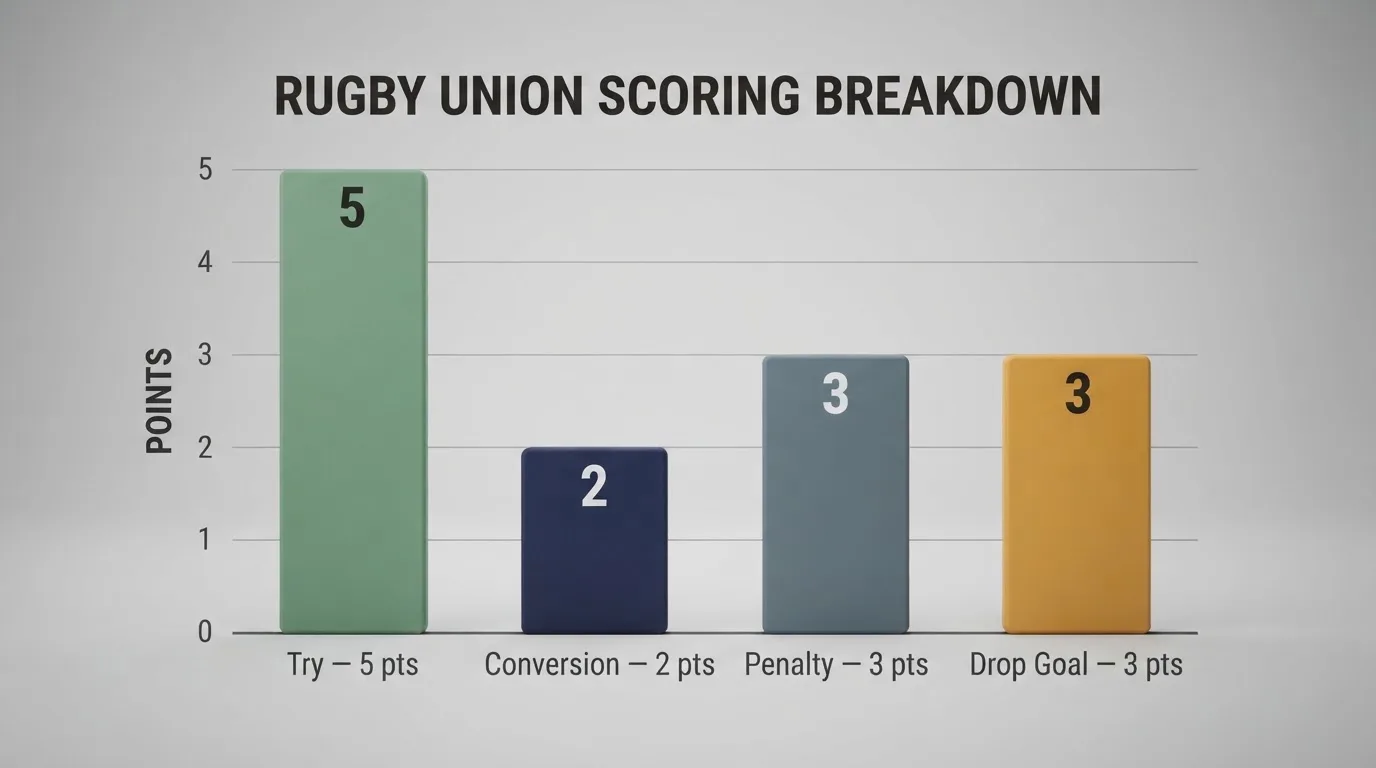
A rugby union team has fifteen players on the field, the match runs two forty-minute halves, and stoppage time is not added in the way football adds it — a match whose clock reads 80:00 has run eighty minutes of playing time and may have run ninety minutes of real time. World Rugby has governed the sport since 1886. Scoring is five points for a try, two for a conversion, three for a penalty and three for a drop goal; a converted try is therefore seven, and an unconverted try five. These are the fundamentals every bookmaker’s price rests on.
The competitions the bookmakers price are the competitions the punter follows. The English Premiership runs from September to June, with twelve clubs and a playoff; the United Rugby Championship runs from October to June with sixteen clubs from Ireland, Italy, South Africa, Scotland and Wales; the Top 14 runs from September to June with fourteen French clubs; Super Rugby from Ireland includes the Pacific sides from New Zealand, Australia and Japan and runs from February to June; the Rugby World Cup, the sport’s flagship, ran first in 1987 in Australia and New Zealand, where New Zealand won the inaugural title. The 2027 Rugby World Cup is hosted by Australia from 1 October to 13 November 2027, with twenty-four teams in six pools of four and fifty-two matches. South Africa are the defending champions after beating New Zealand in the 2023 final.
The domestic leagues and the international calendar sit alongside the European Champions Cup and the Challenge Cup, which run from December to May. The British and Irish Lions tours, every four years, are a separate competition the bookmaker prices as outrights rather than as matches. The sevens circuit — the World Rugby Sevens Series — runs alongside the fifteen-a-side game, with a separate points system and a separate calendar.
A punter’s competition checklist is which bookmaker prices the league the punter follows most fully, and at what margin. The English Premiership is the most-priced league among GB bookmakers; the URC, Top 14 and Super Rugby are priced by the larger operators and patchily by the smaller. Outright markets on the Rugby World Cup run the year before the tournament and pull in the most money; outright markets on the English Premiership run all season.
The top ten UK bookmakers for rugby union: ranking and comparison (2026)
The table below lists the ten operators reviewed on this page. Every operator holds a remote general betting licence for real events with the Gambling Commission, and every licence has been checked against the Commission’s public register. The licence numbers and the licence holders are stated as the register carries them. The fourth column is the operator’s own terms on the subject of rugby union betting, where the register’s own terms say anything specific.
| Brand | Gambling Commission remote licence | Licence holder | What the operator’s own terms state on rugby union |
|---|---|---|---|
| Tote | 054779-R-331321-008 (account 54779) | TDCO Limited | Pool betting on horse racing; pool dividends rather than fixed-odds singles |
| Hollywoodbets | 053028-R-330019-013 (account 53028) | Hollywoodbets International UK Limited | Welcome offer of stake returned as a free bet of up to £30 on a first qualifying losing accumulator (£10+ deposit, 3+ legs, 4/1 or greater, settled within seven days) |
| Sporting Index | 027343-R-308898-011 (account 27343) | Sporting Index Limited | Fixed-odds and spread betting on the same account, with in-play, Bet Builder for football, auto cash-out and Multi-Markets |
| QuinnBet | 061011-R-335683-004 (account 61011) | QuinnBet (Gibraltar) Limited | Best Odds Guaranteed on UK and Irish horse racing from 10:00am daily, singles and multiples, capped at £150 per customer per race |
| Betboro | 044181-R-324363-007 (account 44181) | Webmedia Development N.V. | Welcome offer of 100% matched free bet up to £25, debit-card deposit of £10+, first bet £5–£25, 3+ selections each at 3/5 (1.60) or higher |
| BetGoodwin | 002927-R-327985-008 (account 2927) | Goodwin Racing Limited | Welcome offer of “Bet £10 & Get £15 in Free Bets” — £5 sports, £5 acca, £5 Sub-Cover |
| Fitzwilliam Sports | 048760-R-335434-009 (account 48760) | SBKI Limited | Dublin bookmaker with capped membership; “High Stakes Welcome” subject to compliance criteria |
| Betfair | 039439-R-319330-013 (account 39439) | PPB Counterparty Services Limited | Sportsbook with in-play, Bet Builder, free live streaming of UK and Irish horse racing and football, and 90 Minute Payout on football |
| Bet Ahoy | 100094-R-341742-003 (account 100094) | Bet Ahoy Ltd | Welcome offer of “Bet £10 & Get £10 in Free Bets” — £5 sports, £5 acca |
| Kalooki Sportsbook | 057730-R-333396-005 (account 57730) | Kalooki Sportsbook Limited | Online sportsbook; GAMSTOP member; identity verification before first deposit |
The table is a snapshot of the register and the operator’s own terms, not a ranking. The blocks below take each operator in turn, describe the rugby union offering in the operator’s own language, and close with the page’s verdict on which punter the brand suits.
Tote
Tote’s licence is held by TDCO Limited, and the brand runs pool betting on horse racing. Pool betting is a different product from fixed-odds singles: the punter bets into a pool, the pool is divided among the winning tickets after a deduction, and the dividend depends on the pool size and the number of winners. Tote does not run fixed-odds rugby union singles in the standard bookmaker sense, and the welcome-offer frame on this page does not apply. A punter who wants to bet on the Tote is buying a dividend rather than a price, and the comparison is with other pool operators rather than with the fixed-odds bookmakers reviewed below.
For a punter who follows the pool-betting tradition and wants to bet on rugby union through a GB-licensed operator with a long history, the brand fits. For a punter who wants fixed-odds singles, accumulators or in-play markets, the brand is the wrong product.
Hollywoodbets
Hollywoodbets is licensed under Hollywoodbets International UK Limited, and the brand runs a sportsbook alongside its racing offering. The welcome offer is a stake-returned free bet of up to £30 on a first qualifying losing accumulator: the punter deposits £10 or more by card, places an accumulator of three or more legs at combined odds of 4/1 (5.00 decimal) or greater, and the stake is returned as a free bet if the accumulator loses. The free bet is settled within seven days. One free bet per customer. The qualifier is binding — a punter who backs an accumulator at combined odds shorter than 4/1 does not qualify, and the seven-day window is short for an accumulator punter who shops around.
The brand suits a punter whose first bet on the platform is an accumulator they expect to lose at longer prices. The punter whose first bet is a single at short odds does not trigger the offer.
Sporting Index
Sporting Index is licensed under Sporting Index Limited and runs both fixed-odds and spread betting under one roof. The punter can switch between fixed-odds singles, doubles and accumulators and spread markets on the same account. Spread markets on rugby union cover total match points, the margin of victory, the time of the first score and similar event-level lines; the spread bet pays the difference between the spread and the actual outcome, multiplied by the unit stake. Spread betting losses can exceed deposits, and that warning is in the operator’s own terms.
The brand suits a punter who wants spread betting on rugby union from a GB-licensed operator with fixed-odds on the same account. The punter who wants only fixed-odds singles, and who would not open a spread book, is better served by a fixed-odds-only bookmaker from the list below.
QuinnBet
QuinnBet is licensed under QuinnBet (Gibraltar) Limited and runs a sportsbook. The brand’s headline promotion is Best Odds Guaranteed on UK and Irish horse racing, applied from 10:00am daily on singles, multiples and system bets, with a maximum benefit of £150 per customer per race. BOG does not apply to rugby union, but the BOG frame tells the punter something about the brand: it is a fixed-odds bookmaker that pays the starting price if the starting price is bigger than the price the punter took, and the cap on the benefit is the operator’s house rule.
The brand suits a punter who bets on UK and Irish racing as well as on rugby union, and who values the BOG frame. The punter who bets on rugby union only does not get the headline promotion, and the brand’s rugby union offering is no better than the field’s.
Betboro
Betboro is licensed under Webmedia Development N.V., a Curaçao-incorporated operator running on a GB remote licence for the British market. The welcome offer is a 100% matched free bet of up to £25 on the first qualifying wager: the punter deposits £10 or more by debit card and places a first bet of £5 to £25 with at least three selections each at 3/5 (1.60 decimal) or higher. The minimum price on each leg is the binding rule — a punter who picks shorter favourites does not qualify — and the matched free bet carries the stake-not-returned qualifier.
The brand suits a punter who plans a first bet of three or more legs at the 3/5 minimum or longer, and who wants the matched free bet to compound the welcome. The punter whose first bet is a single at short odds does not trigger the offer, and the brand is otherwise a standard sportsbook.
BetGoodwin
BetGoodwin is licensed under Goodwin Racing Limited, a smaller licensee with a long racing heritage. The welcome offer is “Bet £10 & Get £15 in Free Bets”, paid back as three free bets of £5 each: a sports free bet, an acca free bet and a Sub-Cover free bet. The structure rewards a punter who plans to use the free bets across the three products, and the stake-not-returned qualifier applies to each. The Sub-Cover free bet is a niche product, and a punter who has not used one before should check the terms before claiming.
The brand suits a punter who wants the headline value of £15 in free bets from a £10 qualifying stake, and who plans to use the free bets across the three products. The punter who wants a single sports free bet is better served by an operator whose offer is paid back as one free bet rather than three.
Fitzwilliam Sports
Fitzwilliam Sports is licensed under SBKI Limited and describes itself as a Dublin bookmaker with capped membership. The “High Stakes Welcome” is subject to compliance criteria the punter must request from the bookmaker, and the capped membership means the brand accepts customers selectively. The offering includes instant deposits, fast withdrawals, timeouts and deposit limits, and the brand links to GambleAware, GamStop and Gamblers Anonymous. The bookmaker’s house style is conservative and high-stakes-oriented.
The brand suits a higher-stakes punter who wants a Dublin-tradition bookmaker with a GB remote licence, and who can qualify for the membership. The punter who wants a standard welcome offer from a publicly-available sportsbook is better served elsewhere.
Betfair
Betfair’s sportsbook is licensed under PPB Counterparty Services Limited — the same licensee that runs Paddy Power — and the offering includes in-play betting, Bet Builder, free live streaming of UK and Irish horse racing and football within the app, and a 90 Minute Payout market on football. The 90 Minute Payout market pays a winning pre-match football bet if the selected team goes two goals ahead, and it does not apply to rugby union. The sportsbook is the fixed-odds arm of the brand; the exchange runs separately under a betting intermediary licence, and a punter who wants to back and lay needs both.
The brand suits a punter who wants a sportsbook with the broadest feature set on this page — in-play, Bet Builder, free live streaming — alongside an exchange for lay betting. The punter who wants only fixed-odds singles does not need the exchange, and the smaller operators below will serve them as well.
Bet Ahoy
Bet Ahoy is licensed under Bet Ahoy Ltd, a smaller licensee, and the welcome offer is “Bet £10 & Get £10 in Free Bets”, paid back as a £5 sports free bet and a £5 acca free bet. The structure is similar to BetGoodwin’s, with the same stake-not-returned qualifier. The brand runs a smaller sportsbook than the field’s larger names, and the rugby union offering is a standard set of markets rather than the broadest in the field.
The brand suits a punter who wants a small welcome offer from a smaller licensee, and who plans to use the free bets on sports and accumulator markets. The punter who wants the largest feature set is better served by Betfair, Sporting Index or bet365 — the latter outside the reviewed set but referenced in the live-betting section above.
Kalooki Sportsbook
Kalooki Sportsbook is operated by Kalooki Sports Book Ltd (company number 12938274), licensed by the Gambling Commission under account 57730, and is a GAMSTOP member. The brand’s offering is a standard online sportsbook with identity verification before the first deposit and the credit-card ban observed through the standard payment methods. The welcome offer and the rugby union market depth are not documented in the same detail as the larger brands in the field.
The brand suits a punter who wants a smaller licensee with a GB remote licence and the standard protections. The punter who wants the broadest market depth on rugby union is better served by the larger names.
Overview: how a rugby union bet is built
The price on a rugby union match is a number, and the number is an overround plus a probability. A bookmaker quoting England at 1.91 against France at 1.91 on a two-way match has built in an overround of about 4.7% — the excess of the implied probabilities over 100%. A bookmaker quoting the same match at 1.85 / 1.95 has built in an overround of around 5.3%. The tighter the price, the less the punter pays to access the market, and the comparison across bookmakers is a comparison of overrounds as much as it is a comparison of features.
The bet types on rugby union are the same bet types on every sport. The single, the double, the treble, the accumulator, the handicap, the outright, the each-way, the spread — each carries its own margin, and the punter’s job is to read the margin off the price before placing the bet. The handicap market on a balanced match carries a lower margin than the outright; the outright market on a long-priced outsider carries a higher margin than the favourite’s price; the spread market on a niche line carries a wider margin than the standard match-odds market.
The competitions are the competitions the punter follows, and the English Premiership, the URC, the Top 14, the Super Rugby competitions and the Rugby World Cup are the league and tournament calendar the bookmaker prices. Outrights on the World Cup run the year before the tournament; outrights on the domestic leagues run all season. The 2027 Rugby World Cup is hosted by Australia from 1 October to 13 November 2027, with twenty-four teams in six pools of four and fifty-two matches, and South Africa are the defending champions after beating New Zealand in the 2023 final.
The welcome offers attached to the ten operators above are the marketing, and the wagering requirement, the minimum price, the deadline and the stake-not-returned qualifier are the substance. A punter who reads the small print before claiming sees the offer for what it is.
Legality and regulation: the framework around the bet
The Gambling Commission licenses the entire commercial betting market in Great Britain under the Gambling Act 2005, and the licence covers England, Scotland and Wales. Northern Ireland sits under a separate older law. Since the Gambling (Licensing and Advertising) Act 2014 an operator whose remote facilities are used in Great Britain needs a Commission licence wherever it is based, and a Curaçao, Maltese or Gibraltar licence alone is not a substitute. Every operator on this page holds a remote general betting licence for real events with the Commission, and the licence number is in the table above.
The licence categories matter for the punter. A remote general betting standard (real events) licence covers betting on real sporting events — rugby union, football, horse racing and the rest. A remote general betting standard (virtual events) licence covers betting on computer-simulated events. A remote betting intermediary licence covers betting exchanges. A remote pool betting licence covers pool bets on horse or dog racing. A punter who wants to bet on rugby union singles needs an operator holding the first of those, and that is what every operator on this page holds.
The Commission’s licence conditions and codes of practice are the rules operators follow. The LCCP covers social responsibility, marketing, self-exclusion, identity verification and the financial-vulnerability check. The 10x wagering cap on bonuses, in force since 19 January 2026, is an LCCP marketing condition. The credit-card ban, in force since 14 April 2020, is an LCCP social responsibility condition. GAMSTOP membership is mandatory for online operators. Every operator on this page is bound by these conditions, and a punter’s recourse against an operator who fails them runs through the Commission.
Tax is the operator’s, not the punter’s. General Betting Duty is paid by the operator on gross profits at 15%, with a new remote betting rate of 25% from 1 April 2027 within it — a change that may move prices as the date approaches, since operators may pass duty on through odds. Spread betting has its own rates — 3% on financial, 10% on other — and the punter pays no tax on winnings in Great Britain. General information, not tax advice: a professional gambler should ask HMRC or an adviser.
The honest summary: a GB-licensed operator offers the framework, the protections and the recourse. An unlicensed operator offers none of those, and the punter pays for the absence of them with no British consumer redress if funds are withheld. The review above covers only licensed operators.
Frequently asked questions
How does rugby union betting work in Great Britain?
Rugby union betting works through a licensed bookmaker who prices a market on a match, a tournament or a season outright, and pays out at the price quoted if the bet wins. The price carries the bookmaker’s margin inside it, and the punter pays the margin by holding the bet to settlement. Identity verification is mandatory before the first deposit, the credit-card ban covers all gambling payments, and GAMSTOP self-exclusion is a feature every licensed online bookmaker offers. The market is licensed by the Gambling Commission under the Gambling Act 2005 and is open to any operator who meets the conditions, with no cap on the number of licences.
How do you bet on rugby union?
A punter bets on rugby union by opening an account with a licensed bookmaker, depositing through a permitted payment method, selecting a match or a market, choosing a stake and confirming the bet. The bet settles at the price the punter took if the selection wins, or loses the stake if the selection does not. The minimum stake is set by the bookmaker, the maximum stake is set by the bookmaker per market per customer, and the markets range from match odds to handicaps, totals, try-scorer markets and outright tournament winners.
How can a punter check that a bookmaker holds a Gambling Commission licence?
The Commission’s public register is searchable by business name, trading name, domain or account number, and is the whole test of who holds a licence. A punter types the bookmaker’s name into the register and checks the licence categories, the licence holder and the account number. The ten operators on this page are listed in the table above with their account numbers, and a punter can reconcile the entry on the page with the register entry in a few clicks.
How is the return on a bet worked out from the stake and the odds?
The return is the stake multiplied by the decimal odds. A £10 stake at decimal odds of 2.50 returns £25, made up of £15 profit and the £10 stake returned. The net profit is the stake multiplied by the odds minus one: a £10 stake at 2.50 returns a profit of £15. For a combination bet the odds of the legs multiply into one price, so an accumulator of three legs at 2.00, 3.00 and 4.00 has combined odds of 24.00 and a £10 stake returns £240.
What is the bookmaker’s margin and how can it be seen in the odds?
The bookmaker’s margin is the excess of the implied probabilities over 100%. The implied probability of a price is 1 divided by the decimal odds: a price of 2.00 implies 0.50, or 50%, and a price of 4.00 implies 0.25, or 25%. The two prices’ implied probabilities add to 75% on a two-way market — the remaining 25% is the bookmaker’s margin. The tighter the prices, the smaller the margin, and a punter reading the margin off the price is reading the cost of the privilege of being told who wins.
How do fractional odds such as 5/1 convert to decimal odds such as 6.00?
The conversion is a divided by b plus one, so 5/1 becomes 5 ÷ 1 + 1 = 6.00 in decimal. A fraction of 11/4 becomes 11 ÷ 4 + 1 = 2.75 in decimal, and a fraction of 4/6 (also written 2/3 in reduced form) becomes 4 ÷ 6 + 1 = 1.67 in decimal. Evens, written 1/1, is decimal 2.00. The decimal odds include the stake in the return; the fractional odds state the profit relative to the stake, and the conversion folds the stake back in.
Rugby, cricket & Gaelic – Best betting
Content created by the «Best betting» team
